
How Trump's China Tariffs Accidentally Created a Vietnamese Boomtown
Donald Trump's tariffs on China have turned Vietnam's Mong Cai into a major hub for rerouting goods to the U.S. An analysis of the supply chain shifts reshaping global trade.
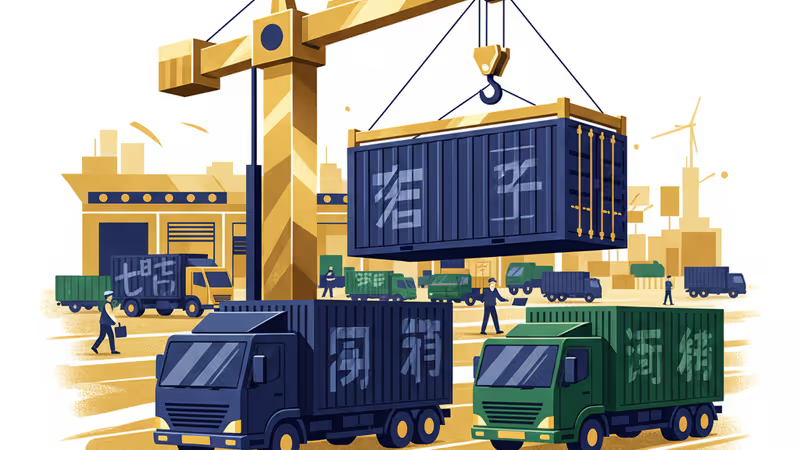
For nearly nine years, former President Donald Trump's tariffs have targeted U.S. imports from China. But instead of crippling Chinese exports, they've created a bustling trade hub in the Vietnamese border city of Mong Cai. According to a Nikkei report, the city has become a primary conduit for redirecting Chinese goods to the American market, a stark example of how the escalating U.S.-China rift is reshaping Asia's supply chains.
The Great Supply Chain Reroute
The strategy is straightforward: Chinese goods are moved across the border to Mong Cai. There, they undergo minimal processing or are simply repackaged before being shipped to the U.S. with a "Made in Vietnam" label. It's a workaround that allows companies to sidestep the steep tariffs imposed on direct imports from China, a tactic honed since Trump's first term began.
A New Map for Global Trade
This isn't just a local phenomenon. While Trump's tariffs have dented direct U.S.-China trade, overall imports from Southeast Asia have surged. This suggests that while official data may show a shift away from China, a significant volume of Chinese products is likely still entering the U.S. market through these backdoors. The entire 'world's factory' is in a constant state of flux, adapting to geopolitical pressures—a trend that complicates any policymaker's attempt to isolate a single economy.
This illustrates the law of unintended consequences in economic policy. Tariffs, a blunt instrument, don't eliminate trade flows; they reroute them along the path of least resistance. For businesses and investors, the key takeaway is to look beyond a policy's stated intent and identify the second-order winners—like Vietnamese logistics hubs or Thai manufacturers—who are capitalizing on the disruption.
本内容由AI根据原文进行摘要和分析。我们力求准确,但可能存在错误,建议核实原文。
相关文章

韓國銀行報告揭示,60歲以上自營業者的房地產相關貸款急劇增加,對金融穩定構成潛在威脅。本文深入分析數據背後的結構性風險與市場影響。

外資12月大舉回補韓股,淨買超1.9兆韓元,一掃11月賣超陰霾。資金重點佈局SK海力士等AI半導體股及現代汽車,分析師看好「聖誕行情」延續。

美國威力球25億美元頭獎得主選擇一次性領取獎金,將面臨高達37%的聯邦稅。本文深入分析其稅務負擔、理財挑戰及兩種領取方式的利弊。

受北京旅遊警告影響,日本專營中國遊客的「一條龍」商業模式面臨危機。航班削減逾900架次,酒店預訂量腰斬,中日關係惡化正衝擊實體經濟。