
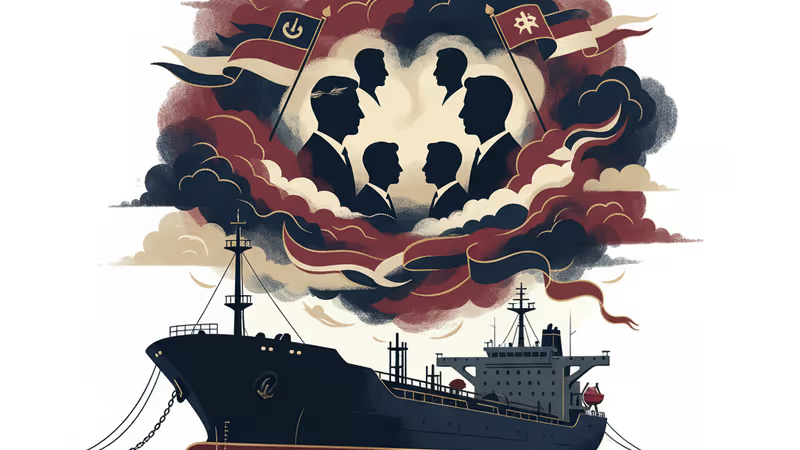
Up to 20 Years in Prison: Venezuela's New Law Targets U.S. Oil Tanker Seizures
Venezuela passes a law with penalties up to 20 years in prison targeting oil tanker seizures, a direct response to the Trump administration's pressure campaign and recent U.S. actions.
Venezuela is drawing a legal line in the sand against U.S. pressure. The country's National Assembly on Tuesday approved a bill criminalizing the seizure of oil tankers and other acts that hinder maritime commerce, imposing penalties of up to 20 years in prison. The move is a direct response to the Donald Trump administration's intensifying pressure campaign on President Nicolás Maduro.
A Swift Legislative Counter-punch
The bill was introduced, debated, and approved in a remarkably short span of just two days by the ruling-party-controlled assembly, according to The Associated Press. While the final text wasn't published, the measure as read on the floor calls for sanctions against anyone who promotes, finances, or participates in “acts of piracy, blockades or other international illegal acts.” The bill now awaits President Maduro's signature to become law.
This legislation was triggered by recent actions from U.S. forces, which seized two tankers carrying Venezuelan oil in international waters this month. The U.S. Coast Guard seized the Panama-flagged 'Centuries' on Saturday, following the seizure of another tanker, the 'Skipper', on Dec. 10. The Trump administration argues these vessels are part of a fleet used by Venezuela to evade U.S. economic sanctions.
Diverging Views: 'Sovereignty' vs. 'Pressure'
The geopolitical standoff has drawn mixed reactions. President Trump has maintained that Maduro's days in power are numbered and has floated the idea of a "blockade" against Venezuela. Conversely, within Venezuela, some opposition figures, including Nobel Peace laureate María Corina Machado, have expressed support for U.S. policy, including the tanker seizures. The new law also aims to provide "incentives and mechanisms for economic... protections" for entities, both foreign and domestic, that continue to do business with the country despite the U.S. sanctions.
本内容由AI根据原文进行摘要和分析。我们力求准确,但可能存在错误,建议核实原文。
相关文章

川普白宮幕僚長蘇西·威爾斯的獨家專訪揭示了一個由個人關係和不可預測性主導的新權力中心。這對全球穩定與地緣政治意味著什麼?
孟加拉最大反對黨領袖塔里克・拉赫曼在流亡17年後將返國,預計500萬支持者將集結首都。此舉為明年2月的國會大選投下變數,考驗該國脆弱的民主轉型。

尼泊爾前總理奧利在爭議聲中三度連任CPN-UML黨魁。他因鎮壓Z世代抗議致77死而受查,此番當選不僅違背民意,更可能引發尼泊爾政局的劇烈動盪。
馬來西亞政府在泰國對澳洲記者韓特提起跨國誹謗訴訟。本文深入分析「惡意訴訟」(SLAPP)如何成為跨國鎮壓工具,及其對東南亞言論自由構成的嚴重威脅。
川普白宮幕僚長蘇西·威爾斯的獨家專訪揭示了一個由個人關係和不可預測性主導的新權力中心。這對全球穩定與地緣政治意味著什麼?
孟加拉最大反對黨領袖塔里克・拉赫曼在流亡17年後將返國,預計500萬支持者將集結首都。此舉為明年2月的國會大選投下變數,考驗該國脆弱的民主轉型。
尼泊爾前總理奧利在爭議聲中三度連任CPN-UML黨魁。他因鎮壓Z世代抗議致77死而受查,此番當選不僅違背民意,更可能引發尼泊爾政局的劇烈動盪。
馬來西亞政府在泰國對澳洲記者韓特提起跨國誹謗訴訟。本文深入分析「惡意訴訟」(SLAPP)如何成為跨國鎮壓工具,及其對東南亞言論自由構成的嚴重威脅。