

U.S. Ends Protected Status for Myanmar Nationals, Exposing a Dangerous Policy Contradiction
The U.S. DHS has ended Temporary Protected Status (TPS) for Myanmar nationals, claiming the country is 'safe' for return. This contradicts other U.S. policies and expert assessments, exposing a major policy inconsistency.
With one hand, Washington condemns Myanmar's military junta; with the other, it's closing the door on the very people fleeing its brutality. The U.S. Department of Homeland Security (DHS) announced on November 24 that it terminated Temporary Protected Status (TPS) for Burmese nationals, creating a stark contradiction in American foreign policy. Secretary Kristi Noem justified the move by claiming conditions in Myanmar had “improved enough” for a safe return, an assessment that directly contradicts other U.S. government bodies and international experts.
A Declaration of 'Safety' vs. A Grim Reality on the Ground
The DHS’s assessment clashes with Washington’s own stated policies. Just a week before the announcement, the House Committee on Foreign Affairs reiterated that the junta's planned elections are a “sham.” This view is echoed by the European Union and U.N. experts like Tom Andrews, the U.N. special rapporteur, who slammed the DHS's description as bordering on military propaganda. Since the 2021 coup, the military has imprisoned leaders like Aung San Suu Kyi, criminalized dissent, killed tens of thousands of civilians, and displaced millions. Critics argue that labeling this situation 'safe' ignores reality.
A Distorted Asylum System and Those Truly at Risk
The decision exposes an uncomfortable truth within the Burmese diaspora. Pro-democracy activists fighting the junta are often blacklisted and unable to leave the country. Meanwhile, a parallel system has reportedly emerged where some middle-class families, not politically involved, have paid agents more than $10,000 for fraudulent documents to obtain U.S. tourist visas, only to claim asylum upon arrival. This has created a perverse inversion where those most at risk are trapped, while those with means and connections can access the U.S. protection system.
At the same time, many genuinely endangered individuals—journalists, researchers, and former civil servants already in the U.S. or who fled shortly after the coup—chose TPS to avoid an overburdened and inconsistent asylum process. With TPS now ending, they may be forced into the very system they sought to avoid, one increasingly tainted by fraudulent claims. The DHS’s narrative of a 'safer' Myanmar only heightens the risk that their legitimate claims will be denied.
本内容由AI根据原文进行摘要和分析。我们力求准确,但可能存在错误,建议核实原文。
相关文章
美國國土安全部宣布終止對緬甸國民的臨時保護身分(TPS),聲稱當地局勢已「充分改善」。此舉引發聯合國專家及人權團體強烈批評,認為華府無視軍政府統治下的殘酷現實。

2026年明尼蘇達州長選舉,共和黨迎來勝選良機,但前總統川普的爭議言論與親信林德爾的參選,恐將反成敗筆。本文深入剖析共和黨內部的路線分歧與戰略困境。
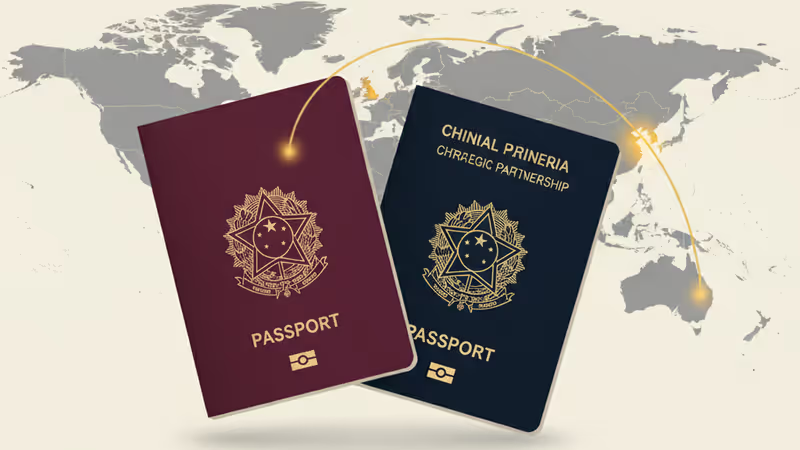
據報導,巴西正計畫對中國的觀光及商務旅客實施免簽證,預計於2026年初宣布。此舉旨在回應中國的單方面免簽措施,並深化與其最大貿易夥伴的關係。

阿爾及利亞國會無異議通過立法,將法國長達132年的殖民統治宣告為「犯罪」,並正式要求道歉與賠償,為兩國緊張關係再添變數。
美國國土安全部宣布終止對緬甸國民的臨時保護身分(TPS),聲稱當地局勢已「充分改善」。此舉引發聯合國專家及人權團體強烈批評,認為華府無視軍政府統治下的殘酷現實。
2026年明尼蘇達州長選舉,共和黨迎來勝選良機,但前總統川普的爭議言論與親信林德爾的參選,恐將反成敗筆。本文深入剖析共和黨內部的路線分歧與戰略困境。
據報導,巴西正計畫對中國的觀光及商務旅客實施免簽證,預計於2026年初宣布。此舉旨在回應中國的單方面免簽措施,並深化與其最大貿易夥伴的關係。
阿爾及利亞國會無異議通過立法,將法國長達132年的殖民統治宣告為「犯罪」,並正式要求道歉與賠償,為兩國緊張關係再添變數。