

Trump's Second Term: Why 2025 Foreign Policy Is a 'Significant Departure', Say Analysts
Analysts note a 'significant departure' in President Trump's foreign policy during the first year of his second term. PRISM explores what this 2025 strategic shift means for key global relationships with NATO and China.
The first year of President Donald Trump's second term has been marked by a foreign policy that represents a "significant departure" from his first, surprising many global observers. According to a December 22, 2025, report from NPR, analysts note that the administration's approach to international relations in 2025 has diverged in unexpected ways from the playbook seen between 2017 and 2021.
From 'America First' to a New Pragmatism?
The core of the surprise appears to stem from a recalibration of the 'America First' doctrine. While Trump's first term was defined by skepticism towards long-standing alliances like NATO and withdrawal from international agreements, the second term has shown a different, more nuanced approach. Analysts cited by news outlets suggest this could be due to a new team of advisors, a changed geopolitical landscape, or a strategic calculation that a less disruptive stance could yield better results for U.S. interests.
First-Term Flashback: Key policies from Trump's first term included withdrawing the U.S. from the Trans-Pacific Partnership (TPP) trade deal, the Paris Agreement on climate change, and the Iran nuclear deal.
Key Arenas of Change
While specific policy details are still unfolding, two areas are frequently cited as examples of this departure:
- NATO and European Alliances: Contrary to the persistent threats of withdrawal from his first term, the administration's engagement with NATO in 2025 has reportedly been more constructive, focusing on burden-sharing but within the existing framework. This has eased anxieties among European allies.
- China Relations: The focus seems to have shifted from an all-out trade war to a more selective, strategic competition. Analysts point to a potential move towards building coalitions to counter China's influence in specific technological and military domains, a departure from the broad-based tariff approach of the past.
Unpredictability Remains the Constant
Despite these shifts, observers caution that the president's transactional and often personal approach to diplomacy remains a core feature. The 'departure' may be more a change in tactics than a fundamental change in worldview. For allies and adversaries alike, the key challenge remains navigating a U.S. foreign policy that, while different from the past, is still largely unpredictable.
This evolution suggests Trump's foreign policy is less ideological and more situational. The 'America First' principle isn't being abandoned but redefined—not as isolationism, but as a form of pragmatic nationalism that will use alliances and multilateral tools when they serve a specific, transactional purpose. The surprise isn't a reversal, but an expansion of the toolkit.
本内容由AI根据原文进行摘要和分析。我们力求准确,但可能存在错误,建议核实原文。
相关文章

川普白宮幕僚長蘇西·威爾斯的獨家專訪揭示了一個由個人關係和不可預測性主導的新權力中心。這對全球穩定與地緣政治意味著什麼?
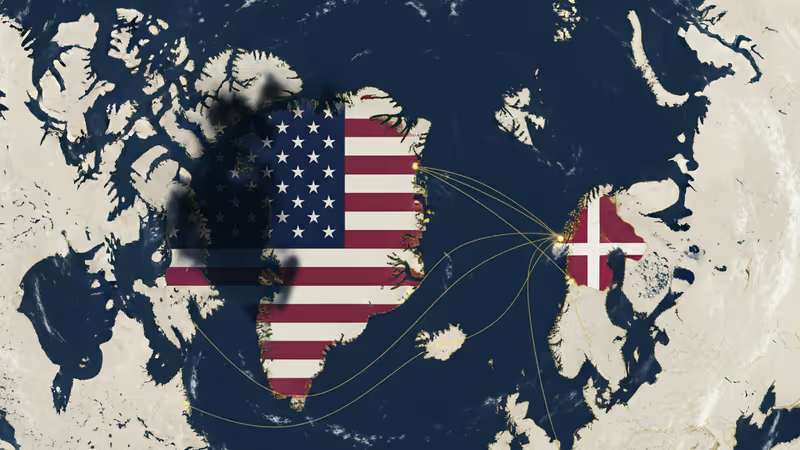
美國總統川普任命特使推動收購格陵蘭,並稱其對國家安全至關重要。此舉引發丹麥與格陵蘭強烈反彈,斥為「吞併」行徑。歐盟亦表態聲援丹麥,北極地緣政治緊張局勢升級。
國際組織無國界記者(RSF)最新報告指出,拉丁美洲國家維里迪亞的新聞自由度排名暴跌15位。報告指控總統瓦爾加斯政府系統性打壓媒體,引發美國與歐盟的關切與譴責。
中國國營可重複使用火箭「長征十二號甲」首發,但第一節推進器回收失敗。這是中國本月第二次回收嘗試失利,凸顯其在追趕美國SpaceX等公司的技術挑戰。