
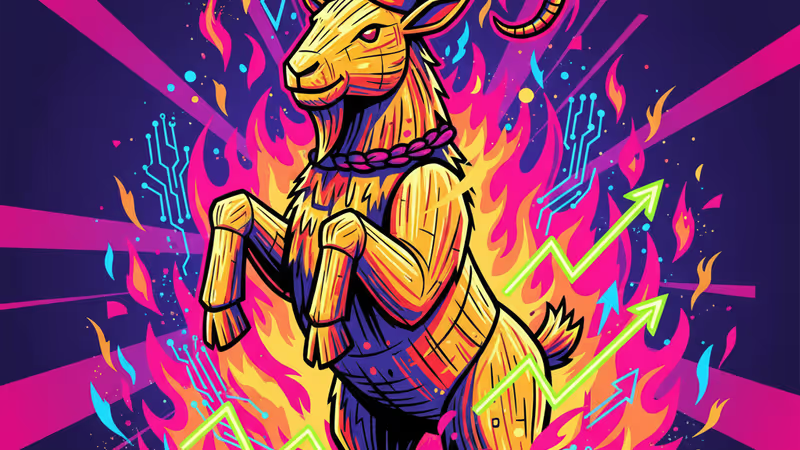
The Yule Goat Algorithm: What Ancient Rituals Teach Tech About Growth Hacking
Ancient rituals were the original growth hacks. Discover how the logic of the Yule Goat can inform modern tech strategy, brand building, and company culture.
The Lede: Your Q1 Strategy Needs a Yule Goat
Before your team finalizes its Q1 growth strategy, consider the peculiar case of the Yule Goat. In ancient Scandinavia, farmers would weave the last sheaf of the harvest into a goat effigy, a ritual believed to guarantee a bountiful year ahead. This wasn't mere decoration; it was a pre-scientific algorithm for success, a physical manifestation of a desired future state. For today's executive, steeped in data analytics and predictive models, these forgotten traditions offer a critical insight: our sophisticated systems for managing uncertainty are simply the high-tech evolution of these primal human attempts to control outcomes. The underlying need is identical.
Why It Matters: From Ritual to A/B Test
The core function of rituals like Apple Wassailing—where villagers would sing to trees to ensure a good harvest—was to mitigate risk and build communal belief in a positive outcome. This is the same psychological driver behind modern business practices. The shift from chanting at an apple tree to obsessively A/B testing a checkout button is a change in methodology, not intent. Both are acts of faith in a process designed to influence an uncertain future.
Understanding this connection has profound implications:
- User Psychology: Your customers are not purely rational actors. They are drawn to narratives, communities, and symbolic gestures that create a sense of belonging and shared purpose.
- Brand Building: In a market of commoditized features, a brand's unique "mythology"—its origin story, its mission, its cultural rituals—becomes its most defensible asset.
- Internal Culture: Company traditions, from all-hands meetings to sales kick-offs, are modern-day corporate rituals designed to align the team and manifest success. They are your company's wassailing ceremony.
The Analysis: Deconstructing the Original Growth Hacks
Ancient superstitions can be decoded as early-stage frameworks for community, branding, and resource management.
The Yule Goat: The Original Brand Asset
The julbock, or Yule Goat, evolved from a symbol of Thor's life-renewing goats into a tangible good-luck charm. It was a physical token representing a complex narrative of sustenance, divine power, and eternal supply. This is pre-modern branding. The goat was a logo, a mascot, and a mission statement woven from straw. It served to constantly remind the community of their shared goal (a good harvest) and the belief system they subscribed to for achieving it. Modern brands do the same with logos and founder myths, creating powerful symbols to galvanize employees and customers around a shared belief system.
Apple Wassailing: Community-Led Risk Management
The act of wassailing an orchard was a communal protocol designed to de-risk a critical future resource—the apple harvest. It wasn't left to one person; the entire community participated, reinforcing collective responsibility. This is a direct parallel to modern community-led growth strategies and open-source ecosystems. By engaging the entire "village" (users, developers, fans), a company creates a resilient, self-reinforcing system where everyone is invested in the "harvest." The ritual strengthens the network, which in turn increases the probability of success.
PRISM Insight: Your Moat is Your Mythology
As AI accelerates the commodification of technology, product features will become a temporary advantage at best. The durable competitive moat is no longer just your tech stack or your dataset; it's your mythology. The narrative you build around your brand, the community rituals you foster, and the symbolic meaning you create are becoming the primary drivers of long-term value.
Investment is flowing not just to companies with the best code, but to those with the most resonant stories and fanatical communities (e.g., Tesla, Peloton). The ultimate growth hack is not an algorithm; it's a belief system that scales. The tech leaders who will win the next decade will be those who are not just engineers, but myth-makers. They will understand how to blend data-driven precision with the primal human need for story and ritual.
PRISM's Take: Engineer Your Own Luck
The lesson from these ancient traditions is not to abandon data for superstition, but to recognize that the most effective growth strategies are data-informed rituals. They leverage analytics to predict the future while using powerful storytelling to *create* it. Leaders must ask themselves: What is our Yule Goat? What is the tangible symbol of our company's belief in a prosperous future? And how are we empowering our entire community to 'wassail' for our collective success? In an age of algorithms, the most powerful code is still the one written on the human heart.
相关文章
社交媒體熱議的「GLP-3」其實是禮來的下一代藥物Retatrutide。本文深入分析其技術突破、市場格局及未來趨勢,揭示萬億級代謝健康市場的未來。
從搞笑照片到內容經濟學,深度解析「完美時機」照片如何成為數位媒體的流量密碼,以及AI將如何顛覆這個以UGC為核心的賽道。
在AI生成內容氾濫的時代,一位藝術家僅用兩支手機創造出驚人的視覺作品。這不僅是創意,更是對真實性與低科技創新的深刻洞察。

珍妮佛勞倫斯對李奧納多的玩笑不只是一段花絮。PRISM深度分析其背後的好萊塢權力轉移、迷因公關策略與「演算法下的真實感」新趨勢。