

The Trump Contingency: How a US Political Shift Is Forcing a Global Security Reboot
Analysis of how global leaders are re-evaluating security and alliances amid uncertainty over future US foreign policy and a potential Trump return.
The Lede: The World is Hedging Its Bets
A palpable sense of anxiety is rippling through the world's foreign ministries. From Helsinki to Kinshasa, leaders are no longer just reacting to today's crises; they are actively war-gaming a future where the United States is a more unpredictable, transactional, and potentially isolationist partner. The prospect of a second Donald Trump presidency is acting as a powerful catalyst, forcing a fundamental reassessment of national security, economic alliances, and regional power dynamics. For business leaders and investors, this isn't just political noise—it's the sound of the global chessboard being reset, creating both significant risk and unprecedented opportunity.
Why It Matters: Beyond the Headlines
This global recalibration has profound second-order effects that extend far beyond diplomatic circles. The core issue is a crisis of confidence in the reliability of the post-WWII security architecture, which has underpinned global commerce for decades.
- Defense Spending & Industrial Base: European nations like Estonia and Finland are accelerating defense investments, not just to counter Russia, but to build a credible 'European pillar' within or alongside NATO. This signals a long-term boom for European defense contractors and a push for interoperable, non-US military technology.
- Supply Chain Fragmentation: Strategic autonomy is the new mantra. Nations are increasingly viewing reliance on any single power—including the US—for critical technologies, energy, and resources as a critical vulnerability. This will accelerate the onshoring or 'friend-shoring' of supply chains, creating new industrial hubs and altering global trade flows.
- Regional Power Plays: With perceived US disengagement, regional conflicts could either escalate or be resolved on local terms. Tensions like those between the DRC and Rwanda, or the complex dynamics in Venezuela, may see less US mediation, forcing regional blocs (like the African Union or Latin American bodies) to take a more assertive role. Adversaries may feel emboldened to test established red lines.
The Analysis: From Hub-and-Spoke to Point-to-Point
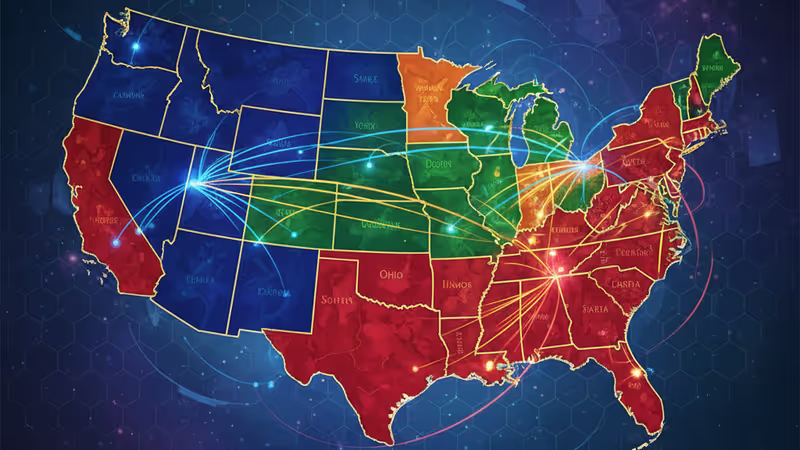
The source interviews reveal a clear pattern: the world is shifting from a US-centric 'hub-and-spoke' security model to a more complex, networked 'point-to-point' system. For 75 years, Washington was the undeniable hub, with allies as spokes. Now, the spokes are building direct connections with each other out of necessity.
Europe's Dilemma: As noted by diplomats from Spain, Finland, and Estonia, the concern isn't just about Trump's rhetoric on NATO funding. It's a deeper fear that the US security guarantee is no longer absolute. This is forcing uncomfortable conversations in Brussels about a truly independent European defense capability. The debate is no longer *if*, but *how fast* Europe can build up its military-industrial capacity and strategic cohesion, a process fraught with internal political challenges but driven by external threats.
Global South's Calculus: For nations like Kenya or the DRC, the implications are different. A less interventionist US could mean more autonomy, but it also means less developmental aid and a less reliable partner to call upon during security crises. This creates a vacuum that other powers, notably China and Russia, are eager to fill, but it also pushes leaders like Kenya's Ruto to forge stronger intra-African alliances and seek a greater role on the world stage, independent of legacy superpower dynamics.
PRISM Insight: The Rise of 'Sovereign Tech'
The most significant undercurrent in this geopolitical shift is the drive toward 'Sovereign Tech.' This is the national-level imperative to develop and control domestic capabilities in critical technology sectors to ensure national security and economic resilience. We are seeing a massive acceleration of investment in:
- Defense AI & Autonomy: Nations are pouring capital into AI-driven intelligence, surveillance, reconnaissance (ISR), and autonomous weapons systems to create a technological edge and reduce reliance on US platforms.
- Cybersecurity & Grid Resilience: The fear of both state-sponsored attacks and the potential loss of access to US cyber-defense umbrellas is driving massive domestic investment in hardening critical infrastructure.
- Next-Gen Communications: Secure, independent communication networks (5G/6G, satellite constellations) are now viewed as essential elements of national sovereignty, creating a new space race and telecom infrastructure boom.
For investors, the key is to identify the emerging national champions in these sectors, particularly in Europe and key Indo-Pacific nations, who are set to benefit from this multi-trillion-dollar pivot toward technological self-reliance.
PRISM's Take: The Shift Is Already Here
The outcome of the US election is, in some ways, secondary. The perception of American unreliability has already triggered an irreversible shift in global strategic thinking. Allies have been put on notice that they must prepare for a future where they are the primary guarantors of their own security. Adversaries have seen that the international order is more malleable than previously thought. The world is not waiting for November to act; the contingency plans are being implemented now. The era of comfortable dependence on a predictable superpower is over. For strategists and executives, the winning playbook will be one based on agility, diversification, and a clear-eyed understanding of a newly fragmented and intensely competitive world.
相关文章

川普白宮幕僚長蘇西·威爾斯的獨家專訪揭示了一個由個人關係和不可預測性主導的新權力中心。這對全球穩定與地緣政治意味著什麼?
川普背書布萊克曼競選紐約州長,揭示MAGA運動在共和黨內部的影響力。分析紐約州政治挑戰、史蒂芬尼克退出策略,以及川普主義對未來選舉和黨內路線的深遠影響。

從加薩人道危機到全球地緣政治衝突與社會動盪,PRISM深度分析多重危機下的全球政治版圖,並探討技術如何應對挑戰。

深度解析美國外交政策、新興政治力量與全球主權挑戰,探索數位時代社會正義運動如何重塑未來國際秩序與治理模式。