
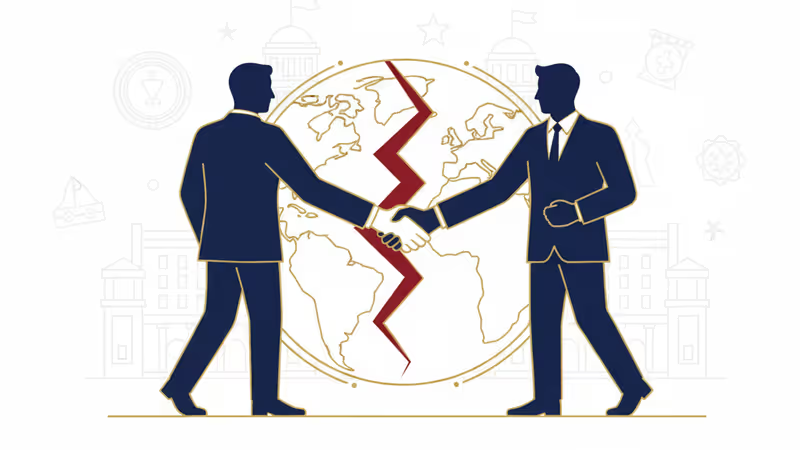
The Scapegoat Strategy: How Global Leaders Weaponize Division for Power
From Ukraine to Venezuela, leaders are increasingly using scapegoating to justify conflict and deflect blame. A PRISM analysis of the growing global risk.
The Lede: Why This Matters Now
In an era of complex global challenges, from economic friction to protracted warfare, a dangerously simple political playbook is re-emerging: the strategic scapegoating of ‘the other’. This isn't just rhetoric; it's a calculated geopolitical tool used to consolidate power, justify aggression, and distract from domestic failure. For global executives and investors, understanding this dynamic is no longer an academic exercise—it is a critical factor in forecasting instability and navigating an increasingly fragmented world.
Why It Matters: The Ripple Effect of Blame
The weaponization of identity and grievance has profound, tangible consequences. It's a primary driver of geopolitical risk, directly impacting global stability and commerce.
- Conflict Perpetuation: As seen in Ukraine, framing the conflict as an existential battle against an evil ‘other’ helps sustain public support for a costly war, making prolonged financial aid, such as new EU loans, politically palatable. It transforms a complex geopolitical issue into a moral crusade, complicating diplomatic off-ramps.
- Economic Destabilization: In nations like Venezuela, external sanctions become a convenient scapegoat for a regime's economic mismanagement. This narrative deflects internal dissent and entrenches the ruling power, creating a feedback loop of poverty and political paralysis that renders the market environment toxic for investment.
- Human Capital Degradation: The establishment of what UN experts call a “society of gender apartheid” in Afghanistan is the ultimate expression of this strategy. By systematically scapegoating and oppressing women, the Taliban regime solidifies its ideological control, but in doing so, it eradicates half of the nation's potential human capital, ensuring long-term poverty and instability.
The Analysis: A Global Playbook of Division
The core mechanism is timeless. As one of our sources notes, both Anti-Semitism and Islamophobia are fundamentally “about scapegoating.” By creating a clear enemy—internal or external—a leader can forge a powerful, if fragile, sense of national unity and purpose. This tactic is now being deployed with modern efficiency across multiple global flashpoints.
The Internal Enemy: Consolidating Power
The most brutal application of this strategy is internal. The Taliban’s war on women is a textbook case of creating a subjugated out-group to enforce ideological purity and control on the in-group. By defining the nation against what women represent—progress, freedom, education—the regime cements its identity and power structure. This isn't a policy failure; it's the core feature of their governance model.
The External Enemy: Justifying Action
More commonly, leaders project blame outward. For years, the Venezuelan government has used U.S. sanctions as the all-encompassing explanation for hyperinflation, food shortages, and crumbling infrastructure, masking a deep history of corruption and economic malpractice. This allows the regime to portray itself as a nationalist defender against foreign imperialism, a powerful narrative for domestic consumption.
Similarly, the war in Ukraine is sustained by competing scapegoat narratives. Russia frames NATO expansion as an existential threat, justifying its invasion to its populace. Conversely, Western nations frame Russia as a singularly aggressive, expansionist power, simplifying a decades-long history of complex security dynamics to rally public and financial support for Ukraine. Both narratives serve to galvanize their respective bases and shut down dissenting viewpoints.
PRISM Insight: Technology as the Great Accelerator
The scapegoat strategy is being supercharged by technology. State-sponsored “information warfare,” as seen in Beijing’s rhetoric surrounding US-Taiwan relations, is no longer confined to state media. It now operates at scale through social media algorithms and AI-driven disinformation campaigns. These tools are ruthlessly effective at creating echo chambers, amplifying grievance, and dehumanizing the targeted ‘other’ with unprecedented speed and reach.
For investors and corporations, this means traditional political risk analysis is insufficient. The new imperative is to actively monitor the digital information ecosystem. Tracking sentiment, identifying state-backed narrative campaigns, and understanding how quickly a foreign company or country can be turned into a public scapegoat are now essential components of risk management in any major market.
PRISM's Take: Seeing Past the Pointed Finger
Scapegoating is an ancient political tool, but its synthesis with modern technology and global interconnectedness makes it uniquely corrosive today. It creates a brittle world where diplomacy is replaced by denunciation and complex problems are met with simplistic blame.
The antidote is not merely more fact-checking, but a strategic focus on de-escalation and institutional resilience. For leaders in business and government, the critical skill for the next decade will be to look past the scapegoat and analyze the motives of the leader who is pointing the finger. Those who continue to mistake the symptom—the conflict, the sanctions, the protest—for the underlying political strategy will be consistently outmaneuvered in a world where the most valuable currency is not what is true, but what can be blamed.
相关文章
歐盟對烏克蘭的巨額貸款不僅是軍事援助,更是一場重塑歐洲安全、挑戰俄羅斯並影響全球金融格局的深遠地緣政治博弈。
美國在邁阿密召集卡達、埃及和土耳其,進行新階段加薩協議談判。分析顯示,這場非典型會議標誌著地緣政治格局的轉變與新外交策略的試驗。
艾普斯坦文件揭示了全球權力、財富與司法的黑暗交集。本分析探討其地緣政治影響、對菁英階層的信任危機,以及未來的衝擊。
中國視北極航道為戰略安全關鍵,旨在繞過馬六甲咽喉。這不僅是貿易捷徑,更是中俄聯手重塑全球地緣政治格局的冰上賽局。