
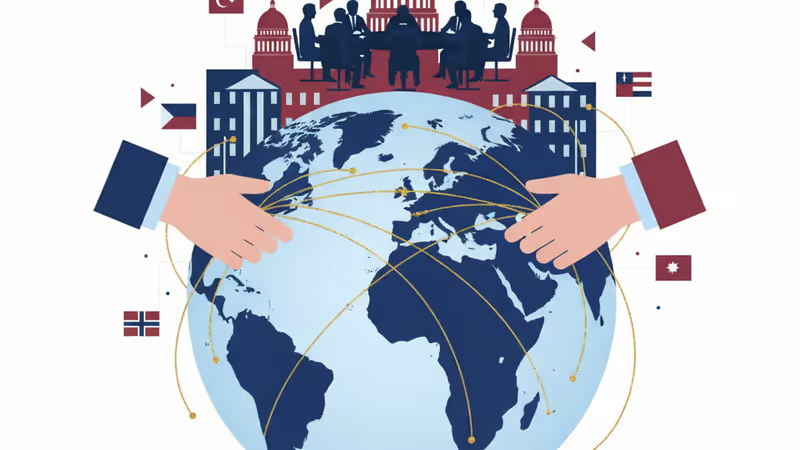
The Sahand Signal: How a Military Drill in Iran Is Forging a New Eurasian Power Bloc
Analysis of the SCO's 'Sahand 2025' military drill in Iran. A deep dive into the geopolitical shift as China and Russia solidify a new anti-Western security axis.
The Lede: A New Axis Takes Formation
A recent joint military exercise on Iranian soil, dubbed “Sahand 2025,” was far more than a routine counter-terrorism drill. Featuring troops from China, Russia, India, and other Shanghai Cooperation Organization (SCO) members, it was a public declaration of a new geopolitical reality. For any executive managing global risk, supply chains, or energy strategy, this event signals the formalization of a non-Western security architecture, deliberately designed to counterbalance U.S. and European influence. This isn't just about military hardware; it's about the hardening of a new economic and political bloc with the power to reshape global trade and conflict dynamics.
Why It Matters: The Second-Order Effects
The consolidation of this Iran-China-Russia axis carries significant, tangible impacts beyond the immediate military theater:
- Energy Market Realignment: This bloc represents a formidable concentration of global energy producers and consumers. Their deepening military and economic coordination could accelerate the move towards non-dollar energy transactions and create a pricing mechanism immune to Western sanctions, challenging the Petrodollar's long-standing dominance.
- Maritime Chokepoint Control: Iran's strategic position astride the Strait of Hormuz, a conduit for a third of the world's seaborne oil, is now implicitly backed by the military and economic weight of China and Russia. This raises the geopolitical risk premium for global shipping and energy transport, directly impacting insurance costs and supply chain stability.
- Recalibrated Regional Power: The exercise grants Tehran a new level of legitimacy and deterrence. For regional rivals like Saudi Arabia and Israel, the calculus of confronting Iran is now fundamentally altered. Any conflict no longer involves just Iran, but potentially its powerful SCO partners, demanding a strategic rethink across the Middle East.
The Analysis: From Pariah to Partner
This moment marks a decisive reversal of China's long-held caution towards Iran. For years, Beijing kept Tehran at arm's length, wary of its pariah status, nuclear ambitions, and potential to destabilize a region vital to China’s energy security. This careful diplomatic dance was predicated on maintaining stable relations with the U.S. and its allies.
Two key factors dismantled this status quo. First, the U.S. withdrawal from the JCPOA nuclear deal in 2018 under President Trump effectively removed the incentives for Iranian restraint and signaled to Beijing and Moscow that the U.S. was an unreliable diplomatic partner. Second, the escalating strategic competition between Washington and Beijing transformed China's risk assessment. The liability of associating with Iran became smaller than the strategic benefit of building a coalition to resist U.S. pressure.
The successful China-brokered rapprochement between Iran and Saudi Arabia in 2023 was the diplomatic masterstroke that cleared the path. By demonstrating it could be a regional stabilizer—not just an economic partner—Beijing mitigated the risk of a regional conflict disrupting its oil supplies. Iran's subsequent entry into the SCO (2023) and BRICS (2024) were the institutional capstones on this strategic pivot, moving it from an isolated state to a fully integrated member of an emerging Eurasian order.
PRISM Insight: The Rise of 'Autonomy Tech'
Beneath the geopolitical maneuvering lies a critical technology trend: the development of a parallel, non-Western defense tech ecosystem. This military exercise is a showcase for what we call 'Autonomy Tech' — a stack of military and dual-use technologies designed to function independently of Western-controlled systems like GPS, SWIFT, or Silicon Valley components.
Observe the synergy: Iran provides battle-tested, low-cost drone expertise. Russia offers advanced military hardware and electronic warfare capabilities, honed by its conflict in Ukraine. China brings the scalable manufacturing, AI, satellite navigation (BeiDou), and 5G communications backbone. For investors and corporations, this means the era of assumed Western technological supremacy in defense is ending. A new market of interoperable, sanction-proof military technology is emerging, and it will be exported globally to nations seeking to reduce their dependence on the West.
PRISM's Take: Normalization is the Strategy
The “Sahand 2025” exercise should not be viewed as a prelude to an imminent, coordinated war. Its primary purpose is more subtle and strategic: normalization and interoperability. By conducting these drills openly, the SCO is making routine what was once unthinkable—the integration of Iran into a major international security framework. They are building the logistical, command, and political muscle memory for joint operations, slowly eroding the effectiveness of Western sanctions and containment policies.
This is the tangible construction of the 'multipolar world' that Russia and China have long espoused. The key takeaway for Western leaders and strategists is that the policy of isolating adversarial states is yielding diminishing returns. As these nations build their own clubs with powerful patrons, a new playbook is required—one that acknowledges this consolidated bloc not as a temporary 'axis of convenience' but as a structural feature of the 21st-century global landscape.
相关文章
從經濟制裁到資訊戰,PRISM深度解析當代全球衝突的破碎化本質,以及科技如何重塑地緣政治的未來。
普丁重申對烏克蘭的領土要求,而歐盟加碼鉅額援助。在川普試圖斡旋之際,地緣政治僵局加深,分析戰爭的未來走向。
美國綠卡抽籤因槍擊案暫停,PRISM深度解析其背後長期的政治角力、對全球人才戰的影響,以及美國移民政策的未來走向。
歐盟批准對烏克蘭的巨額無息貸款,繞過法律爭議大的俄羅斯凍結資產。此舉不僅是財政援助,更是歐洲戰略自主及應對全球不確定性的關鍵一步。