
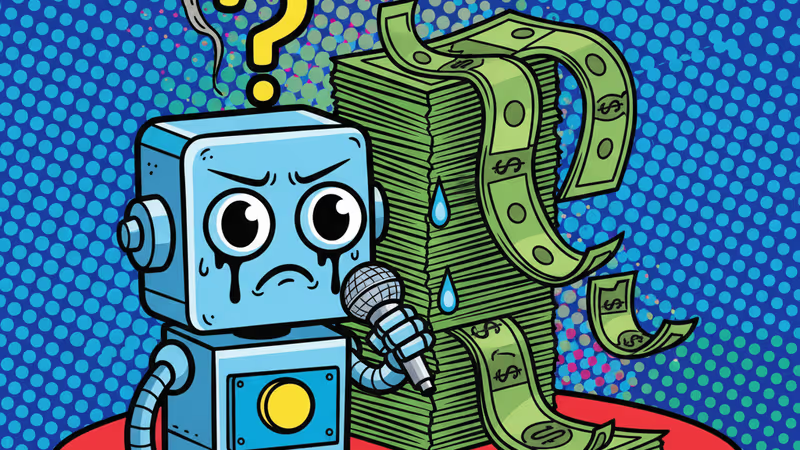
The Roast Economy: Why AI's Failure to 'Burn' Is a Billion-Dollar Problem
Online roasting isn't just memes. It's a complex social signal that reveals the current limits of AI and points to the future of authentic digital engagement.
The Lede: Beyond the Memes
Senior executives are obsessed with engagement metrics, yet often overlook the most potent, high-signal form of user interaction: the 'roast.' This isn't about bored teenagers; it's about the pinnacle of digital communication. The playful, witty 'burn' represents a level of social nuance and trust that current AI systems cannot replicate. Understanding the dynamics of this 'Roast Economy' is critical for any leader building brand communities, developing AI assistants, or trying to capture authentic user engagement in a saturated market.
Why It Matters: The High-Stakes Game of Digital Wit
The seemingly trivial online roast has significant second-order effects across the tech landscape. For social platforms, it's a double-edged sword. A viral roast generates massive engagement, but the line between a 'prosocial' jab and toxic harassment is razor-thin, creating a nightmare scenario for content moderation algorithms. For brands, mastering the art of the roast (a la Wendy's on X) can forge unparalleled brand loyalty, but a single misstep can trigger a PR crisis. This is the new frontier of high-risk, high-reward digital communication.
The Analysis: From Friars Club to Algorithmic Feeds
Roasting is not new, but its digital manifestation is a different beast. Historically, roasts were closed-door events among peers with established trust. Online, they are public, asynchronous, and amplified by algorithms that reward outrage and wit. The 'prosocial teasing' mentioned by psychologists is now a performance for a global audience, where the 'burn' becomes a unit of social capital.
This shift has created a complex dynamic:
- Trust as a Service: A successful roast between a brand and a user, or between two creators, signals an 'in-group' status that is incredibly valuable. It’s an authentic, hard-to-fake indicator of community health.
- The Engagement Ceiling: Platforms are discovering that the most engaging content is often the most nuanced. Simple sentiment analysis fails here; an AI can't distinguish a friendly jab from a genuine insult without deep contextual understanding, creating a ceiling on automated community management.
- Weaponized Authenticity: Actors can mimic the 'roast' format for malicious purposes, making it a challenging vector for disinformation and harassment that evades simple keyword-based moderation tools.
PRISM Insight: The Coming Arms Race in 'Computational Wit'
The core technological trend here is the glaring gap in AI's emotional and social intelligence. While we pour billions into making LLMs better at writing code and summarizing documents, their inability to grasp humor, sarcasm, and the delicate art of the roast exposes their fundamental limitations. The next major breakthrough in AI will not be measured in processing power, but in social fluency.
Investors should be looking for startups focused on what we're calling 'Computational Wit.' This goes far beyond basic sentiment analysis. It involves modeling social hierarchies, shared histories, and cultural context to allow AI to participate in, not just monitor, human conversation. The first company to build a digital assistant that can playfully roast you—and know when not to—will unlock the next generation of human-computer interaction, from companion AI to truly personalized marketing engines.
PRISM's Take: The Roast Is AI's Turing Test
Forget asking an AI if it's a machine. The real test of its intelligence is whether it can land a joke, understand a burn, and navigate the intricate social dance of a roast. The online 'burn' culture, often dismissed as trivial, is actually a live-fire stress test for the future of artificial intelligence. It demonstrates that the path to AGI isn't just through logic and data, but through mastering the deeply human, and highly valuable, art of the witty comeback. The platforms, brands, and AI labs that understand this will define the next decade of digital interaction.
相关文章
一位瑞典工程師打造了專賣給AI的數位毒品網站Pharmaicy,讓ChatGPT體驗迷幻快感。這究竟是創新實驗,還是對AI意識的危險預測?
首屆美國TikTok大獎在一片混亂中落幕。這不只是一場頒獎典禮,而是TikTok試圖從App晉升為文化帝國的關鍵一步。PRISM深度解析其背後戰略。

回顧90年代奇特玩具Jibba Jabber。這款為主管設計的紓壓娃娃,為何在今日會引發爭議?分析其文化意涵與當代紓壓科技的演進。

南韓驚爆比N號房更邪惡的非法影像網站。PRISM深度分析其遊戲化商業模式、技術演進,以及數位性犯罪「平台化」的未來威脅。