
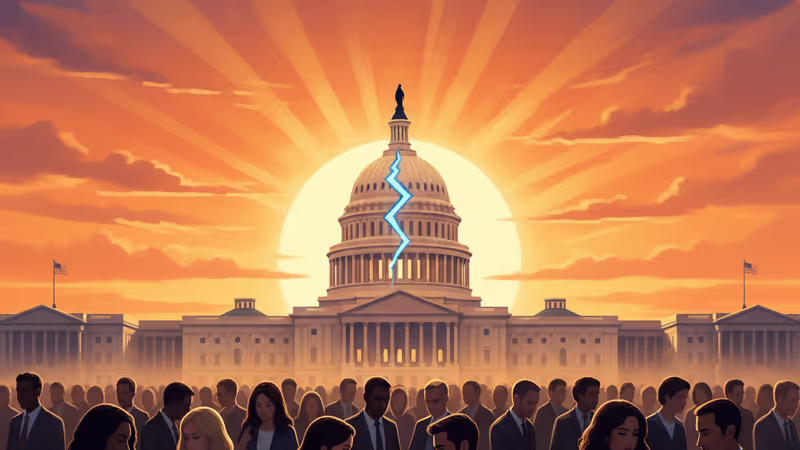
The Republican Civil War: How the 'America First' Pivot is Reshaping Global Risk
An internal struggle in the Republican party over 'America First' principles is creating seismic shifts in U.S. foreign policy, impacting global alliances and investment strategies.
The Lede: Beyond the Beltway, a Global Realignment
A contentious debate in the U.S. Congress over foreign aid is not just political theater; it's a leading indicator of a profound ideological shift within the Republican party. For decades, global business operated on the assumption of a predictable, internationalist American foreign policy. That assumption is now obsolete. This internal GOP battle between traditional internationalism and 'America First' nationalism is creating a new era of geopolitical volatility, forcing global leaders to reassess everything from defense alliances to supply chain resilience.
Why It Matters: The Ripple Effects of Uncertainty
The immediate paralysis over aid packages for allies like Ukraine and Israel is merely the symptom. The underlying condition is a strategic realignment with significant second-order effects for global markets and industries:
- Alliance Instability: U.S. allies in Europe and Asia are questioning the reliability of American security guarantees. This is triggering a historic surge in defense spending in countries like Germany and Japan, creating new markets and reshaping the global defense industry.
- Economic Statecraft: A more transactional U.S. foreign policy could lead to unpredictable tariff regimes and a weakening of global trade institutions like the WTO. Businesses that rely on stable, rules-based international trade face a far more fragmented and nationalistic global economy.
- Power Vacuums: A perceived U.S. pullback creates opportunities for strategic rivals, primarily China and Russia, to expand their influence. This increases the risk of regional conflicts that can disrupt energy markets, shipping lanes, and critical resource supplies.
The Analysis: The End of the Reagan Consensus
For nearly 70 years, the Republican party was the standard-bearer of muscular internationalism. The post-WWII consensus, solidified under President Ronald Reagan, was built on a foundation of strong alliances (like NATO), forward military presence, and the promotion of democracy abroad as core to U.S. interests. This was seen as the price of global leadership and stability.
The ascendant 'America First' wing rejects this premise. It argues that the U.S. has overextended itself, bearing the financial and military burden for wealthy allies who fail to meet their own defense spending commitments. This viewpoint, fueled by voter fatigue from long wars in Iraq and Afghanistan and domestic economic anxieties, prioritizes border security and domestic investment over foreign entanglements. This is not a temporary political tactic; it is a fundamental re-evaluation of America's role in the world, driven by a powerful and organized faction of the party's base.
The current struggle is therefore not just between politicians, but between two fundamentally different grand strategies. One sees American strength in its network of alliances; the other sees those same alliances as a drain on American resources.
PRISM Insight: The Geopolitical Hedge Becomes a Core Strategy
This political shift has direct implications for technology and investment. The era of assuming a U.S.-led, stable global order is over. Smart capital must now price in a higher degree of political risk:
- Defense Tech: While U.S. defense contractors face uncertainty over foreign military sales, their European counterparts are positioned for significant growth as EU nations rush to build domestic military-industrial capacity. Investment is flowing into next-generation European defense platforms, from drones to cyber warfare.
- Semiconductors & AI: A core tension exists. While 'America First' policies support domestic production (e.g., the CHIPS Act), containing China's tech ambitions requires deep international cooperation on export controls and R&D. A fractured Western alliance could weaken efforts to set global standards for critical technologies like AI, creating a more chaotic and competitive landscape.
- Supply Chain Diversification: The concept of 'friend-shoring' becomes more complex when the definition of a reliable 'friend' is subject to political change. Companies must accelerate diversification beyond China, but also build redundancy to hedge against potential instability among traditional Western allies.
PRISM's Take: Adapt to a Transactional World
The ideological battle within the Republican party is a structural change, not a cyclical one. Regardless of the outcome of the next election, the pre-2016 foreign policy consensus is unlikely to return in its old form. The 'America First' movement has permanently altered the party's center of gravity, ensuring that any future Republican administration will be more skeptical of foreign interventions, more demanding of allies, and more focused on a transactional, interests-based approach to global affairs.
For business and government leaders, this means the geopolitical risk dial is now permanently turned up. The key takeaway is not to predict the winner of this internal GOP fight, but to build strategies resilient enough to withstand a more volatile and unpredictable America on the world stage. Long-term planning must now model scenarios where U.S. commitments are conditional, alliances are fluid, and global stability is no longer a given.
相关文章

前北卡州長Jim Hunt的逝世不僅是一個政治人物的告別。分析他如何以教育為核心,將傳統經濟轉型為全球科技重鎮,為今日的決策者提供深刻啟示。

分析政治漫畫如何從傳統媒體轉向數位戰場,面對迷因與AI的挑戰,並探討其在全球政治與未來科技趨勢中的新角色。

分析中國無人機「黑飛」事件如何凸顯其「低空經濟」戰略的巨大挑戰,以及在技術創新與航空安全之間的艱難平衡。

日本與中亞五國的峰會不僅是地緣政治佈局,更是其太空戰略的延伸。PRISM分析日本如何利用技術優勢,在與中國的戰略競爭中搶佔宇宙高地。