
The Profanity Protocol: How Swearing Is a Biohack for Peak Performance
Science confirms swearing boosts strength. PRISM analyzes why this matters for biohacking, AI, and the future of human performance technology.
The Lede: This Isn't About Rudeness, It's About Root Access
Forget nootropics and expensive wearables for a moment. New research confirms a startlingly low-tech method for boosting physical output: swearing. While it seems trivial, for any leader obsessed with human potential, this is a critical insight. It demonstrates that the human brain has a built-in, voice-activated 'override mode' that bypasses our standard cognitive governors. Understanding this 'profanity protocol' is less about foul language and more about unlocking the latent capabilities hardwired into our own biology.
Why It Matters: From the Gym to the UI
The immediate implications are clear for sports and physical training, but the second-order effects are where the real value lies. This isn't just a quirk of psychology; it's a blueprint for designing more effective human-machine interfaces and performance-enhancement systems.
- The 'Activated' Self: The fitness tech industry is moving beyond passive tracking (Quantified Self) toward active intervention (Activated Self). Imagine a Peloton or Tonal workout that strategically prompts for a 'primal yell' or a 'power word' during a peak effort. This research provides the neurological basis for turning catharsis into a measurable performance feature.
- Affective Computing: This finding is a goldmine for developers of AI and voice assistants. A system that recognizes the user's frustration (e.g., swearing at a non-responsive UI) could interpret it not just as negative sentiment, but as a cue that the user is in a state of high cognitive load and requires a different, more direct intervention. Swearing becomes a valuable data point for adaptive interfaces.
- Corporate Training & Simulation: High-stress training simulations for surgeons, pilots, or financial traders could incorporate this understanding. Allowing for, and even analyzing, these emotional, verbal releases could provide deeper insights into an individual's stress response and decision-making under extreme pressure.
The Analysis: Bypassing the Prefrontal Gatekeeper
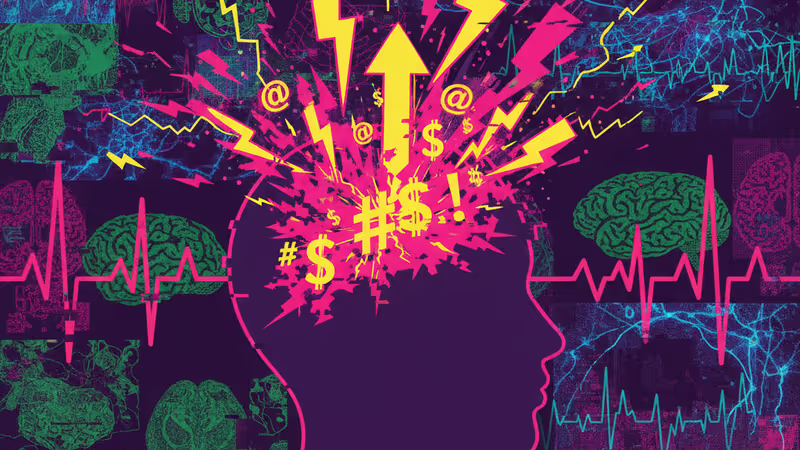
Historically, human development has been a story of the prefrontal cortex—our brain's CEO—gaining control over the older, more reactive limbic system. Social norms, politeness, and long-term planning are all executive functions. Swearing, it turns out, is a temporary coup. It's a limbic-driven vocalization that short-circuits the prefrontal cortex's constant social filtering.
This creates a state of 'transient hypofrontality'—a brief dialing-down of the analytical brain—which reduces inhibition and pain perception. In a competitive landscape where companies spend billions on incremental gains through technology, this research highlights a powerful, organic, and entirely free performance enhancer. The true competition isn't between two athletes, but between an individual's potential and the self-imposed neurological limits they operate under. Swearing is simply a key to momentarily unlock that governor.
PRISM Insight: Invest in Emotional Bandwidth
The key tech trend this illuminates is the move toward systems with greater 'emotional bandwidth.' For decades, we've communicated with machines through rigid, logical commands. This research proves the power of the illogical, the emotional, the primal. The next frontier for AI, robotics, and software isn't just about understanding the words we say, but the psycho-emotional state from which they originate.
Investment should focus on technologies that facilitate this—advanced voice analysis that detects stress, frustration, and determination, not just phonemes. Look to startups building empathetic AI companions, next-gen mental wellness platforms, and bio-integrated feedback systems. The ROI is in creating technology that partners with the whole human, not just the polite, logical part we present to the world.
PRISM's Take: Make Swearing a Feature, Not a Bug
The notion of cursing to get stronger feels like a joke, but it's a profound demonstration of the mind-body connection. It reveals that our brains are programmed with legacy 'cheats' that can be activated under specific conditions. The biggest takeaway is that peak human performance isn't always achieved through calm, deliberate, and logical effort. Sometimes, it's unlocked by a raw, unfiltered emotional surge.
For the innovators building our future, the lesson is clear: stop designing for the idealized, perfectly rational user. The most robust and effective systems of the future will be those that understand and even leverage the full, messy, and occasionally profane spectrum of human experience. The day you can curse at your smart-home device and have it respond with, "Understood. Engaging maximum effort mode," will be the day our technology truly starts to understand us.
相关文章

東京一宗母子四人死亡的悲劇,不僅是家庭慘案,更揭示了日本社會中母親的極度孤立與隱形精神壓力。PRISM深度解析。

《波士頓藍》季中結局不只是一個劇情轉折。我們深度分析CBS如何利用這部《警察世家》衍生劇,在串流戰爭中建立其媒體內容帝國。
從節日放閃到品牌帝國,深度分析 Justin 與 Hailey Bieber 如何將名人光環轉化為商業價值,揭示 Rhode Skin 成功背後的策略。
一篇關於假日旅行氣象的簡單建議,揭示了價值數十億美元的氣象智能產業。了解AI和數據如何改變我們的旅行決策。