
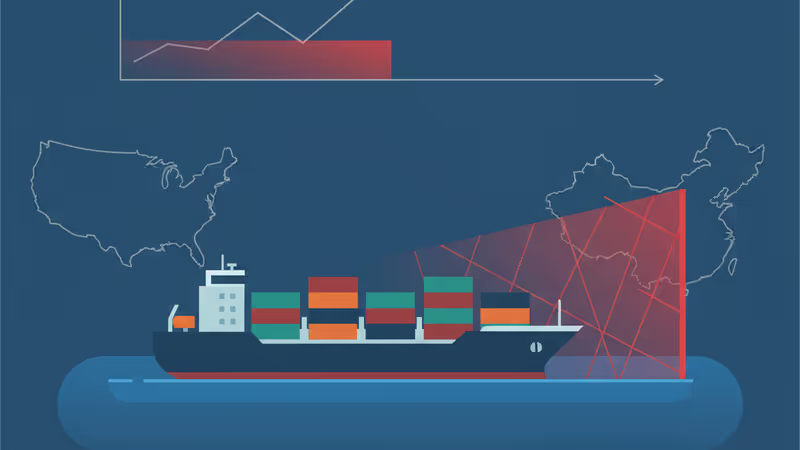
The Great Soybean Standstill: Why China's Unshipped US Orders Signal a New Trade War Tactic
China's massive but unshipped US soybean orders are not a logistics issue, but a new geopolitical tactic. Our analysis unpacks the risk for investors and global trade.
The Lede: More Than Just Beans
Beijing is holding millions of tonnes of committed US soybean purchases in a state of commercial limbo. While over half of a massive 12-million-tonne deal appears secured on paper, the physical shipments are conspicuously absent. This isn't a simple logistics delay; it's a calculated geopolitical maneuver that weaponizes agricultural trade, creating profound uncertainty for US farmers, global supply chains, and investors navigating the fraught US-China economic landscape.
Why It Matters: The Ripple Effect of Inaction
The deliberate pause on shipments injects a new type of risk into the global commodity market. It's not a tariff or a ban, but the implicit threat of cancellation—a powerful, non-committal lever.
- For Agribusiness: US farmers and exporters like ADM and Cargill face a high-stakes waiting game. This ambiguity complicates planting decisions for future seasons, disrupts inventory management, and could trigger price volatility if mass cancellations occur.
- For Global Supply Chains: This serves as a stark reminder of the vulnerabilities in concentrated supply chains. For companies reliant on cross-border trade, it highlights the urgent need to model for politically-motivated disruptions, not just economic ones.
- For the US Economy: The agricultural sector is a cornerstone of the American heartland. This uncertainty can translate into political pressure in an election year and has the potential to influence futures markets and food price inflation.
The Analysis: A Familiar Playbook with a New Twist
We've seen this before, but the execution has evolved. During the 2018-2019 trade war, China used soybean tariffs as a blunt instrument to target the US agricultural base. Today's strategy is more subtle and, arguably, more sophisticated. By booking massive orders—many under the opaque "unknown destinations" category—and then delaying shipment, Beijing achieves several strategic goals simultaneously:
- Securing Optionality: China locks in a price and secures a potential supply buffer against disruptions from its primary supplier, Brazil. This is a hedge against climate risks and logistical snags in South America.
- Maintaining Leverage: The unshipped orders hang over the US market like a sword of Damocles. It's a powerful bargaining chip that can be used to influence US policy without firing a single tariff shot.
- Market Manipulation: The practice of booking to "unknown destinations" prevents the market from fully pricing in China's demand, giving its state-owned buyers an edge. The sheer scale of these delayed shipments, however, turns a common tactic into a strategic signal.
PRISM Insight: The Rise of Geopolitical Risk-as-a-Service
For investors, the key takeaway is that geopolitical risk is no longer a tail-risk event; it's an embedded feature of the market. The 'cancellation risk' on these soybean orders represents a new, difficult-to-quantify variable for agricultural ETFs (like SOYB) and publicly traded agribusiness giants.
This environment creates a massive opportunity for technology. We're seeing a surge in demand for platforms that offer Geopolitical Risk-as-a-Service (GRaaS). These systems fuse satellite imagery (to monitor Brazilian crop health in real-time), AI-powered logistics tracking (to spot shipping anomalies), and natural language processing (to analyze Chinese policy documents) into a single dashboard. Companies that can accurately forecast the probability of these phantom orders being shipped or cancelled will hold a significant competitive advantage.
PRISM's Take: Welcome to the Era of Strategic Commodities
This soybean standoff is a masterclass in what Chinese policy planners call 'food security' and what Western analysts call 'economic statecraft.' It’s de-risking in action, but from Beijing's perspective. By building a portfolio of commodity options rather than just physical stockpiles, China is enhancing its national resilience while keeping economic pressure on Washington.
The era of straightforward, transactional commodity trading is over. For business leaders and policymakers, the lesson is clear: every major cross-border deal is now subject to the logic of strategic competition. Expect to see more 'phantom orders' and calculated delays across other critical sectors, from energy to microchips, as this new global dynamic solidifies.
相关文章

FTX核心高管遭SEC重罰,分析指出這不僅是懲罰,更象徵加密產業告別草莽,進入嚴格合規與治理的新紀元。投資者應如何應對?

美國聯準會考慮為加密企業設立新型「支付帳戶」。這一步將如何重塑金融科技競爭格局,並為投資者帶來新機遇?PRISM深度解析其背後意涵。
EigenLayer提出新的EIGEN代幣經濟學,旨在將協議收入與代幣持有者掛鉤,推動生態系從投機轉向實際應用。這對再質押賽道意味著什麼?
比特幣在9萬美元遭遇強大阻力,呈現「美國時段拋售」模式。本篇深度分析探討機構行為、資本輪動至山寨幣的現象,並提供關鍵投資洞察。