
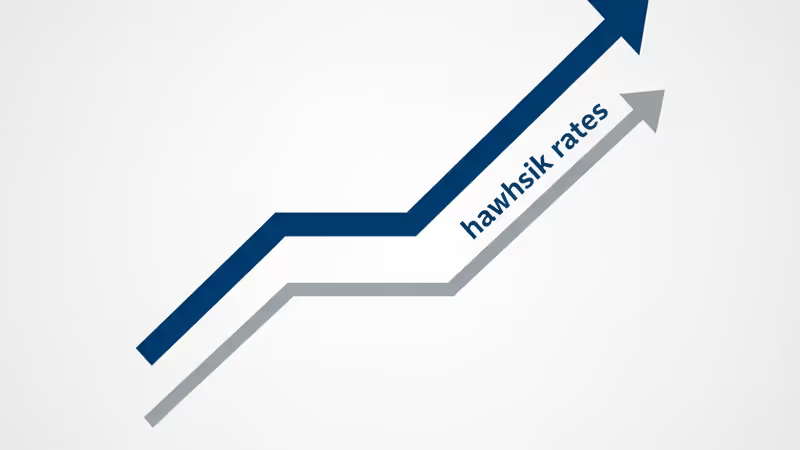
The Fed’s Great Decoupling: Why Hawkish Rates and Softer QT Is the New Playbook
The Fed is holding rates high while easing QT. PRISM analyzes why this policy decoupling is the new playbook for investors and business leaders.
The Lede: The Fed's Two-Front War
The Federal Reserve is now fighting a two-front war, and global leaders who miss the nuance will be blindsided. While headlines fixate on the “higher for longer” interest rate mantra, the real story is a strategic decoupling of policy tools. The Fed is signaling it can keep rates punishingly high to crush inflation while simultaneously preparing to ease its balance sheet reduction (Quantitative Tightening or QT). This isn't a contradiction; it’s a sophisticated recalibration designed to keep credit tight for the real economy without breaking the plumbing of the global financial system. For executives and investors, this means the cost of capital will remain elevated, but the risk of a systemic liquidity crisis is being deliberately managed down.
Why It Matters: The New Rules of Capital
This policy shift fundamentally re-writes the risk calculus for the next 18-24 months. It’s no longer a simple 'risk-on/risk-off' world driven by Fed pivots. It’s a market of haves and have-nots, defined by balance sheet strength.
- Industry Impact: Capital-intensive sectors without dominant cash flow (think speculative tech, commercial real estate, green energy startups reliant on funding) face a prolonged winter. In contrast, cash-rich tech titans (the 'Magnificent Seven' and their ilk) gain a massive competitive advantage, able to fund R&D and M&A while debt-laden rivals struggle.
- Second-Order Effects: A persistently strong U.S. dollar will continue to pressure multinational earnings and strain emerging markets. Companies with significant foreign revenue must brace for currency headwinds, while global investors must factor in heightened sovereign risk in dollar-dependent nations. The cost of hedging is now a critical line item.
The Analysis: Beyond the Volcker Playbook
In the 1980s, Fed Chair Paul Volcker had one blunt instrument: the federal funds rate. Today, the Fed’s $7.5 trillion balance sheet is an equally potent, and far more complex, tool. The original post-2008 playbook was to use these tools in tandem. The new playbook recognizes they serve different purposes.
Interest rates are the primary weapon against inflation, acting as a brake on broad economic activity. By keeping them high, the Fed ensures borrowing costs for mortgages, corporate loans, and consumer credit remain restrictive.
Quantitative Tightening (QT), however, is about managing liquidity in the financial system. Aggressive QT drains reserves from the banking system, risking a repeat of the 2019 repo market crisis where short-term lending markets seized up. By signaling a slowdown in QT, the Fed is essentially saying: “We will keep the pressure on inflation, but we will not allow the Treasury market—the bedrock of global finance—to become dysfunctional.” This is a technical maneuver to ensure financial stability, not an economic stimulus.
PRISM Insight: The Great Bifurcation of Tech
This new Fed doctrine accelerates the bifurcation of the technology sector. The era of cheap capital funding moonshots is over. The market is now rewarding a specific profile: fortress balance sheets and demonstrable AI-driven productivity gains. Companies that can self-fund innovation and show clear efficiency improvements from technology will attract a massive capital premium. Those reliant on the next funding round will face consolidation or extinction. The key metric for investors is no longer just Total Addressable Market (TAM); it’s Free Cash Flow (FCF) conversion and path to durable profitability.
PRISM's Take: Adapt to the New Regime
Do not misinterpret the Fed’s technical adjustments on its balance sheet as a dovish pivot. It is the opposite: a strategic move that enables the Fed to maintain its hawkish stance on interest rates for longer than the market anticipates. The core message is that the cost of money will not be cheap again anytime soon. The era of ZIRP (Zero Interest-Rate Policy) is a historical artifact. Businesses must plan for a higher baseline cost of capital, and investment strategies must pivot from chasing speculative growth to identifying resilient, cash-generative leaders. The Fed isn't just fighting last year's inflation; it's re-architecting the financial landscape for the decade ahead.
相关文章
BP任命百年首位外部CEO Meg O'Neill,標誌其綠色戰略終結。PRISM深度分析此舉如何重塑能源巨頭的未來、股東價值與ESG投資格局。
SEC新規將在2026年引發加密貨幣ETP發行狂潮,但專家警告市場飽和將導致大規模清算。投資者應如何應對這場機遇與風險並存的變局?
一次有瑕疵的CPI數據揭示了加密市場對宏觀敘事的脆弱依賴。深度分析比特幣為何暴漲暴跌,以及投資者應如何應對數據可信度危機。
比特幣「已實現市值」創下歷史新高,顯示強勁的資本鎖定。這挑戰了傳統四年週期,暗示宏觀經濟因素正成為市場主導力量。