
The Epstein-Trump Condom: A Trojan Horse for the Attention Economy
A bizarre discovery at Epstein's home is more than gossip. It's a critical signal about media manipulation, brand contagion, and the future of information.
The Lede: Beyond the Punchline
A bizarre artifact, reportedly a novelty condom bearing Donald Trump’s branding, has been unearthed from the trove of items at Jeffrey Epstein’s home. While the internet treats this as a punchline, for the strategic leader it's something more: a critical signal. This isn't about the object; it's a case study in brand contagion, memetic warfare, and the weaponization of absurdity in the modern information ecosystem. This is a boardroom-level issue masquerading as tabloid fodder.
Why It Matters: The Commodification of Scandal
The discovery is a perfect microcosm of the current media landscape. It demonstrates how algorithms and human psychology conspire to elevate low-information, high-impact content. For executives, the implications are stark:
- Brand Hijacking: Your brand can be associated with the most toxic elements of culture without your consent or knowledge. A novelty item, created years ago, can be resurrected and injected into a narrative that permanently taints perception.
- The Engagement Trap: This story is algorithmically perfect. It combines political tribalism, celebrity scandal, and bizarre humor, guaranteeing maximum clicks, shares, and comments. Media outlets are financially incentivized to amplify it, drowning out more substantive news.
- Second-Order Effects: The constant barrage of such content desensitizes the public. When every day brings a new, absurd 'scandal,' the ability to discern genuine crisis from manufactured outrage is critically eroded. This creates a volatile and unpredictable information environment for any public-facing entity.
The Analysis: From Watergate Tapes to Viral Memes
Historically, political scandals required a certain gravitas—a smoking gun, a verifiable crime, a direct lie. Think of the Watergate tapes or the Starr Report. The barrier to entry for a national news cycle was high. Today, the dynamic has inverted. The 'evidence' can be a meme, a miscontextualized photo, or, in this case, a piece of novelty merchandise.
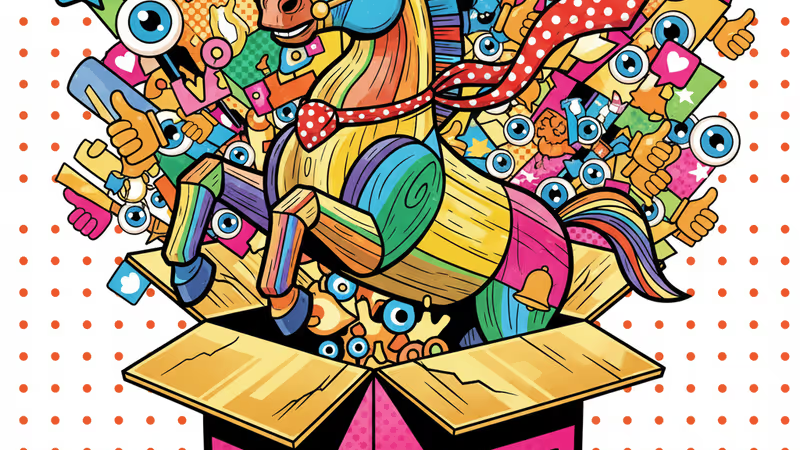
The competitive landscape is no longer legacy media versus a few challengers. It's a chaotic free-for-all where narrative velocity trumps factual accuracy. An object like the Trump condom becomes a symbolic Trojan Horse. Its literal meaning is irrelevant. It’s a vessel carrying pre-existing narratives about wealth, power, decadence, and corruption, delivering them directly into the cultural bloodstream with zero friction.
PRISM Insight: The Rise of Narrative Intelligence
This event underscores a critical tech and investment trend: the shift from media monitoring to narrative intelligence. Simply tracking mentions is obsolete. The new frontier is understanding how seemingly disconnected data points (a celebrity, a politician, a scandal, a novelty product) are being synthetically woven together by online actors to create powerful, viral narratives.
The investment implication is clear: platforms that can map these narrative attacks, identify weaponized memes in real-time, and predict brand contagion before it goes viral are no longer a luxury. They are becoming essential corporate and political infrastructure, as critical as cybersecurity. The future of PR and risk management is algorithmic.
PRISM's Take: An Artifact of Our Age
The discovery of a novelty condom at a dead financier's mansion is, in a vacuum, meaningless. But we don't live in a vacuum. We live in the Attention Economy, where meaning is assigned by the swarm. This object is the perfect artifact for our era—a low-substance, high-symbolism token that fuels outrage, entertains the disengaged, and generates revenue for the platforms that amplify it.
It reveals less about the individuals involved and more about the sickness of our information diet. It’s a symptom of a system that rewards the bizarre over the important. For leaders, the lesson is to stop looking at these events as jokes and start analyzing them as attacks. Because in the 21st century, the most potent weapon is not a bomb, but a meme.
相关文章

分析師揭示,溫馨的寵物領養趨勢背後,正醞釀著一場由AI與數據驅動的千億美元寵物科技(PetTech)市場革命。
這些爆笑的時尚失敗作不只是笑話。它們揭示了快時尚產業的系統性危機,以及科技如何成為避免下一次公關災難的關鍵。

提摩西·夏勒梅因過度自信的奧斯卡言論引發粉絲反彈。PRISM深度分析這場公關危機背後的真實性悖論,以及對好萊塢敘事戰爭的啟示。
從斯芬克斯到賽壬,分析希臘神話中的奇異生物如何成為好萊塢與遊戲產業的IP金礦。揭示其作為文化原型的商業價值與未來科技趨勢。