
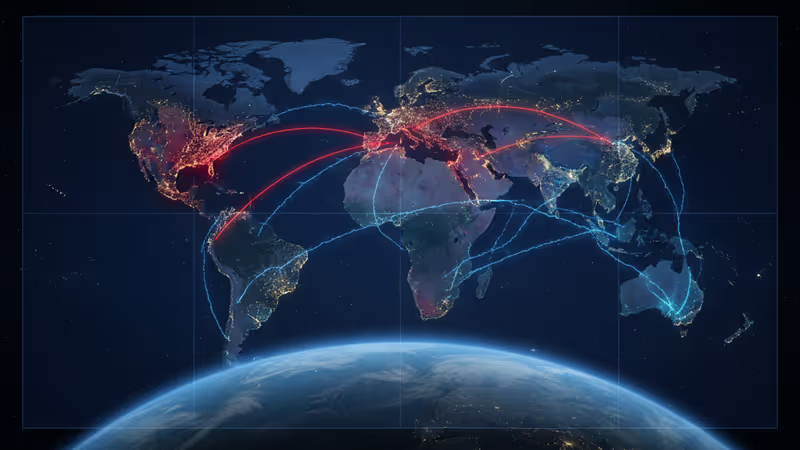
The Echoes of War: Why We're Preparing for the Wrong Global Conflict
Our historical view of war is a cognitive trap. The next global conflict will be fought with code, data, and AI, not just tanks. Are we prepared?
The Lede: The Cognitive Trap Blinding Global Leaders
As a leader, your greatest vulnerability may not be in your supply chain or your cybersecurity, but in your own mind. The global strategic landscape is being shaped by a pervasive cognitive bias: leaders, policymakers, and even military experts are preparing for the last war. This 'reminiscence bias,' reinforced by a century of history and Hollywood, frames future conflict in familiar terms of trenches, tanks, and aircraft carriers. This is a catastrophic failure of imagination that leaves nations and corporations dangerously exposed to the true nature of 21st-century power competition.
Why It Matters: The New Battlefields Are in Your Boardroom
Misdiagnosing the threat leads to a fatal misallocation of resources and attention. While nations budget for conventional military hardware, the real conflict is already underway in the 'gray zone'—a persistent state of competition below the threshold of declared war. The second-order effects are profound:
- Economic Warfare: Supply chains are no longer just logistical challenges; they are strategic battlegrounds. Weaponized trade tariffs, control over critical mineral processing, and dominance in semiconductor manufacturing are the new blockades.
- Infrastructure Paralysis: The front line is now critical infrastructure. A cyberattack on a port, a power grid, or a financial system can achieve strategic objectives with far less cost and attribution than a missile strike.
- Information Dominance: The fight for public opinion and political stability is a primary objective. AI-driven disinformation campaigns can destabilize societies and cripple a nation's decision-making ability from within, long before a single shot is fired.
The Analysis: The Maginot Line of the Modern Age
History provides a stark warning. In the 1930s, France built the Maginot Line, a masterpiece of engineering designed to fight a static, World War I-style conflict. Germany simply went around it with its Blitzkrieg doctrine—a new paradigm of speed and combined arms. Today, the West's focus on exquisite, high-cost military platforms risks creating a modern Maginot Line.
Our primary strategic competitors, notably China and Russia, are not seeking a symmetric, force-on-force confrontation. Their doctrines explicitly target the West's perceived vulnerabilities in non-military domains:
- China's 'Unrestricted Warfare': This concept, articulated by PLA colonels two decades ago, views conflict as a holistic struggle encompassing economic, technological, and informational domains. Beijing’s Military-Civil Fusion strategy operationalizes this by blurring the lines between its commercial tech sector and its military ambitions, turning companies into instruments of state power.
- Russia's Gerasimov Doctrine: This doctrine emphasizes the use of non-military means—political, economic, informational, and humanitarian—to achieve strategic goals, often at a ratio of 4:1 over conventional military action. We have seen this playbook run in Georgia, Crimea, and through election interference campaigns across the globe.
While the U.S. and its allies plan for a high-intensity kinetic fight over Taiwan, adversaries may see greater value in instigating a domestic financial crisis, severing undersea data cables, or compromising satellite networks upon which the global economy depends.
PRISM Insight: The New Defense Sector is Dual-Use Tech
The definition of the 'defense industrial base' is rapidly expanding beyond traditional hardware. The crucial battlegrounds of tomorrow require dominance in dual-use technologies. The war in Ukraine has been a brutal real-world laboratory, proving the strategic value of commercial tech. SpaceX's Starlink provided resilient communications, while AI-driven software from companies like Palantir enabled rapid targeting and intelligence analysis. Investment and innovation must shift focus:
- Networked Autonomy: The future belongs to inexpensive, autonomous, and swarming systems—drones, sensors, and decoys—powered by AI.
- Space and Cyber Resilience: Low-Earth orbit (LEO) satellite constellations for communication and surveillance are now critical infrastructure. Securing these assets, along with terrestrial and undersea data networks, is a paramount national security issue.
- Quantum & AI Arms Race: The race for quantum computing, which could render current encryption obsolete, and for superior AI in intelligence and command-and-control, is a core pillar of long-term strategic competition.
For investors, this means the lines between the tech sector and the defense sector are irrevocably blurred. The most impactful 'defense' companies of the next decade may look more like SaaS startups than traditional manufacturers.
PRISM's Take: Win the War of Imagination
The greatest strategic threat facing the world's established powers is not a deficit of firepower, but a deficit of imagination. We are clinging to an obsolete mental model of war while our competitors are rewriting the rules of engagement. Victory in the 21st century will not be determined by who has the most advanced fighter jet, but by who can best integrate economic, technological, and informational power to achieve their objectives. The first shots of the next great conflict will not be artillery shells; they will be lines of code, manipulated market trades, and viral pieces of disinformation. Leaders in government and industry must urgently update their cognitive software, or risk becoming casualties of a war they never even saw coming.
相关文章
新公布的愛潑斯坦檔案將柯林頓推上風口浪尖,成為美國兩黨鬥爭的最新武器。深度分析其背後的政治盤算與對全球信任的侵蝕。

分析中國製零件如何助長俄羅斯的無人機戰爭,揭示這條新興科技供應鏈對全球安全構成的非對稱威脅及未來地緣政治影響。
美菲同盟的重啟不僅是軍事合作,更是重塑印太戰略格局的關鍵一步。分析其對中國、台灣及全球半導體供應鏈的深遠影響。

美國司法部首批艾普斯坦文件公開,但大量塗黑引發爭議。本分析探討其背後的政治角力、司法透明度危機,以及對公眾信任的深遠影響。