
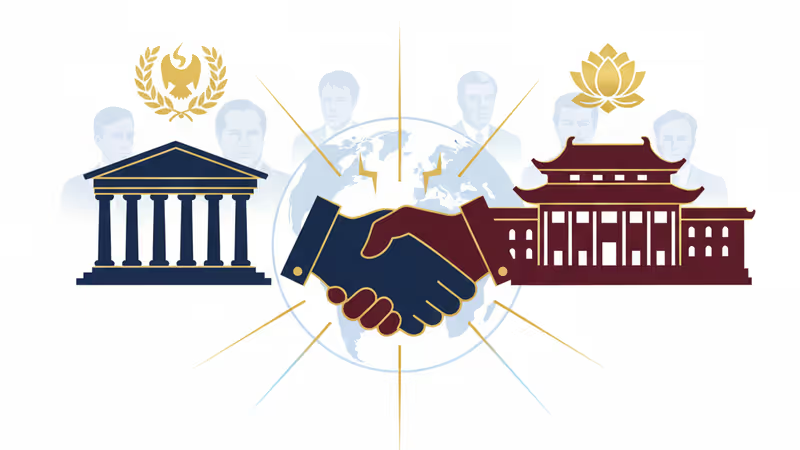
The Dissident's Dilemma: A Chinese Filmmaker's Asylum Case Puts U.S. Policy to the Test
A Chinese dissident who exposed detention camps is now in US custody. His case is a microcosm of the US-China geopolitical struggle over tech, human rights, and global influence.
The Lede: A High-Stakes Standoff in an Immigration Cell
A Chinese citizen journalist named Guan Heng sits in a U.S. immigration detention facility, a world away from the purported detention camps he filmed in his homeland. After publishing the footage and fleeing to the Bahamas, he sailed to the U.S. seeking refuge. Instead, he found himself in custody. For global executives and policymakers, his case is far more than a human-interest story; it is a live-fire stress test of America's strategic coherence. It forces a critical question: In an era of intense geopolitical competition, can a nation's bureaucratic immigration process align with its high-level foreign policy rhetoric against an authoritarian rival? The answer will send a powerful signal to Beijing, to allies, and to every dissident weighing the risk of speaking out.
Why It Matters: The Geopolitical Ripple Effect
Guan Heng's situation is a microcosm of the broader U.S.-China conflict, touching on technology, human rights, and national credibility. The outcome has significant second-order effects:
- Credibility on the World Stage: The Biden administration has centered its China policy on a coalition of democracies standing against authoritarianism. Prolonged detention of a dissident who acted on these stated values could be perceived globally as hypocrisy, undermining U.S. diplomatic efforts.
- The Dissident's Calculus: Activists and whistleblowers inside China and other autocratic states are watching. If the U.S. is seen as an unreliable or slow-moving sanctuary, it could create a chilling effect, discouraging future disclosures that provide vital intelligence on human rights abuses and state repression.
- Domestic Policy Collision: The case highlights the friction between America's complex, overburdened immigration system and its strategic foreign policy goals. While one arm of the government condemns Beijing's actions, another holds a key witness to those actions in detention, bound by legal procedure.
The Analysis: A Modern-Day Cold War Dilemma
Historically, the United States leveraged its asylum system as a potent ideological weapon during the Cold War, welcoming high-profile defectors from the Soviet bloc as proof of its moral and political superiority. Today's landscape is vastly more complicated. The post-9/11 security apparatus and a deeply politicized immigration debate have created a formidable, slow-moving bureaucracy that is ill-equipped to handle cases with acute geopolitical sensitivity.
From Beijing's perspective, this scenario is a win-win. They can label Guan a criminal, dismiss his footage as foreign-backed propaganda, and point to his detention in the U.S. as proof that American rhetoric on freedom is hollow. It reinforces their narrative that the U.S. system is chaotic and that its criticisms of China are purely for political gain.
From Washington's perspective, it's a legal and political bind. The Department of Homeland Security must adhere to established asylum protocols, which require vetting claims and processing individuals regardless of their political significance. To expedite one case over thousands of others would open the administration to criticism of political favoritism and further strain the immigration system. Yet, to do nothing is to cede the narrative to Beijing and appear weak or indifferent.
PRISM Insight: The Weaponization of Bureaucracy and Tech
The Guan Heng case epitomizes a key trend: the use of legal and bureaucratic systems as tools of statecraft. China uses its opaque legal system to silence dissent. In response, the U.S. is constrained by its own transparent, process-driven system. In the fast-paced arena of global influence, this procedural correctness can become a strategic liability.
Furthermore, this incident underscores the dual-edged role of technology. A smartphone camera becomes a tool for accountability, allowing a citizen to challenge a state narrative. But the digital trail also makes dissidents vulnerable. For investors and corporations, this highlights the growing political risk for employees in autocratic nations. A local staff member could become the next Guan Heng, creating a major reputational and diplomatic crisis for the company.
PRISM's Take: Reconciling Process with Policy
Guan Heng's detention is not a failure of American values, but a failure of its systems to adapt to the speed of modern geopolitical competition. The U.S. immigration framework, designed for methodical due process, is now a crucial battleground in an information war with China. While adherence to the rule of law is a core American strength, its slow application in high-profile cases can project indecisiveness.
To remain credible, Washington must find a way to create a more agile process for asylum cases that carry significant national security and foreign policy implications. Without such reform, the U.S. risks possessing a powerful ideological message that it is procedurally incapable of delivering. Guan Heng's fate is not just about one man; it's about whether America's founding ideals can operate effectively as strategic assets in the 21st century.
相关文章
挪威積極推動綠色能源轉型,卻引發與薩米原住民的土地權利衝突。這場「綠色殖民」爭議,揭示了全球ESG浪潮下的核心挑戰。

美國在太平洋以打擊毒品為名發動軍事打擊,引發戰爭罪指控與地緣政治危機。這場行動的真正目標是委內瑞拉嗎?PRISM深度解析。
歐盟批准向烏克蘭提供900億歐元貸款,但避開動用凍結的俄羅斯資產。PRISM深度解析此決策背後的金融穩定考量、地緣政治裂痕及全球影響。

歐盟批准900億歐元對烏克蘭貸款,但迴避動用俄羅斯凍結資產。此舉凸顯了歐洲內部的法律謹慎與對未來美國政策不確定性的深層考量。