
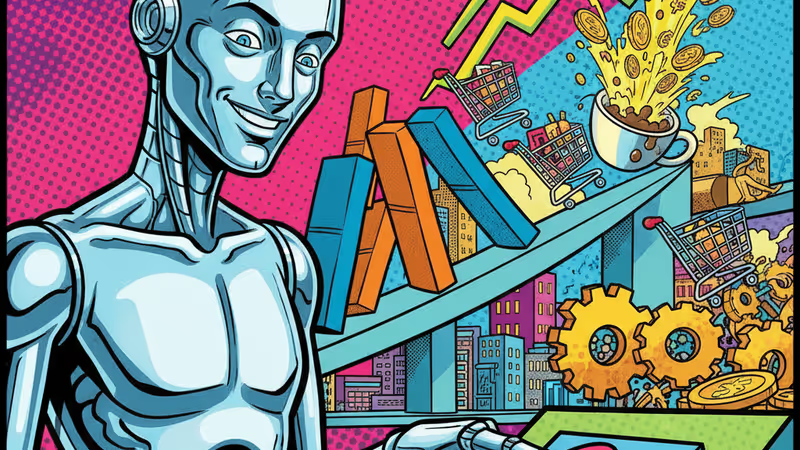
The Chaos Dividend: Why 'Perfectly-Timed Disasters' Are the Future of AI and Marketing
Viral 'disaster' photos signal a shift to an authenticity economy. This creates a new frontier for AI in marketing, redefining content strategy for brands.
The Lede: Beyond the Laughs
While social media feeds are filled with 'perfectly-timed' photos of comical disasters—a falling wedding photographer or a seal hitting glass—the underlying trend signals a seismic shift for the C-suite. The era of polished, top-down corporate content is over. The new, high-value currency is Engineered Authenticity, a concept that the next generation of AI is poised to master and monetize at an unprecedented scale.
Why It Matters: The End of the Polished Persona
The virality of these 'moments before disaster' is not random; it's a market signal. Consumers, particularly Gen Z and Millennials, are increasingly rejecting manicured brand narratives in favor of raw, relatable, and chaotic content. This has profound implications across industries:
- Marketing & AdTech: The multi-billion dollar stock photography industry, built on sterile perfection, is becoming obsolete. Budgets are shifting from high-end production studios to creator collaborations and AI-powered tools that can generate or curate content that feels user-generated. Brands that fail to adopt this 'perfectly imperfect' aesthetic risk being perceived as inauthentic and, consequently, ignored.
- Media & Content Platforms: The algorithms that govern attention are being re-written. Platforms like TikTok have already proven that unpolished, serendipitous moments outperform high-gloss productions. This forces a strategic rethink for legacy media and content creators: the goal is no longer production value, but 'vibe' and relatability.
- Second-Order Effects: The demand for authenticity creates a trust paradox. As brands and AI get better at faking spontaneity, audiences will become more skeptical. This will ignite an arms race between AI generation and AI detection, and place an even higher premium on verifiable human creators.
The Analysis: From Getty Images to Generative AI
The evolution of digital imagery follows a clear trajectory. We moved from the era of highly controlled, professional stock photos (think Getty Images) to the first wave of user-generated content (Flickr, early Instagram), which celebrated amateur, filtered reality. The 'perfectly-timed photo' represents the peak of human-captured serendipity—a moment of pure chance captured by a person.
We are now entering the third wave: synthetically-generated serendipity. The competitive landscape is no longer just about human photographers. It's about AI models like Midjourney, DALL-E, and video generator Sora, which are rapidly learning the visual language of chaos, humor, and imperfection. The challenge has shifted from 'capturing the moment' to 'generating a moment that feels captured.' This pits human creators against infinitely scalable AI, and platforms that master AI-driven content will hold a significant competitive advantage.
PRISM Insight: The Rise of 'Generative Authenticity' Platforms
The next major investment cycle in MarTech will be focused on a new category: Generative Authenticity. These are not just tools to create images, but platforms designed to replicate the chaotic, unpredictable nature of viral UGC. Watch for capital flowing into startups that can:
- Analyze and Deconstruct Virality: AI that ingests terabytes of UGC to identify the latent patterns of 'accidental' humor and visual surprise.
- Generate Imperfect Assets: AI models trained specifically on 'imperfect' datasets—blurry photos, awkward angles, lens flare, chaotic compositions—to produce content that doesn't look like AI.
- Automate Content Curation: Tools that allow brands to scan and license authentic UGC in real-time, beating competitors to the punch on emerging trends and memes.
The smart money is not on AI that creates perfect worlds, but on AI that can flawlessly recreate the charming imperfections of our own.
PRISM's Take: Mastering the Art of the Happy Accident
The core takeaway is that the 'perfectly-timed photo' phenomenon is a preview of the future of all digital content. The highest engagement will no longer come from flawless execution, but from the perception of spontaneous, authentic moments. The ultimate irony for the next decade will be watching corporations spend billions on AI models to meticulously recreate the low-fi, chaotic energy of a dog failing to catch a chicken nugget.
This isn't just a fleeting social media trend. It is a fundamental response to a world saturated with artificial perfection. The leaders of the next era of digital engagement will not be those who create the most beautiful content, but those who best master the art of the algorithmically-generated happy accident.
相关文章
科學研究揭示,罵髒話能顯著提升止痛效果與肌力。這項免費的「生物駭客」技術,將如何影響未來的健身與健康科技?
我們分析為何「你可能做錯的日常小事」內容會瘋傳。這不僅是生活技巧,更揭示了價值千億的優化經濟與未來科技趨勢。
迪士尼不僅販賣懷舊。本文深度分析其如何透過跨類型音樂合作,將經典IP轉化為持續增長的資產,並揭示其背後的「懷舊即服務」商業策略。
GB News為「梅根母親入獄」的假新聞道歉,但這不僅是單一錯誤。PRISM深度分析揭示了英國媒體在「後真相時代」的商業模式轉變與「美國化」危機。