
The Bermeja Deception: What a Lost Island Teaches CEOs About Data Integrity
Phantom islands on old maps offer a critical lesson for today's leaders. Discover why data integrity is the new frontier for geopolitical and corporate strategy.
The Lede: Why Your Digital Twin Has Ghost Islands
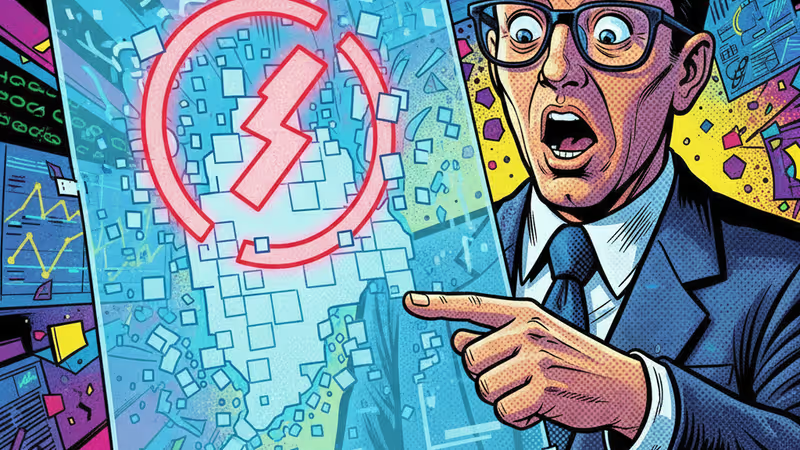
In the late 1990s, the Mexican government launched a high-stakes search for an island named Bermeja. For centuries, it was a fixed point on maps, a crucial marker for defining maritime boundaries—and the multi-billion-dollar oil rights that came with them. But when the ships arrived, they found only open water. The island, a piece of foundational data for geopolitical strategy, never existed. For today's executive, Bermeja isn't a historical curiosity; it's a parable. We are building a 'Digital Twin' of our world, from supply chains to entire cities, all based on data. This incident is a stark warning that our digital worlds are haunted by their own phantom islands—flawed data points that can lead to catastrophic strategic and financial miscalculations.
Why It Matters: The Compounding Cost of 'Bad Data'
The disappearance of Bermeja highlights a timeless business principle: the integrity of source data is paramount. A single error on a 16th-century map nearly redrew the economic map of the Gulf of Mexico 400 years later. This is the ultimate example of 'garbage in, garbage out,' with geopolitical consequences.
In the modern enterprise, the effects are faster and more devastating:
- AI & Machine Learning: Models trained on flawed or incomplete datasets will produce biased or simply wrong outputs, compromising everything from credit scoring to medical diagnostics.
- Supply Chain Logistics: An inaccurate location pin, a miscalibrated sensor, or a faulty inventory entry can trigger a cascade of delays and costs across a global network.
- Autonomous Systems: For self-driving cars or drones, a 'phantom island' in their mapping data isn't a curiosity; it's a critical failure with life-or-death implications.
The core issue is that we trust our maps—whether they are paper charts or complex data platforms. When that trust is violated, the entire operational and strategic stack built upon it becomes unstable.
The Analysis: Intentional Phantoms vs. Accidental Ghosts
The history of phantom islands reveals two types of data corruption that are more relevant than ever. The case of Bermeja appears to be a centuries-old cartographical error—an accidental ghost in the machine. It persisted through generations of maps simply because it was copied, a process not unlike how bad data gets replicated across modern databases without verification.
Contrast this with Crocker Land, the non-existent landmass 'discovered' by explorer Robert Peary in 1906. Peary named the 'island' after a potential financial backer, George Crocker, in a blatant attempt to secure funding for his North Pole expedition. This was not an error; it was intentional data fabrication for financial gain. Crocker Land is the historical equivalent of faking engagement metrics to secure a round of VC funding, or a 'deepfake' designed to manipulate markets. We now face a battlespace where data is not just accidentally wrong, but deliberately malicious.
PRISM Insight: The Race for Verifiable 'Ground Truth'
The next frontier of competition is not just in collecting massive datasets, but in proving their accuracy. This is the emerging economy of 'Ground Truth as a Service' (GTaaS). Companies like Planet Labs, Maxar, and others providing satellite imagery and geospatial data are no longer just selling pixels; they are selling verified reality. Their value is directly tied to their ability to prevent digital 'Bermejas' from appearing in their clients' strategic models.
Expect to see a surge in investment in technologies for data verification and provenance. This includes leveraging decentralized systems like blockchain to create immutable records of geographic or physical asset data. If a location or a sensor reading is recorded on a distributed ledger, it becomes vastly more difficult to tamper with, creating a 'trust layer' for the physical world's digital twin.
PRISM's Take: The Phantom Island Test
The age of phantom islands is not over; it has simply migrated from paper maps to our data stacks. The fundamental challenge remains the same: how do we know what is real? Leaders must now apply the 'Phantom Island Test' to their own organizations: Where is our single point of data failure? What core assumption, if proven false, would cause our strategy to collapse? In the 16th century, the answer was a dot on a map. Today, it could be a key dataset feeding your pricing algorithm or a sensor network managing your infrastructure. Charting the known world was the great challenge of the last millennium. Verifying our digital representation of it is the great challenge of the next.
相关文章
社交媒體熱議的「GLP-3」其實是禮來的下一代藥物Retatrutide。本文深入分析其技術突破、市場格局及未來趨勢,揭示萬億級代謝健康市場的未來。

從搞笑照片到內容經濟學,深度解析「完美時機」照片如何成為數位媒體的流量密碼,以及AI將如何顛覆這個以UGC為核心的賽道。

在AI生成內容氾濫的時代,一位藝術家僅用兩支手機創造出驚人的視覺作品。這不僅是創意,更是對真實性與低科技創新的深刻洞察。

珍妮佛勞倫斯對李奧納多的玩笑不只是一段花絮。PRISM深度分析其背後的好萊塢權力轉移、迷因公關策略與「演算法下的真實感」新趨勢。