
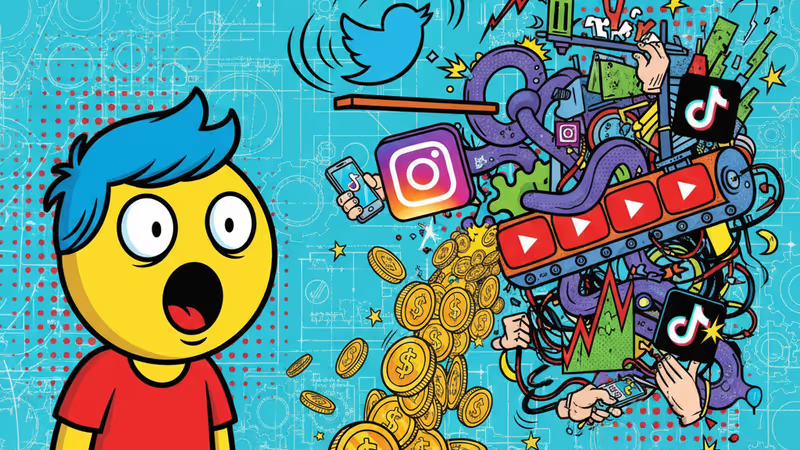
The Berkeley Mews Blueprint: How Twisted Comics Decode the Creator Economy
Viral comic artist Berkeley Mews isn't just funny—his work is a masterclass in the creator economy. We break down his formula for digital success.
The Lede: Subverting Nostalgia is the New Growth Hack
A viral webcomic artist with a penchant for adding twisted, dark endings to innocent setups is more than just entertainment; it's a masterclass in the attention economy. Ben Zaehringer, known as Berkeley Mews, leverages childhood nostalgia from sources like Disney and Peanuts as a trojan horse to deliver unexpected, jarring punchlines. For any executive navigating the saturated digital landscape, this isn't just a comic—it's a blueprint for cutting through the noise. It demonstrates a powerful formula: use a familiar framework to disarm your audience, then subvert their expectations to create a memorable, high-impact emotional spike. This is the new currency of engagement.
Why It Matters: The Engagement Arms Race
In a world of infinite scroll, capturing attention is a zero-sum game. Traditional content models are failing because audiences have developed an immunity to predictable narratives. The Berkeley Mews model matters because it's engineered for the modern media environment.
- Pattern Interrupt: The comics hijack the user's mindless scrolling by presenting a familiar, comforting visual style, only to shatter it with the punchline. This creates a powerful 'pattern interrupt' that forces cognitive engagement and cements the content in the user's memory.
- Emotional ROI: The swift journey from comfort to shock delivers a high 'emotional return on investment' for the minimal time required to view a single comic. This efficiency is what drives likes, and more importantly, shares. The user is compelled to share the jolt of surprise they just experienced.
- Second-Order Effects: As this strategy becomes more prevalent, we enter an engagement arms race. Audiences will demand increasingly clever subversions, pushing creators to find new cultural touchstones to deconstruct. The baseline for what is considered 'clever' or 'shocking' will continuously escalate.
The Analysis: From Newspaper Strips to Digital Jabs
The evolution of the comic format provides critical context. Zaehringer himself references legacy newspaper strips like Peanuts and FoxTrot, which relied on character familiarity and gentle, recurring gags over decades. Their business model was built on daily, low-impact consistency. In contrast, the modern webcomic competes not against the next comic on the page, but against a TikTok dance, a news headline, and a friend's vacation photo, all within the same second.
Berkeley Mews' competitive advantage is compressing an entire deconstructionist narrative arc—the kind you might see in an episode of South Park or Black Mirror—into a single, shareable asset. The core theme he identifies, 'disappointment,' is a powerful universal feeling, making his hyper-niche content broadly relatable. He isn't just an artist; he's a highly efficient digital strategist who has weaponized nostalgia against itself to win in a fragmented media ecosystem.
PRISM Insight: The Rise of Algorithmic Subversion
The Berkeley Mews formula—Familiarity + Subversion = Virality—is dangerously close to being automatable. This is not about replacing the artist, but about codifying his strategy for technological application. We anticipate the rise of generative AI tools trained specifically on this principle.
Imagine a marketing AI that can take a brand's established assets or a wholesome cultural trend and generate thousands of 'twisted' variations for A/B testing on social media. It could create memes, short video scripts, or ad copy designed to provide that same jolt of unexpectedness. The investment implication points toward startups developing 'creative risk' algorithms—AI that doesn't just optimize for clicks, but for the more potent metric of emotional surprise. This is the next frontier of computational creativity.
PRISM's Take: Authenticity in Absurdity
The success of Berkeley Mews signals a profound shift in cultural sentiment. In an era defined by pervasive anxiety and curated perfection, content that acknowledges life's inherent absurdity and disappointment feels more authentic than relentless positivity. The 'dark and twisted humor' isn't just a gimmick; it's a coping mechanism for a generation fluent in irony. For brands, leaders, and creators, the lesson is clear: manufactured optimism is losing its power. The ability to connect with an audience now depends on acknowledging the darkness, not just selling the light. Mastering this paradox is no longer optional—it's the key to relevance.
相关文章
科學研究揭示,罵髒話能顯著提升止痛效果與肌力。這項免費的「生物駭客」技術,將如何影響未來的健身與健康科技?
我們分析為何「你可能做錯的日常小事」內容會瘋傳。這不僅是生活技巧,更揭示了價值千億的優化經濟與未來科技趨勢。
迪士尼不僅販賣懷舊。本文深度分析其如何透過跨類型音樂合作,將經典IP轉化為持續增長的資產,並揭示其背後的「懷舊即服務」商業策略。
GB News為「梅根母親入獄」的假新聞道歉,但這不僅是單一錯誤。PRISM深度分析揭示了英國媒體在「後真相時代」的商業模式轉變與「美國化」危機。