
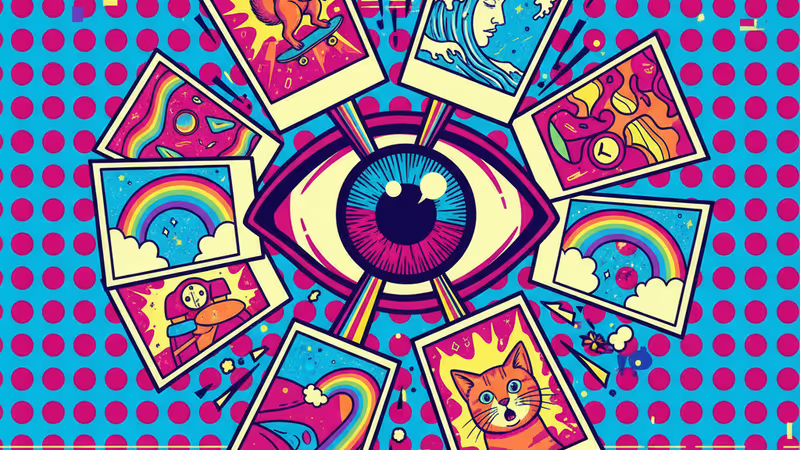
The Algorithm's Eye: Is Generative AI Killing the 'Perfectly Timed' Photo?
Viral 'perfectly timed' photos highlight a dying art. PRISM analyzes how AI is replacing serendipity with synthesis, reshaping media, trust, and visual truth.
The Lede: Beyond the Happy Accident
Collections of 'perfectly-timed' photos—a dog catching a nugget, a photographer falling at a wedding—regularly go viral. They represent moments of pure, unpredictable serendipity. For a business leader, this seems trivial. It is not. These images are cultural artifacts of a rapidly closing era: the age of photographic chance. You should care because the underlying technology of image creation is shifting from capture to synthesis. This is not a change in photography; it's a fundamental rewiring of visual communication, brand trust, and the very nature of reality—a shift with profound implications for every industry that uses an image to sell a product or tell a story.
Why It Matters: The End of Visual Trust
The rise of computational and generative AI in imaging creates seismic second-order effects. The core value proposition of a photograph—as a record of a moment that actually occurred—is evaporating. This has immediate consequences:
- The Authenticity Crisis: As flawless, AI-generated images flood every channel, consumer trust in visual media will plummet. Brands relying on 'authentic' user-generated content or influencer marketing will face a crisis of credibility.
- Hardware Becomes a Data Funnel: The smartphone camera's role is shifting. It's no longer just capturing light; it's capturing data (depth, motion, context) to feed AI models that 'perfect' or completely generate the final image. The hardware's value is becoming subservient to the AI ecosystem.
- Redefinition of Skill: The 'decisive moment'—the photographer's skilled anticipation—is being replaced by the 'decisive prompt.' The value chain is moving from those who can capture reality to those who can articulate a desired reality to a machine.
The Analysis: From Cartier-Bresson to DALL-E
Historically, photography's gold standard was Henri Cartier-Bresson's 'decisive moment': capturing the ephemeral, perfectly composed intersection of time and space. The skill was in the waiting, the seeing, the timing. The viral photos of today are the logical, chaotic descendants of this ideal.
The first disruption was digital editing (Photoshop), which allowed for post-facto manipulation. The second was computational photography (Google's Best Take, Apple's Deep Fusion), where the device makes pre-emptive decisions, capturing frames before you even press the button and algorithmically assembling an 'ideal' shot. We are now entering the third and final stage: total synthesis. Generative AI doesn't need a real-world moment to capture or augment. It simply needs a prompt. It can create a 'perfectly-timed photo' of an event that never happened, with a subject who doesn't exist.
These 'happy accident' photos represent the last gasp of an analog paradigm, where the universe, not an algorithm, provides the beautiful chaos.
PRISM Insight: Investing in the Synthetic Reality Stack
The transition from captured media to synthetic media is creating a new technological stack and clear investment vectors. The value is not in the individual images, but in the engines of their creation and verification.
- The 'Picks and Shovels' Play: The foundational layer of this new world is computational power. Companies like NVIDIA (GPUs) and cloud providers (AWS, Azure, Google Cloud) offering AI model training are the essential infrastructure.
- The Rise of the 'Authenticity Premium': As synthetic content becomes the default, provably authentic content will command a premium. This creates a market for technologies in digital watermarking, content provenance, and blockchain-based verification to certify that an image is an unaltered capture of reality. Startups in this 'truth layer' are a critical emerging category.
- The Great Stock Photo Pivot: The stock photography industry (e.g., Getty Images, Shutterstock) is at a crossroads. Their archives of real-world images face existential competition from infinite, customizable AI generations. Their survival depends on pivoting from being libraries of past realities to becoming platforms for generating future ones, integrating AI tools directly into their offerings.
PRISM's Take: Embrace the Inevitable, Build the Guardrails
Mourning the decline of the serendipitous photo is understandable, but it is a nostalgic distraction. The generative wave is not a tide that can be turned back. For leaders, the strategic imperative is not to resist this shift but to understand and shape it. The creative canvas is now infinite, offering unprecedented opportunities for marketing, design, and entertainment.
The 'perfectly-timed photo' will not vanish. Instead, its cultural role will change. It will evolve from a lucky snapshot into a valued artifact, a testament to a moment when reality, in all its messy, unpredictable glory, was more than enough.
相关文章

深入分析獨裁者的飲食習慣,揭示食物如何成為權力、偏執與控制的工具。從歷史教訓看見現代「零信任」資安架構的未來。
在愛潑斯坦家中發現的川普保險套不只是一則花邊新聞。它揭示了政治品牌IP化、迷因戰爭以及實體物件在數位時代的全新風險。
一部關於綿羊偵破謀殺案的電影為何值得關注?PRISM深度解析其背後的好萊塢IP戰略、影視技術革新與下一波內容趨勢。
一項追蹤2800萬人的法國研究顯示,新冠疫苗不僅能預防病毒,更能將總體死亡率降低25%。這對未來公共衛生與mRNA技術意味著什麼?