
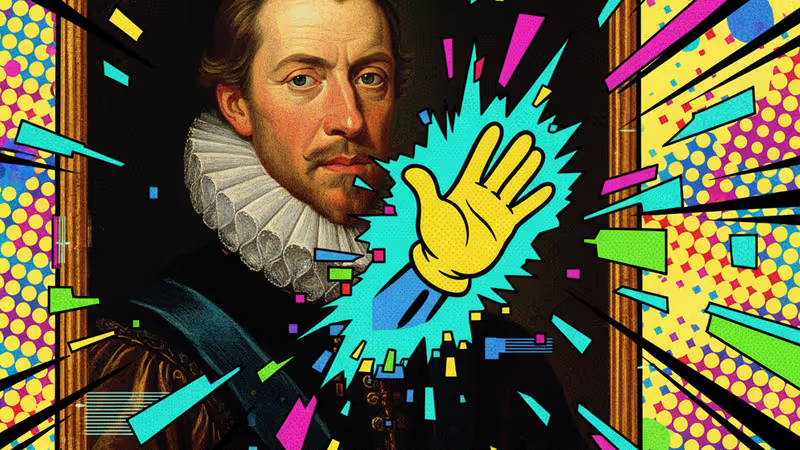
The 400-Year-Old 'Glitch' That Redefined Human Connection: How 'Goodbye' Explains Everything About Modern Communication
The history of 'goodbye' is not just trivia. It's a 400-year case study in linguistic compression that explains the future of AI, UI/UX, and brand communication.
The Lede: Language as a Legacy Protocol
Busy executives optimize for efficiency, yet often overlook the most fundamental protocol we use: language. The evolution of "goodbye" from the 14th-century blessing "God be with you" is not a trivial piece of history. It's a 400-year case study in user-driven network optimization, demonstrating how human connection relentlessly seeks efficiency. Understanding this linguistic compression is critical for anyone designing user interfaces, building brand messaging, or leading teams in an era of abbreviated, high-velocity communication.
Why It Matters: The API of Interaction is Evolving
Language is the original Application Programming Interface (API) for human interaction. The shift from "God be with you"—a high-context, high-latency spiritual transaction—to "goodbye" represents a fundamental change in that API's protocol. This was a user-led 'fork' of a common expression, driven by a desire for social and cognitive efficiency.
This matters today because we are witnessing the same process on a compressed timeline:
- Brand Communication: Brands that use formal, legacy language ("For your convenience...") are being outcompeted by brands that speak in the compressed, authentic shorthand of their customers.
- UI/UX Design: The journey from command-line interfaces to intuitive, icon-driven GUIs mirrors the path from "God be wy you" to a simple wave emoji. It's about reducing cognitive load.
- AI & Chatbots: An AI that understands the literal meaning of "goodbye" is basic. An AI that understands the subtle, context-dependent difference between "bye," "byeee," "k bye," and a ghosting is revolutionary. This history reveals the deep layers of social compression AI must master.
The Analysis: From Sacred Blessing to Secular Sign-off
The source material reveals that the transition wasn't a clean, top-down decree. It was a messy, user-generated process. In the 16th century, variations like "godbwye" (Gabriel Harvey, 1575), "God be wy you," and "good b' w' y" were essentially different beta versions being tested in the marketplace of conversation. Shakespeare himself used at least three different variants.
The pivotal moment was the 'corruption' of "God" into "good." This wasn't a mistake; it was a standardization influenced by existing linguistic models like "good day" and "good night." Users unconsciously refactored the archaic phrase to fit a more modern, secular, and pattern-consistent framework. This is a classic example of folk etymology acting as a collective intelligence, smoothing out an irregularity in the system for better usability. The original sacred intent was deprecated in favor of a streamlined, universally applicable social function.
PRISM Insight: Invest in Brevity and Abstraction
The trajectory of "goodbye" provides a clear investment thesis: human communication systems always trend towards greater abstraction and efficiency. The value isn't in the raw data ("God be with you") but in the speed and ease of the transaction ("bye").
This historical data point validates investment in technologies that facilitate this compression. Think of the valuation of companies that created new, faster protocols for connection: the shift from email (letters) to Slack (real-time chat), from text messages to reaction emojis, from phone calls to ephemeral stories. Each layer further abstracts and accelerates interaction. The next billion-dollar communication platforms will be those that create even lower-friction ways to convey presence, intent, and emotion. The evolution of language shows that the demand for this is relentless and centuries old.
PRISM's Take: Your Culture is Your Compression Algorithm
The story of "goodbye" is more than a linguistic curiosity; it's a blueprint for social and technological evolution. It demonstrates that the most powerful systems are not designed, but evolve. They are shaped by the countless small, seemingly insignificant choices of their users who are unconsciously optimizing for efficiency and relevance.
For leaders, the lesson is to pay attention to the 'desire paths' in your organization's communication. Where are your teams creating their own shorthand? What formal processes are being unofficially bypassed for faster, more direct methods? These aren't signs of breakdown; they are the equivalent of "godbwye" emerging in the 1500s. They are the leading indicators of where your operational protocol needs to evolve. The future doesn't arrive via a formal memo; it emerges from the messy, brilliant, and relentless human drive to simply say what needs to be said and move on.
相关文章

拜登在首場總統辯論中的災難性表現,引發民主黨內部恐慌與換人呼聲。PRISM深度分析這場政治地震如何影響市場、科技與全球格局。

日本壽司Sushiro在上海引爆排隊潮,揭示了中日政治冷、經濟熱的矛盾。PRISM深度分析消費者行為、軟實力與餐飲科技的真正力量。

一張C羅的半裸照片,揭示了運動員如何轉型為媒體巨頭與品牌CEO。PRISM深度分析其背後的商業策略、科技趨勢與投資啟示。

泰勒絲新紀錄片不僅揭露巡演秘辛,更展示其背後龐大的商業運作。從39秒換裝到品牌敘事,深度解析巨星經濟學的未來。