
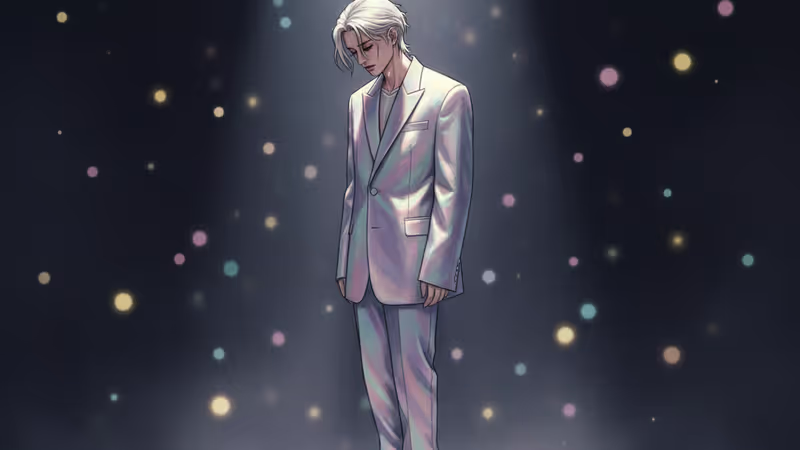
SHINee’s Key and the Impossible Performance of Grief
SHINee Key's tribute to Jonghyun sparked backlash, revealing a dangerous new era of parasocial policing and the weaponization of celebrity grief.
The Lede: Beyond the Backlash
SHINee Key's recent tribute to the late Jonghyun, and the subsequent fan backlash, is more than a fleeting social media drama. For strategists and executives, it’s a critical case study in the escalating fragility of celebrity reputation in hyper-connected fan economies. It demonstrates how personal acts of remembrance are now high-stakes brand management exercises, where authenticity is paradoxically expected to be performed on a rigid, public schedule. This incident signals a dangerous new phase where an artist's entire reputational stack can collapse when a personal moment is judged through the lens of an unrelated controversy.
Why It Matters: The Weaponization of Grief
The fallout from Key’s post reveals a systemic shift with significant second-order effects for the entertainment industry. The expectation for idols to publicly mourn in a fan-approved manner, at a precise time, transforms a personal process into a commodified performance. This sets an unsustainable precedent.
- Reputational Contagion: The negative sentiment from Key’s recent “unlicensed doctor” controversy directly infected the perception of his tribute. This shows that in the current media ecosystem, context is collapsible. Unrelated issues are bundled by online mobs to create a single, damning narrative, erasing any room for nuance.
- The Chilling Effect on Authenticity: When genuine, albeit imperfect, expressions of grief are met with accusations of being “creepy” or “disingenuous,” artists are incentivized to retreat. The future of artist-fan communication will likely become more sanitized, pre-vetted, and ultimately less authentic, as the risk of a misstep becomes too high.
- The New PR Minefield: Anniversaries and memorials, once moments for unity, are now potential flashpoints. PR and management teams must now war-game not just album releases, but moments of profound personal significance, treating grief as a potential vector for a brand crisis.
The Analysis: The Collapse of the Parasocial Contract
For two decades, I've watched the relationship between K-Pop idols and their fans evolve. SHINee, in particular, has always maintained a unique bond with their fandom (Shawols), built on a perception of artistic integrity and genuine connection. Jonghyun’s tragic passing in 2017 fundamentally altered this dynamic, making his memory a sacred, yet fiercely protected, part of the group's public identity.
What we are witnessing is the breakdown of an unspoken parasocial contract. Fans, who invest immense emotional and financial capital, feel a sense of ownership not just over the idol's art, but over their narrative and even their grieving process. In the pre-social media era, grief was a private affair, mediated by the company through official statements. Today, it is a live, unmediated negotiation between the artist and millions of followers, each acting as judge and jury.
Key’s post—a day late, with a somber photo and a raw caption—was likely a moment of private reflection made public. But in the digital panopticon of modern fandom, it was judged against a collective, unspoken script. The timing was 'wrong'. The tone was 'off'. It failed the public performance audit, especially with his social capital already depleted by a prior scandal.
PRISM Insight: The Rise of Reputational Hedging
This incident is a clear signal for the C-suite at entertainment labels. The core asset is no longer just the artist's talent, but their real-time public sentiment score. We are entering an era where talent management must integrate sophisticated, AI-driven sentiment analysis not as a reporting tool, but as a predictive one.
Investment in technology that can model the “reputational contagion” effect—how a scandal in one domain (e.g., personal judgment) can impact perceptions in another (e.g., sincerity of a tribute)—will become standard. Agencies that fail to hedge against this volatility by building proactive digital reputation strategies will see their marquee talent, and by extension their market value, exposed to unprecedented risk.
PRISM's Take: The Authenticity Paradox Will Break the System
The core conflict here is the “Authenticity Paradox”: fans demand raw, human connection from idols, but simultaneously require that this humanity be performed flawlessly and according to rigid, unspoken rules. Key's situation is not an outlier; it is the new norm. An artist is expected to be vulnerable, but only in pre-approved ways. They are expected to be grieving, but on a deadline.
This is an unsustainable model. It forces artists into an impossible position that is detrimental to both their mental health and the long-term health of the fan-artist relationship. The industry must move beyond reactive crisis management. The future lies in educating fandoms about the dangers of parasocial overreach and architecting new platforms that allow for more nuanced, less performative communication, or we will see more artists either retreat from public life or have their careers derailed by the very communities that claim to support them.
相关文章

深度解析Dispatch元旦情侶文化,揭示其不僅是八卦,更是韓國娛樂產業中的權力遊戲、商業模式與未來趨勢。
從Rain的美國巡演票房焦慮,深度剖析K-POP產業面臨的市場飽和、世代競爭與數據決策新趨勢。當傳奇不再是門票保證,行業該如何應對?
「注射阿姨」醜聞不只是八卦。PRISM深度分析K-Pop的系統性壓力、粉絲經濟的考驗,以及潛在的產業變革與投資啟示。
深度分析aespa Winter刺青事件,探討K-Pop偶像戀愛禁忌、粉絲文化,以及娛樂公司如何透過IP資產對沖藝人個人生活的商業風險。