
Seoul's Political Shockwave: Why the Yoon Scandal is a Global Tech & Security Red Flag
Analysis of the Yoon Suk Yeol scandal in South Korea. Discover the geopolitical and global supply chain implications of this high-stakes political turmoil.
The Lede: Beyond Local Drama
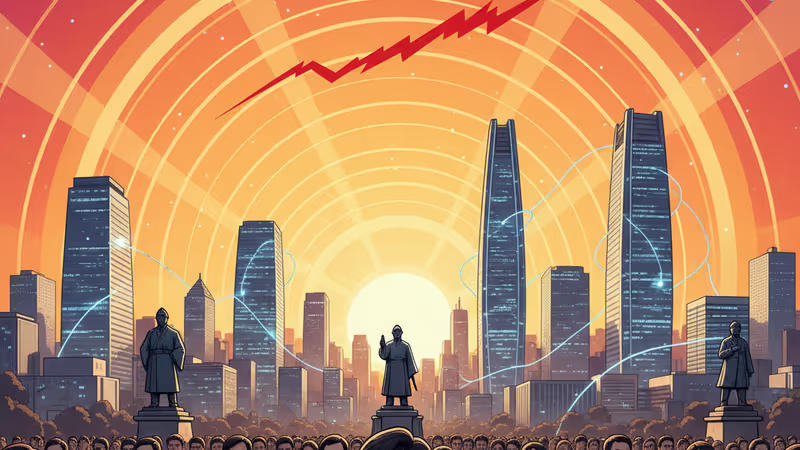
A former South Korean president facing hours of interrogation over a corruption scandal involving the first lady isn't just a domestic headline; it's a critical data point for global executives. For a nation that is a linchpin in global semiconductor, EV battery, and technology supply chains, this level of political instability signals potential turbulence for international markets and strategic alliances. This is a stress test of the democratic institutions governing one of the world's most vital economies, and the outcome will have ripple effects far beyond the Korean Peninsula.
Why It Matters: The Second-Order Effects
The investigation into former President Yoon Suk Yeol creates significant uncertainty with broad implications:
- Investor Confidence & The 'Korea Discount': Persistent political scandals and the cycle of presidential prosecutions reinforce the so-called 'Korea Discount,' where South Korean equities trade at a lower valuation than their global peers. This instability spooks foreign investors who prize policy predictability.
- Geopolitical Alignment: South Korea is a cornerstone of the U.S. alliance structure in the Indo-Pacific. A government consumed by domestic political warfare can become a distracted and less reliable partner, potentially undermining coordinated efforts with Washington and Tokyo to counter regional threats from China and North Korea.
- Policy Paralysis: When political capital is spent on defending against or prosecuting a former administration, it leaves little room for tackling crucial long-term economic and security challenges. This can stall vital reforms in everything from corporate governance to national defense posture.
The Analysis: A System Under Strain
The questioning of a former president is a recurring feature in South Korea's hyper-partisan political landscape. Since the country's democratization in 1987, nearly every former president has faced investigation, imprisonment, or personal tragedy linked to post-office legal battles. This pattern reveals less about any single individual and more about systemic issues within South Korean politics: a 'winner-take-all' system, powerful presidencies, and the use of the justice system as a tool for political retribution.
From a global perspective, this dynamic is viewed with concern. For Washington, it raises questions about the long-term stability and policy continuity of a key ally. For Beijing, such internal division can be seen as an opportunity to weaken the U.S.-ROK alliance through economic and diplomatic pressure. The use of a special counsel, appointed to bypass the regular prosecutorial system, highlights the deep distrust between the ruling and opposition parties, suggesting the political divide is widening, not healing.
PRISM Insight: De-Risking the Korean Connection
For corporations and investors, this scandal is a potent reminder of the political risk embedded in South Korean assets and supply chains. While the nation’s tech giants like Samsung and SK Hynix are models of operational excellence, their strategic planning is subject to the whims of a volatile political environment. Companies heavily reliant on Korean suppliers should be actively mapping their supply chain vulnerabilities and considering geographic diversification strategies. This event underscores the need for businesses to integrate high-level geopolitical analysis into their risk management frameworks, as a corruption probe in Seoul can ultimately impact chip availability in Silicon Valley.
PRISM's Take: More Than a Scandal, A Symptom
The investigation into former President Yoon is not an isolated incident but a symptom of a deeply polarized political system where the transition of power is often followed by legal warfare. While a robust and independent judiciary holding leaders accountable is a hallmark of a strong democracy, the cyclical nature of these investigations in South Korea suggests a deeper institutional flaw. The critical question is whether the country's democratic institutions can withstand these recurring political earthquakes without suffering long-term damage. For global stakeholders, the key takeaway is clear: South Korea's domestic politics are now an unavoidable and critical factor in global business and security calculations. The stability of this tech powerhouse cannot be taken for granted.
相关文章

川普背書布萊克曼競選紐約州長,揭示MAGA運動在共和黨內部的影響力。分析紐約州政治挑戰、史蒂芬尼克退出策略,以及川普主義對未來選舉和黨內路線的深遠影響。

從加薩人道危機到全球地緣政治衝突與社會動盪,PRISM深度分析多重危機下的全球政治版圖,並探討技術如何應對挑戰。

深度解析美國外交政策、新興政治力量與全球主權挑戰,探索數位時代社會正義運動如何重塑未來國際秩序與治理模式。
「艾普斯坦檔案」釋出未能揭示關鍵真相,引發公眾對司法透明度及精英問責的深層質疑。透明化之路仍漫長。