
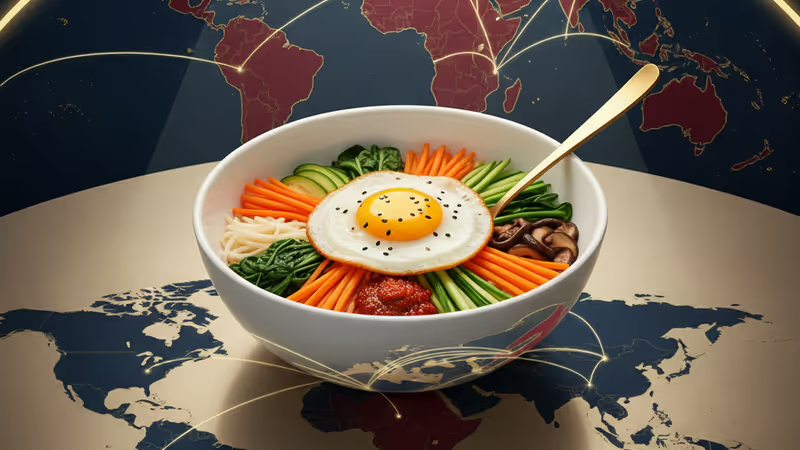
South Korea Sets $21 Billion Annual Food Export Target for 2030, Riding K-Culture Wave
South Korea's government has announced a comprehensive strategy to boost annual food exports to $21 billion by 2030, leveraging the global popularity of K-culture. The plan includes targeted product strategies, educational initiatives, and cultural integration.
Seoul,December 23– TheSouth Koreangovernment announced Tuesday it aims to achieve$21 billion in annual food exports by 2030, capitalizing on the soaring global popularity of Korean culture. The ambitious target was unveiled at a "K-food global vision declaration ceremony" by the Ministry of Agriculture, Food and Rural Affairs, which vowed to develop the sector into a strategic export industry.
The push comes as K-food exports are already on a strong trajectory. According to the ministry, exports from January to November this year reached a record high of$11 billion. The government now seeks to elevate Korean cuisine to the same level of global recognition as its tech and entertainment industries.
A Multi-Pronged Strategy for Global Palates
To achieve its goal, the ministry outlined five key strategies, including a market-specific approach. It plans to designate strategic items for different regions, such as barbecue sauce for theU.S., high-value health foods forJapan, and Halal-certified beef for the Middle East.
The government also plans to bolster infrastructure and training. A new culinary school focused on Korean cuisine will be established, alongside collaborations with prestigious institutions like the Culinary Institute of America and Le Cordon Bleu to open K-food classes. To support exporters, a one-stop support center will be created to navigate non-tariff trade barriers, and export vouchers for food companies will be doubled next year to40 billion won.
Weaving Food into Culture and Tourism
A central pillar of the strategy is the integration of food with cultural content and tourism. The ministry said it will create various cultural content centered on Korean cuisine and promote it through international cultural and sports festivals. It also aims to develop tourism programs with a culinary focus, hoping to turn foreign visitors into long-term advocates for K-food.
In a congratulatory message, PresidentYoon Suk Yeol stated that "the government will provide firm support to help K-food grow into a strategic export industry," according to the ministry.
This K-food initiative is a clear blueprint for converting cultural influence—soft power—into tangible economic returns. Seoul isn't just selling food; it's building a self-reinforcing ecosystem where K-dramas drive demand for kimchi, and tourism focused on cuisine boosts the nation's brand. If successful, this model could offer a valuable lesson for other nations seeking to monetize their own cultural appeal.
本内容由AI根据原文进行摘要和分析。我们力求准确,但可能存在错误,建议核实原文。
相关文章

中國一家國營博物館爆出驚天醜聞,工作人員涉嫌將16世紀畫作等館藏文物盜賣至市場。一名前館長因下屬舉報而面臨調查,事件被評為「讓羅浮宮竊賊也顯得愚蠢」。

敘利亞北部戰略要地阿勒頗(Aleppo)驚傳戰火,總統阿塞德領導的政府軍與庫德族為主的「敘利亞民主力量」(SDF)爆發激烈武裝衝突,已造成傷亡,區域穩定再添變數。

美國總統川普宣稱格陵蘭對國家安全至關重要,並任命特使推動其「成為美國一部分」。此舉引發丹麥和格陵蘭強烈反彈,稱「不能吞併他國」,北極地緣政治緊張局勢升級。

敘利亞政府軍與庫德族領導的SDF在阿勒坡爆發致命衝突後,達成臨時停火協議。本文分析此事件背後的脆弱平衡,並綜覽俄烏戰爭、以巴衝突等全球其他地緣政治熱點。