
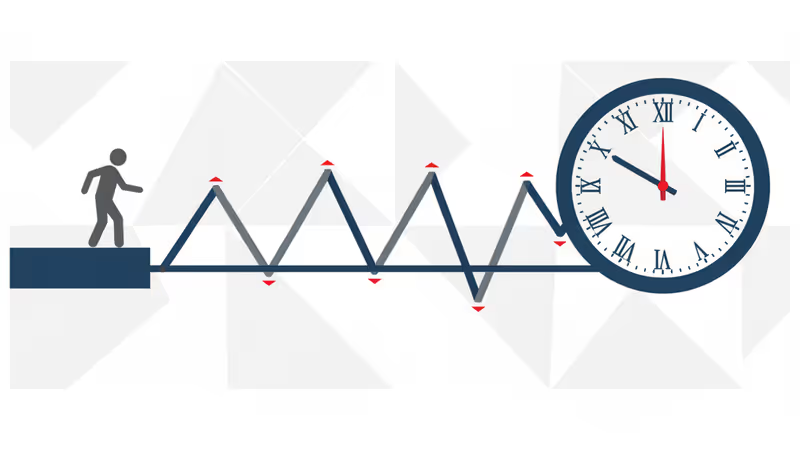
Pakistan's Economic Tightrope: IMF Stability or a Ticking Clock?
Pakistan's economy shows signs of IMF-induced stability, but this is a fragile truce, not a recovery. Here's what investors and policymakers need to know.
The Lede: Beyond the Headlines
Pakistan has once again pulled back from the economic brink, securing a favorable IMF review. The macroeconomic dashboard is flashing green: growth is returning, inflation is tamed, and forex reserves are up. For the C-suite and global investors, however, these numbers are a lagging indicator. The critical question isn't whether Pakistan survived 2023, but whether it can break a multi-decade cycle of debt-fueled consumption and politically-motivated bailouts. This isn't just an economic story; it's a stress test for a nuclear-armed nation of 240 million at the crossroads of Asia, and a bellwether for the IMF's ability to enforce lasting change.
Why It Matters: The Ripple Effects of a Fragile State
The stability of Pakistan's economy has profound second-order effects that extend far beyond its borders. Here’s the strategic calculus:
- Geopolitical Volatility: An economically distressed Pakistan is a risk amplifier for regional security. For policymakers in Washington, Beijing, and Riyadh, ensuring a baseline of stability is paramount. A default would create a power vacuum and a potential humanitarian crisis that no one wants to manage.
- Emerging Market Contagion: In a high-interest-rate world, the default of a major emerging economy could trigger a crisis of confidence across the asset class. Pakistan’s ability to adhere to its IMF program is being watched closely by bond traders from London to Hong Kong as a signal of EM resilience.
- The Climate Finance Test Case: For the first time, the IMF is deploying its Resilience and Sustainability Facility at scale. Pakistan, ravaged by historic floods, is a live experiment. Success would create a new playbook for blending fiscal discipline with climate adaptation; failure would undermine a key pillar of the global green transition strategy.
The Analysis: Deconstructing a Temporary Truce
To a veteran observer, this moment feels dangerously familiar. Pakistan has approached the IMF over 20 times, each time promising the same structural reforms. The current “stability” is built on a precarious foundation.
The celebrated current account surplus is not the result of a vibrant export boom. It's a direct consequence of severe import compression—a policy that starves the economy of the capital goods and raw materials needed for industrial growth. It’s like a patient losing weight because they can't afford food; it lowers the number on the scale but doesn't make them healthier. This policy is unsustainable and throttles long-term potential.
The real battleground is fiscal. The government's achievement of a primary surplus and its ambition to raise the tax-to-GDP ratio from a paltry 12% to 15% is the core of the IMF's prescription. But this isn’t a technical spreadsheet exercise. It is a direct political challenge to deeply entrenched elites in real estate, agriculture, and retail who have systemically evaded taxation. The history of Pakistani political economy suggests that as soon as the immediate crisis abates, the political will for these painful reforms evaporates.
PRISM Insight: The Digital Escape Route
While the traditional economy remains mired in structural dysfunction, a parallel, more hopeful narrative is emerging, driven by technology. The core investment thesis for Pakistan isn't in its legacy industries; it's in its potential to leapfrog them.
- Fintech as a Formalizer: The government's need to document the economy to expand its tax base is a powerful tailwind for fintech. As transactions are forced out of the grey economy and into digital channels, a massive, untapped market for payments, credit, and insurance will open up.
- The Services-Export Engine: Pakistan's most valuable, globally competitive asset is its young, digitally native talent pool. The IT services sector has been a rare bright spot, growing consistently. This is the one part of the economy that can generate sustainable foreign currency inflows without heavy reliance on imported machinery or commodities.
- Climate Tech Imperative: The IMF's climate facility provides more than just funds; it provides a policy anchor. This creates a clear signal for investment in AgriTech for resilient crops, smart water management systems, and distributed renewable energy solutions—markets born from necessity.
PRISM's Take: A Window of Opportunity, Not a Victory
The positive IMF review is not a sign of a cure; it's a sign that the emergency life support is working. Pakistan has bought itself time, but it has not yet bought itself a future. The current calm is an artificial construct, sustained by multilateral loans and demand suppression.
The key variable for investors and policymakers to watch is not the next inflation print, but the government's willingness to spend political capital on deep, unpopular reforms: privatizing loss-making state-owned enterprises and, most importantly, bringing the untaxed elite into the fold.
Without this fundamental rewiring of its political economy, Pakistan is doomed to repeat this cycle. The ultimate bull case rests on whether the country's burgeoning digital economy can grow fast enough to provide an escape velocity from the gravitational pull of its past failures. This window will not stay open forever.
相关文章
巴基斯坦通過IMF審查,但這份脆弱的穩定能否持續?PRISM深度分析其經濟結構性問題、改革挑戰與未來投資前景。
中國正從學名藥工廠轉型為全球醫藥創新中心。深度分析其成本效率優勢、對全球製藥巨頭的挑戰,以及未來的投資機遇。
中國減持美債至17年新低,這不僅是經濟考量,更是地緣政治下的戰略轉向。PRISM分析「去美元化」趨勢對全球投資者的影響。
日本央行(日銀)結束長達數十年的負利率政策,升息至0.75%。此舉將如何衝擊日圓、全球資本流動及您的投資組合?PRISM深度解析。