
South Korea's Push for Military Autonomy Puts 70-Year U.S. Alliance at a Crossroads
As South Korea pursues greater military autonomy, including the OPCON transfer and nuclear submarines, the 70-year alliance with the U.S. is at a turning point. An analysis of the motives and future.
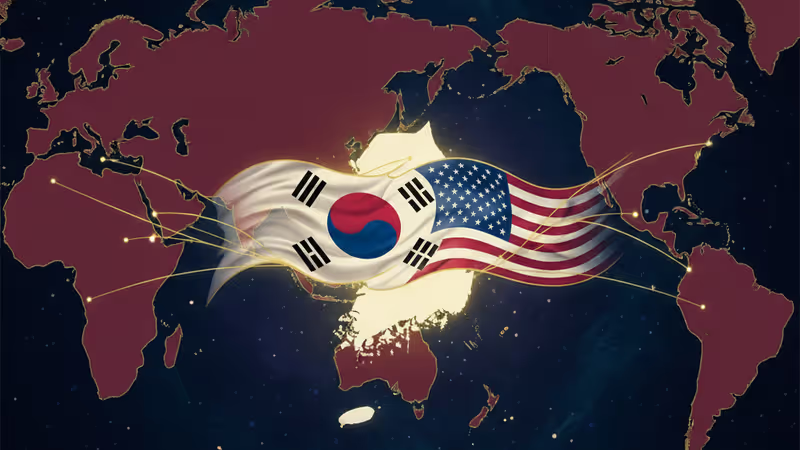
They're shaking hands, but the calculations under the table are complex. South Korea is accelerating its push for greater military autonomy—from seeking to retake wartime operational control (OPCON) from Washington to building its own nuclear-powered submarines. While the U.S. appears to be receptive, this shift in the decades-old alliance is being driven by a much larger geopolitical game: containing China.
Seoul's Drive for Self-Reliance
South Korean President Lee Jae Myung’s administration is aiming to retake wartime OPCON before his term ends in 2030. A transition would mean a South Korean general would lead the allies' combined forces during a conflict. In a sign of progress, Defense Minister Ahn Gyu-back and U.S. Defense Secretary Pete Hegseth agreed last month in Seoul to develop a roadmap to "expedite" the process, according to a Yonhap report.
This pursuit of autonomy extends beyond command structures. After bilateral missile guidelines were lifted in 2021, South Korea gained the ability to develop ballistic missiles with ranges greater than 800 kilometers. More recently, Seoul has been pushing to acquire nuclear-powered submarines, an effort that received backing from U.S. President Donald Trump during their summit in late October.
Washington's Strategic Calculus
The U.S. appears receptive because a stronger, more autonomous South Korea aligns with its broader strategy of countering China. Nam Chang-hee, a professor at Inha University, told Yonhap that Washington believes the benefits of bolstering its ally's capabilities to check China outweigh the risks of its increased autonomy. RAND Corp. senior defense analyst Bruce Bennett added that the U.S. government realizes that both the economic burden and control must be shared with its allies.
However, some observers argue that Trump's support is more transactional than strategic. His backing for the submarine project followed grueling trade negotiations where Seoul committed to investing US$350 billion in the U.S. The view on the ground is also more cautious. Gen. Xavier Brunson, commander of U.S. Forces Korea (USFK), has stressed that meeting the agreed-upon conditions for the OPCON transfer is more important than adhering to a specific timeline.
本内容由AI根据原文进行摘要和分析。我们力求准确,但可能存在错误,建议核实原文。
相关文章
南韓正積極尋求從美國手中收回戰時作戰指揮權(OPCON),此舉獲川普政府支持。在美中競爭加劇的背景下,美韓同盟的權力轉移將如何重塑東亞安全格局?

川普白宮幕僚長蘇西·威爾斯的獨家專訪揭示了一個由個人關係和不可預測性主導的新權力中心。這對全球穩定與地緣政治意味著什麼?

韓國製造業薪資已超越日本27.8%、台灣25.9%,但生產力增長遲緩正侵蝕其全球競爭力。本文深入分析其背後的雙重結構與法規挑戰。

日本國會掀起「外國人犯罪率高1.72倍」的驚人言論。本篇報導深入東京地方法院旁聽席,透過實際案例與前刑警分析,揭示日本社會在歡迎外籍勞工背後的治安隱憂與司法挑戰。
南韓正積極尋求從美國手中收回戰時作戰指揮權(OPCON),此舉獲川普政府支持。在美中競爭加劇的背景下,美韓同盟的權力轉移將如何重塑東亞安全格局?
川普白宮幕僚長蘇西·威爾斯的獨家專訪揭示了一個由個人關係和不可預測性主導的新權力中心。這對全球穩定與地緣政治意味著什麼?
韓國製造業薪資已超越日本27.8%、台灣25.9%,但生產力增長遲緩正侵蝕其全球競爭力。本文深入分析其背後的雙重結構與法規挑戰。
日本國會掀起「外國人犯罪率高1.72倍」的驚人言論。本篇報導深入東京地方法院旁聽席,透過實際案例與前刑警分析,揭示日本社會在歡迎外籍勞工背後的治安隱憂與司法挑戰。