
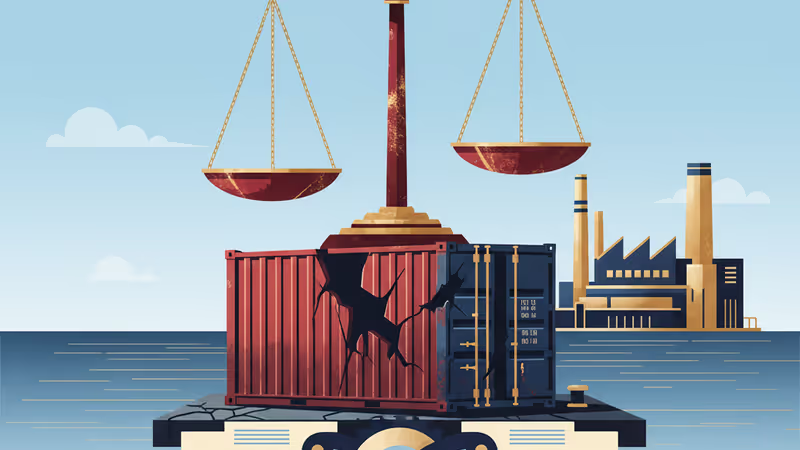
Trump's Blueprint for a Second Term: A 60% Tariff on China and a 'Ring Fence' Around the U.S. Economy
An in-depth analysis of the proposed second-term economic plan for Donald Trump, featuring a 60% tariff on Chinese goods and a 10% universal tariff, and its potential to trigger a global trade war and reshape the U.S. economy.
Advisors to former President Donald Trump have outlined a radical economic plan for a potential second term, proposing a universal 10% baseline tariff on all imports and a staggering 60% tariff on all goods from China. The proposal, intended to aggressively rebalance global trade and bolster U.S. manufacturing, has ignited a firestorm of debate, with critics warning it could trigger a global trade war and severely damage the American economy.
The plan was detailed in recent interviews by Robert Lighthizer, who served as U.S. Trade Representative, and Robert O'Brien, a former National Security Advisor. According to Lighthizer, the ultimate goal is to eliminate the nation's roughly $500 billion annual trade deficit. He argued for creating a "ring around the U.S. economy," using the 10% universal tariff as a starting point for negotiating better terms with trade partners.
1. Universal Baseline Tariff (10%): A flat tax on all goods imported into the U.S., regardless of origin. This would serve as leverage in trade negotiations. 2. Punitive China Tariff (60%+): A targeted, much higher tariff on all Chinese goods, aimed at forcing a dramatic rebalancing of trade with America's largest trade deficit partner.
Proponents frame the strategy as a matter of national security. "It's not just an economic issue; it's a national security issue," O'Brien stated, arguing that dependence on foreign supply chains has hollowed out America's industrial base. The advisors contend that the tariffs from Trump's first term were successful but insufficient to correct long-standing trade imbalances.
The plan was met with immediate and stark warnings from mainstream economists. Adam Posen, president of the Peterson Institute for International Economics, called the proposal a "prescription for a Great Depression." He argued that such tariffs would function as a massive tax on American consumers and businesses, disrupting global supply chains and sparking runaway inflation.
An analysis by the non-partisan Tax Foundation estimated that the plan would reduce long-run U.S. GDP by 1.1%, eliminate 825,000 full-time equivalent jobs, and lower wages.
This proposal is more than a trade policy; it's a fundamental challenge to the post-WWII global economic order. It signals a potential move away from the multilateralism of the WTO toward aggressive, power-based bilateralism. If implemented, global corporations would be forced into a costly and chaotic realignment of supply chains, while consumers would likely face higher prices. The plan underscores that the upcoming U.S. election is a critical inflection point for the future of the global economy.
本内容由AI根据原文进行摘要和分析。我们力求准确,但可能存在错误,建议核实原文。
相关文章

美國重要保守派智庫「傳統基金會」爆發員工離職潮,超過十數名員工出走。事件核心是圍繞右翼網紅所引發的路線之爭,凸顯美國保守主義運動面臨的深刻內部分裂。
南韓執政黨共同民主黨突然同意啟動「統一教」特檢調查,結束了朝野長期的政治對峙。在強大民意支持下,一場可能動搖政壇的全面調查即將展開,揭露宗教組織與政界間的複雜關係。
擁有近兩千年歷史的加薩大奧馬里清真寺在衝突中化為廢墟。本文探討此一文化遺產的歷史價值,並分析武裝衝突中破壞文化古蹟的深遠影響與國際爭議。
2025年即將結束,美國國會立法成果乏善可陳,議員退休潮卻日益加劇。多位前國會議員對此發出警告,直指國會運作已陷入「昏迷狀態」,並認為這些根深蒂固的問題已醞釀多年。