
China's Gambit: Why Myanmar's Junta Is Finally Holding Its Long-Promised Election
Nearly five years after its coup, Myanmar's military is holding an election. Driven by Chinese pressure and a battlefield turnaround, the vote is designed not to restore democracy but to consolidate military rule under a civilian guise.
Nearly five years after seizing power in a coup inFebruary 2021, Senior GeneralMin Aung Hlaing is following through on his pledge to hold an election. After a brutal civil war that has killed tens of thousands, nobody expects the vote to be free or fair. The country's most popular political party, theNLD, is banned from competing. So why now? The answer lies in a combination of overwhelming pressure fromChina and a dramatic reversal of fortune on the battlefield.
A Return from the Brink
Just over a year ago, the military regime seemed to be in terminal decline. InOctober 2023, a powerful coalition of ethnic armed groups known as theThree Brotherhood Alliance launched a stunning offensive, capturing major towns and military bases. Images of seized tanks and hundreds of surrendering regime soldiers flooded social media, fueling a belief that the dictatorship was on the verge of collapse.
Fearing that a victorious pro-democracy movement would be too close to the West,China intervened to an unprecedented degree. According to reports,Beijing pressured the Alliance groups on its border to sign a ceasefire, closing border crossings they rely on for supplies and forcing them to return key territories to junta control. ByDecember 2024, Chinese officials were overseeing a ceremony where the major northern city of Lashio was handed back to the regime without a fight. This intervention saved the junta from collapse.
An Election by Design, Not by Choice
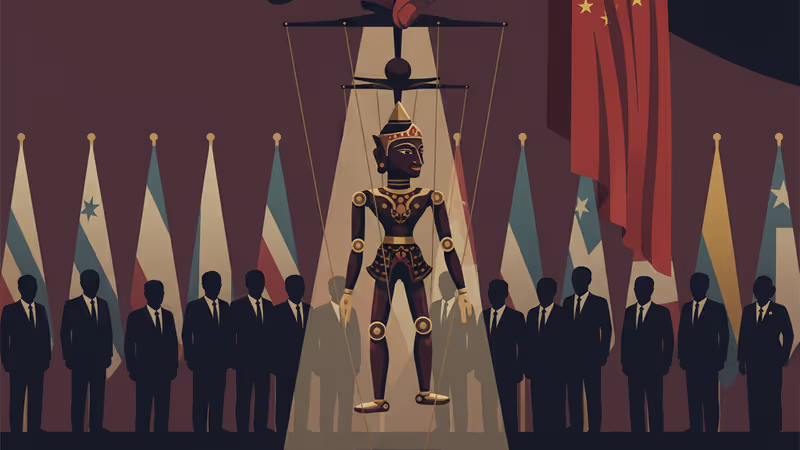
Owing its survival toChina, the junta is now under intense pressure to satisfy its benefactor’s demand for an election. With the military back in a dominant position,Min Aung Hlaing also feels politically secure enough to stage a carefully managed vote. It’s less a political transition and more “a procedural exercise to consolidate military rule behind a thin civilian veneer,” says Richard Horsey, senior Myanmar advisor for the International Crisis Group.
The election's structure is engineered to guarantee military control. Voting will be cancelled in nearlyhalf of townships. Paradoxically, this strengthens the military's hand. Under the 2008 constitution, the military directly appoints25% of parliamentary seats. As analyst Min Zaw Oo notes, with fewer elected seats in play, this appointed bloc will constitute a significantly larger percentage of the total, giving the junta an even tighter grip on power.
The timing also serves to undermine the oppositionNUG. The NUG's mandate stems from the2020 election, which is now set to expire. Having already lost relevance due toChina's hostility and its inability to command the loyalty of all anti-junta forces, the NUG is being further politically and militarily isolated.
This election isn't a step toward resolution but the formalization of a new, China-influenced reality in Myanmar. It aims to sideline Western-leaning democratic forces for good and create a managed, authoritarian state that secures Beijing's strategic interests. The key question is no longer if the junta will fall, but how power will be shared among pro-military elites under China's watchful eye.
本内容由AI根据原文进行摘要和分析。我们力求准确,但可能存在错误,建议核实原文。
相关文章

全球地緣政治緊張局勢加劇。本文報導俄羅斯對烏克蘭的致命導彈襲擊、以色列防長對加薩的強硬表態,以及敘利亞、委內瑞拉等地的最新動態。

美國CBS新聞網王牌節目《60分鐘》臨時撤下一則關於薩爾瓦多爭議監獄的報導,引發軒然大波。內部人士指控母公司為討好川普政府而進行政治審查,正值其競購華納兄弟探索之際,新聞自由面臨嚴峻考驗。

美國貿易代表署(USTR)認定中國半導體產業政策具歧視性,對美國商業構成威脅,因此宣布將實施新關稅。初始稅率為0%,預計於2027年6月起調升。

加薩衛生官員警告,由於以色列封鎖,當地醫療系統瀕臨崩潰。近四分之三的藥品短缺,兩萬名患者等待轉診治療,已有上千人在等待中死亡。本文深入剖析這場人道危機。