
Moulton Bill Explained: Congress Moves to Block Trump Administration Funds for Military Action in Venezuela
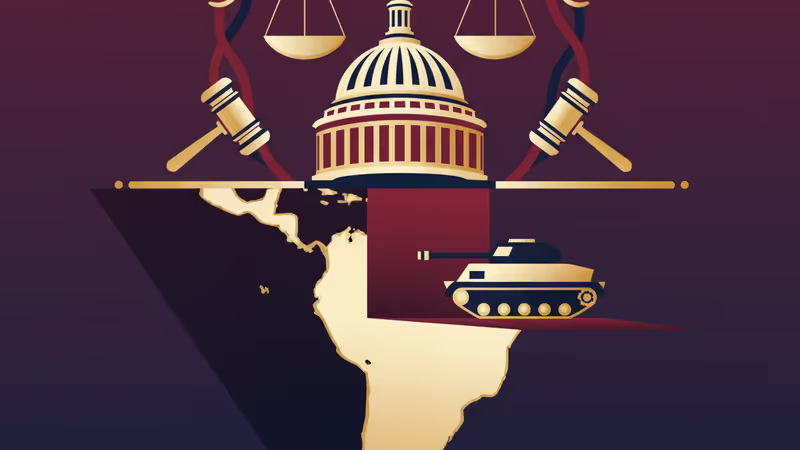
Democratic Rep. Seth Moulton has introduced a bill to block the Trump administration from using federal funds for military action in Venezuela, reigniting the U.S. debate on presidential war powers.
In a direct challenge to presidential authority, Democratic Congressman Seth Moulton of Massachusetts has introduced legislation aimed at preventing the Trump administration from using federal funds for military action against Venezuela. The move, announced on December 23, 2025, escalates the ongoing debate over war powers between the White House and Congress.
A Legislative Check on Executive Power
According to NPR, which spoke with the congressman, the bill explicitly seeks to prohibit the use of federal dollars to "wage war with Venezuela." This legislative strategy leverages one of Congress's most significant constitutional powers—the power of the purse. By controlling federal spending, lawmakers aim to create a legal barrier against any potential military intervention that has not received their explicit authorization.
For context, relations between the United States and Venezuela have been strained for years, marked by diplomatic tensions, economic sanctions, and differing political ideologies. This bill arises from concerns within some U.S. political circles about the potential for these tensions to escalate into armed conflict.
The Broader War Powers Debate
This move is not occurring in a vacuum. It taps into a long-standing constitutional debate in the U.S. over the separation of powers. While the President serves as Commander-in-Chief of the armed forces, the U.S. Constitution grants Congress the sole power to declare war. Congressman Moulton's bill represents an attempt by the legislative branch to reassert this authority and place a preemptive check on the executive's ability to initiate military hostilities independently.
The bill's passage is uncertain and will likely face significant political opposition. However, its introduction alone serves as a powerful political statement and a clear signal from a faction within the Democratic Party regarding the limits of presidential power in foreign policy.
This legislation is less about Venezuela itself and more a litmus test for congressional relevance in 21st-century foreign policy. If successful, it could establish a modern precedent for lawmakers to preemptively restrict military options in other global hotspots, potentially shifting the balance of power from the White House back to Capitol Hill.
本内容由AI根据原文进行摘要和分析。我们力求准确,但可能存在错误,建议核实原文。
相关文章

川普白宮幕僚長蘇西·威爾斯的獨家專訪揭示了一個由個人關係和不可預測性主導的新權力中心。這對全球穩定與地緣政治意味著什麼?

全球地緣政治緊張局勢加劇。本文報導俄羅斯對烏克蘭的致命導彈襲擊、以色列防長對加薩的強硬表態,以及敘利亞、委內瑞拉等地的最新動態。
美國CBS新聞網王牌節目《60分鐘》臨時撤下一則關於薩爾瓦多爭議監獄的報導,引發軒然大波。內部人士指控母公司為討好川普政府而進行政治審查,正值其競購華納兄弟探索之際,新聞自由面臨嚴峻考驗。
美國貿易代表署(USTR)認定中國半導體產業政策具歧視性,對美國商業構成威脅,因此宣布將實施新關稅。初始稅率為0%,預計於2027年6月起調升。