
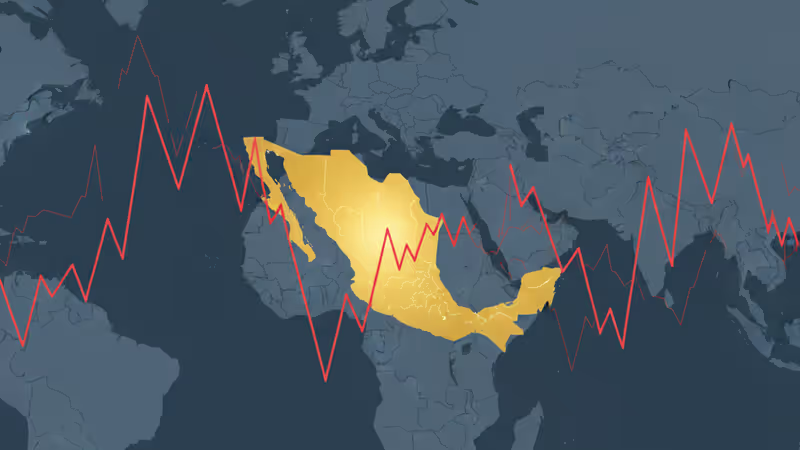
Mexico's Supermajority Shock: Sheinbaum's Mandate vs. Market Meltdown
Mexico's historic election gave Claudia Sheinbaum a powerful mandate, but spooked markets. Our analysis of the geopolitical risk for investors and nearshoring.
The Lede: A Landslide Mandate Meets a Wall of Worry
Mexico just delivered a historic landslide victory to President-elect Claudia Sheinbaum and her Morena party, handing them a potential congressional “supermajority.” For investors and global executives, this isn't just a political headline; it's a flashing red light on the dashboard. The subsequent market crash—with the peso and stock market plummeting—signals a fundamental clash between a powerful democratic mandate and the institutional stability required for global business. The core question now facing every company with exposure to Latin America's second-largest economy is stark: Will Mexico double down on the populist policies that spook investors, or will pragmatism prevail?
Why It Matters: The Nearshoring Dream at a Crossroads
The market panic goes far beyond currency fluctuations. At stake is the entire “nearshoring” thesis that has positioned Mexico as the primary beneficiary of US-China supply chain diversification. Billions in planned investments are predicated on a stable, predictable legal and regulatory framework. The prospect of a supermajority able to unilaterally amend the constitution raises critical risks:
- Institutional Erosion: The most controversial proposed reform—allowing popular election of Supreme Court justices—is seen by investors as a direct assault on judicial independence. This threatens the impartial rule of law, the bedrock of contract enforcement and investment protection.
- Regulatory Upheaval: Plans to dismantle autonomous regulators in sectors like energy and telecommunications could unwind years of market liberalization, reintroducing state interventionism and jeopardizing private and foreign capital.
- USMCA Jitters: With a mandatory review of the US-Mexico-Canada Agreement (USMCA) looming in 2026, any move that undermines investor protections or creates an uneven playing field could create significant friction with Washington, regardless of who occupies the White House.
The Analysis: The Ghost of AMLO's Unfinished Agenda
This market reaction isn't about Sheinbaum herself—a scientist with a reputation for being more data-driven than her populist predecessor, Andrés Manuel López Obrador (AMLO). Instead, the market is pricing in the risk that she will be forced, or politically inclined, to execute AMLO's most radical, unfulfilled ambitions. For six years, a divided congress acted as a crucial check on his power, blocking these very constitutional changes. The election has potentially removed that barrier.
Sheinbaum's administration now faces a classic emerging market dilemma. On one hand, she has an undeniable mandate from over 35 million voters to deepen the “Fourth Transformation”—a political project focused on social programs and state power. On the other, the sharp, immediate rebuke from global markets demonstrates the economic constraints she operates under. Her initial moves, such as retaining the current finance minister and promising central bank autonomy, are classic signals designed to calm nerves. However, her simultaneous push for a “broad survey” on judicial reform is seen by skeptics as political theater—a way to legitimize a predetermined outcome rather than a genuine consultation.
PRISM Insight: The September Cliff
For investors and policymakers, the calendar is now critical. The new Congress takes office on September 1st, a full month before Sheinbaum's inauguration on October 1st. This creates a dangerous lame-duck window where the new, Morena-dominated legislature could theoretically pass controversial reforms with the political backing of the outgoing President AMLO, presenting Sheinbaum with a fait accompli.
The key metric to watch is not just Sheinbaum's rhetoric, but the composition of her cabinet and the final seat count in Congress. If hardliners secure key economic and energy posts, it will signal a tilt towards ideology over pragmatism. Conversely, if technocrats are empowered, it may suggest an internal understanding of the need to maintain market confidence. The nearshoring investment boom is fueled by capital that is both massive and mobile; if the perception of political risk solidifies, that capital will find new homes in Southeast Asia or other Latin American nations.
PRISM's Take: A High-Stakes Balancing Act
President-elect Sheinbaum is navigating a political minefield. She must appease the populist base that gave her an overwhelming victory while simultaneously reassuring the global capital markets that Mexico needs for growth and stability. The market's visceral reaction was a warning shot, reminding the incoming government that even the strongest mandate is subject to economic gravity.
The dream of Mexico as the undisputed hub of 21st-century nearshoring hinges on institutional certainty. The first and most important test of the Sheinbaum era will be her handling of these constitutional reforms. Her choice is clear: either consolidate political power at the expense of institutional checks and balances, risking a flight of capital and confidence, or moderate her agenda to preserve the very framework that has made Mexico an investment magnet. The future of North American economic integration hangs in the balance.
相关文章

深度分析邦迪海灘恐怖攻擊如何衝擊澳洲的國家認同、多元文化主義,以及其在全球反猶太主義浪潮下的政治與立法應對。

教宗任命韓國水原教區新輔理主教。此舉不僅是人事變動,更揭示了梵蒂岡在東亞地緣政治中的長期戰略佈局與深層考量。

巴基斯坦前總理伊姆蘭汗在大選前夕再遭定罪。PRISM分析此案如何揭示軍方對政治的深度影響,以及對南亞地緣政治的潛在衝擊。

南京的GPS與北斗導航系統遭針對性干擾,揭示了全球對衛星定位的嚴重依賴與電子戰的現實威脅。這不僅是技術問題,更是地緣政治警訊。