
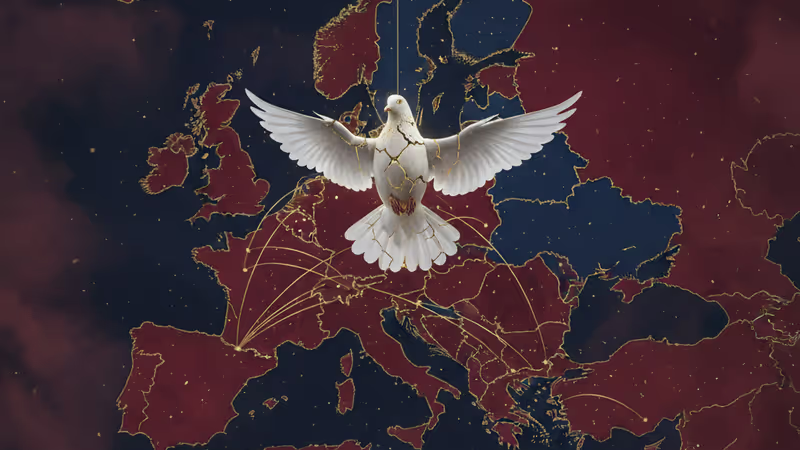
Zelensky Unveils 20-Point Peace Plan, Offers Potential Ukrainian Troop Withdrawal From East
Ukrainian President Volodymyr Zelensky has revealed a new 20-point peace plan, agreed with the U.S., that includes potential troop withdrawals from the east in exchange for strong Western security guarantees.
Could Ukraine trade territory for peace? President Volodymyr Zelensky has detailed a new 20-point peace plan that offers the potential withdrawal of Ukrainian troops from the east—a core demand from Moscow. The proposal could serve as a major framework for ending the war, but it contains sensitive concessions that could spark fierce domestic debate.
Nato-Style Guarantees and an 800,000-Strong Military
Describing the plan agreed with US negotiators in Florida over the weekend, Zelensky called it "the main framework for ending the war." It proposes robust security guarantees from the US, Nato, and Europeans, mirroring Nato membership with a coordinated military response if Russia were to invade again. Ukraine would also maintain a military strength of 800,000, Zelensky explained. Russia is expected to give its response after the Americans have spoken to them.
The Donbas Conundrum
The plan's most contentious element concerns the eastern Donbas region. Russia has long insisted that Ukraine pull its troops out of almost a quarter of the Donetsk region in exchange for a peace deal. While Zelensky said sensitive issues over territory would have to be resolved "at the leaders' level," he offered a potential alternative to a full withdrawal: a demilitarised zone or a "free economic zone."
There are two options: either the war continues, or something will have to be decided regarding all potential economic zones.
He emphasized that such a zone would also need to be established around the Zaporizhzhia nuclear power plant. In return, Russian troops would be required to pull out of four other Ukrainian regions: Dnipropetrovsk, Mykolaiv, Sumy, and Kharkiv.
本内容由AI根据原文进行摘要和分析。我们力求准确,但可能存在错误,建议核实原文。
相关文章

2025年成為巴基斯坦的轉捩點。透過與印度的軍事對峙,巴基斯坦重返國際舞台,改善與美國關係並擴大在中東的影響力。然而,國內經濟困境與政治僵局依然嚴峻。

中國對法國與日本的熊貓外交政策呈現明顯對比,反映出雙邊關係的溫度。本文深入剖析此現象,並揭示熊貓外交的起源可追溯至1941年的蔣介石,而非中共。

2026年明尼蘇達州長選舉,共和黨迎來勝選良機,但前總統川普的爭議言論與親信林德爾的參選,恐將反成敗筆。本文深入剖析共和黨內部的路線分歧與戰略困境。
據報導,巴西正計畫對中國的觀光及商務旅客實施免簽證,預計於2026年初宣布。此舉旨在回應中國的單方面免簽措施,並深化與其最大貿易夥伴的關係。
2025年成為巴基斯坦的轉捩點。透過與印度的軍事對峙,巴基斯坦重返國際舞台,改善與美國關係並擴大在中東的影響力。然而,國內經濟困境與政治僵局依然嚴峻。
中國對法國與日本的熊貓外交政策呈現明顯對比,反映出雙邊關係的溫度。本文深入剖析此現象,並揭示熊貓外交的起源可追溯至1941年的蔣介石,而非中共。
2026年明尼蘇達州長選舉,共和黨迎來勝選良機,但前總統川普的爭議言論與親信林德爾的參選,恐將反成敗筆。本文深入剖析共和黨內部的路線分歧與戰略困境。
據報導,巴西正計畫對中國的觀光及商務旅客實施免簽證,預計於2026年初宣布。此舉旨在回應中國的單方面免簽措施,並深化與其最大貿易夥伴的關係。