
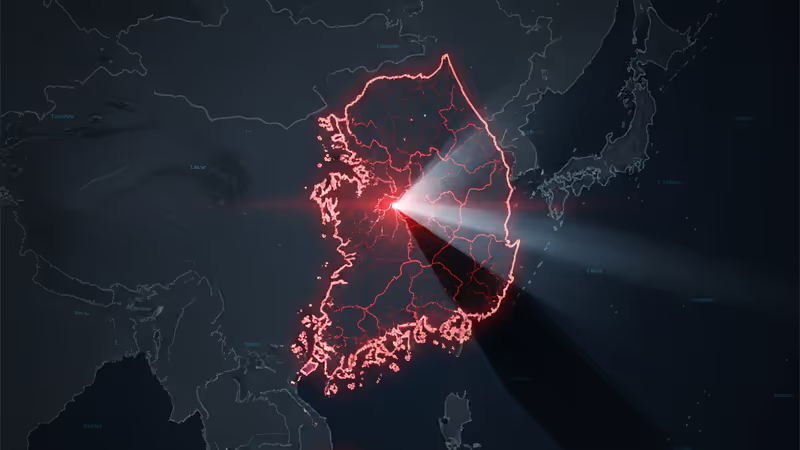
Korea's Presidential Curse: Why the Yoon Probe Signals a Deeper System Failure
Analysis of the corruption probe into former South Korean President Yoon Suk Yeol, exploring the geopolitical risk and systemic political failures it represents.
The Lede: Beyond the Headlines
A former president of a G10 economy and a critical U.S. ally, Yoon Suk Yeol, is now a suspect in a widening corruption probe. For global executives and strategists, this is more than just domestic political theater. It's a flashing red light for sovereign risk in one of the world's most critical tech and manufacturing hubs. The investigation into Yoon and his wife is the latest chapter in South Korea's long history of post-presidency political retribution, a cycle that threatens to paralyze policymaking and create significant uncertainty for international partners and investors.
Why It Matters: The Ripple Effects of Political Instability
The constant specter of investigations against former leaders has profound second-order effects that extend far beyond Seoul's political arena:
- Policy Paralysis: When administrations dedicate significant political capital to investigating predecessors, long-term economic and national security strategies suffer. This creates a volatile environment where policy can swing dramatically from one government to the next, impacting everything from trade agreements to technology regulations.
- Erosion of Institutional Trust: This seemingly endless cycle of accusations and trials deepens public cynicism toward government. This can undermine the state's ability to implement critical reforms and creates fertile ground for populist movements that could further destabilize the political landscape.
- Geopolitical Distraction: For a nation on the front line of tensions with North Korea and a key player in the U.S.-China rivalry, internal political turmoil is a critical distraction. A government consumed by domestic scandal is a less reliable and focused partner on the global stage.
The Analysis: A System Designed for Conflict
This is not an isolated event but a recurring symptom of South Korea's political structure. The nation's democratic journey has been remarkable, but it retains a highly centralized, “imperial presidency” where the winner-take-all system concentrates immense power in the executive branch. This has several consequences:
- The "Presidential Curse": Virtually every living former South Korean president has faced investigation or imprisonment after leaving office. This includes Park Geun-hye (impeached and jailed), Lee Myung-bak (jailed for bribery), and others. Yoon's case fits a well-established and destructive pattern.
- Weaponization of Justice: The powerful special counsel system, while intended to ensure accountability, is often perceived as a tool for political revenge by the party in power. This creates a vicious cycle where each new administration feels compelled to investigate the last, perpetuating instability.
- Chaebol Entanglement: The allegations, often involving favors and gifts, highlight the historically cozy and often corrupt relationship between political power and South Korea's family-run industrial conglomerates (chaebols). These scandals reveal the persistent difficulty in untangling corporate influence from state governance.
PRISM Insight: The GovTech Imperative
The cyclical nature of these corruption scandals exposes a massive market failure that technology can address. The core issue is a lack of systemic transparency and accountability. This points to a significant opportunity for 'GovTech' solutions. Imagine AI-powered auditing systems that can flag conflicts of interest in government contracts in real-time, or blockchain-based ledgers for political donations that are immutable and transparent. For investors, this crisis is a powerful use case highlighting the urgent need for technologies that build institutional trust. The recurring political risk in Korea should compel investment firms to adopt more sophisticated risk models that weigh these unique governance challenges alongside economic indicators.
PRISM's Take: A Stress Test for Democracy
The investigation into Yoon Suk Yeol presents a paradox. On one hand, it demonstrates that South Korea's democratic institutions are robust enough to hold even the most powerful individuals accountable—a standard many Western nations struggle to meet. No one is above the law.
On the other hand, it confirms that the political system is trapped in a debilitating cycle of retribution that cripples governance. The problem is not just the alleged actions of one individual, but the very architecture of power that makes such scandals almost inevitable. Without fundamental constitutional reform to decentralize executive power and foster a more collaborative political culture, South Korea will remain a high-performing economic powerhouse built on a foundation of political quicksand. Global stakeholders must factor this inherent volatility into their strategic calculus for the region.
相关文章

美國呼籲蘇丹停火,揭示了一場由阿聯、埃及等中東強權驅動的代理人戰爭。PRISM深度分析其地緣政治影響及華盛頓面臨的外交兩難。

加薩在戰後首次恢復聖誕慶祝,這不僅是文化韌性的象徵,更是衡量脆弱和平與國際重建努力成敗的地緣政治指標。

分析紐約州眾議員史提芬尼克放棄競選州長的戰略決定,揭示其在共和黨內的權力佈局以及對美國政治未來的深遠影響。

日本宣布對中亞五國提供190億美元商業目標,旨在確保關鍵礦產供應鏈、抗衡中俄影響力,並在地緣政治新棋局中開闢第三條路。