

K-Pop's Billion-Dollar Blind Spot: Why the Industry's Colorism is a Ticking Time Bomb
K-Pop's colorism controversy isn't just fan debate; it's a multi-billion dollar risk. Our analysis on why this beauty standard threatens the industry's future.
The Unbleaching of Hallyu
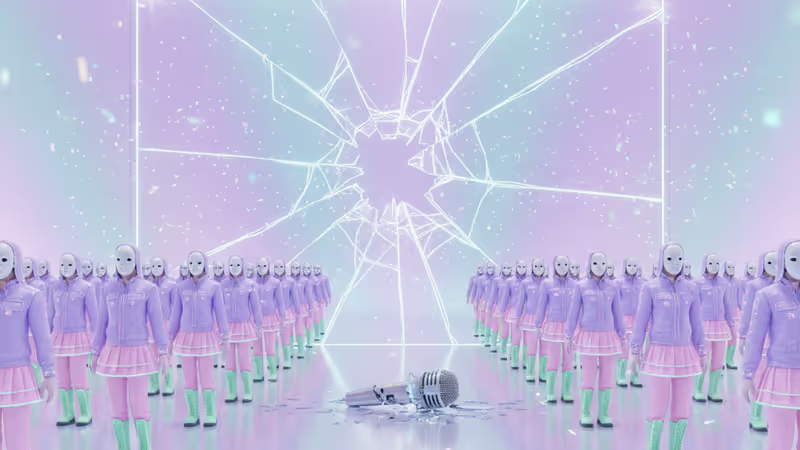
Recent social media firestorms surrounding the perceived skin tones of stars like aespa’s Karina and IVE’s Liz are not mere fan squabbles. For any executive invested in the global culture economy, these are critical data points signaling a foundational risk to K-Pop’s multi-billion dollar empire. The industry’s deeply entrenched domestic beauty standard—an almost ethereal paleness—is now in direct conflict with the diverse, global audience that fuels its growth. This isn't a PR issue; it's a market-limiting crisis in the making.
Why It Matters
The disconnect between a localized aesthetic and a globalized consumer base creates significant, second-order effects that threaten both the music and beauty sectors that form the bedrock of the 'Hallyu' (Korean Wave) phenomenon.
The Global Fanbase Paradox
K-Pop's exponential growth is driven by markets in Southeast Asia, Latin America, and North America, regions where its fanbase is overwhelmingly non-white. By perpetuating a single, narrow beauty ideal through aggressive photo editing, makeup, and lighting, agencies risk alienating the very consumers they depend on. This can manifest as:
- Brand Decay: Vocal fan campaigns against 'whitewashing' can tarnish a group's reputation and lead to boycotts.
- Market Stagnation: The inability to reflect audience diversity can cap growth in new and emerging markets.
- Talent Mismatch: It puts immense pressure on idols, including those of Korean or other Asian descent with naturally darker skin tones, to conform to an often unattainable and unhealthy standard.
The K-Beauty Symbiosis
The K-Beauty industry, a $10 billion-plus market, is inextricably linked to K-Pop. Idols are its most powerful ambassadors. For years, 'whitening' products were a core offering. While many brands have pivoted to the softer term 'brightening', the underlying marketing still promotes a singular vision of beauty. As global consumers, particularly Gen Z, increasingly champion authenticity and inclusivity, this core tenet of K-Beauty becomes a liability.
The Analysis
To understand the current crisis, one must look beyond the stage lights. This isn't a new phenomenon but a deeply rooted cultural preference now clashing with 21st-century globalism.
The Echoes of History
The preference for pale skin in Korea, and much of East Asia, predates K-Pop by centuries. Historically, it was a class signifier, distinguishing the wealthy elite who didn't perform manual labor in the sun from the working class. This historical bias was later compounded by Western colonial influences. What K-Pop did was codify and export this standard on an industrial scale, packaging it as an aspirational, modern ideal.
A Competitive Standoff
The major entertainment agencies (HYBE, SM, JYP, YG) are in a strategic standoff. Deviating from the established norm is a risk. Will domestic fans, still a core market, react negatively? Yet, failing to adapt to global expectations is a greater long-term risk. Currently, the industry standard remains conservative, with 'whitewashing' of official photos and videos a common practice. However, the proliferation of unedited fan-taken photos creates a constant, jarring comparison that fuels the debate and exposes the artifice.
PRISM Insight
The Transparency Arms Race: AI vs. The Filter
The key battleground for this issue is technology. For years, technology has been the primary tool of enforcement—Photoshop, advanced camera filters, and sophisticated stage lighting all work to create and maintain the pale-skin aesthetic. Now, technology is becoming the tool of rebellion. High-definition fancams, social media algorithms that rapidly amplify dissent, and even nascent AI-powered tools that can detect image manipulation are creating a new era of radical transparency. The investment implication is clear: investors must begin to factor in 'Authenticity Risk' when evaluating entertainment and beauty stocks. Companies that lag on adapting to inclusive standards face ESG-related valuation pressures, while those who successfully pivot will unlock a wider, more loyal global market.
PRISM's Take
The 'unbleaching' of K-Pop is inevitable. The current controversies are the early tremors of a major industry-wide seismic shift. The question is not if the industry will adapt, but who will have the foresight to lead. The agencies and brands that continue to sell a manufactured, homogenous ideal will find their influence wane as their global audience demands to see themselves reflected in the culture they consume and celebrate. The future of Hallyu belongs not to those who can create the most flawless illusion, but to those who have the courage to embrace reality. Authenticity is no longer a buzzword; it is the next strategic frontier.
相关文章

HYBE創辦人房時爀遭金融監管機構突擊搜查,揭示了K-Pop巨頭背後的關鍵人物風險與公司治理危機。此事件對投資者與產業發出警訊。

SHINee Key因一則遲來的悼念文引發爭議。本文深度分析事件背後的粉絲文化、公關危機,以及偶像在數位時代面臨的真實性挑戰。

P.O.出演《HEARTMAN》揭示了韓娛的「偶像演員」成功公式。這不只是選角,而是結合粉絲經濟與IP價值的票房策略。
前SNH48成員揭露經紀公司合約黑幕,引爆中國娛樂圈。本文深度分析偶像產業的系統性剝削,及其對K-Pop和全球粉絲的啟示。