
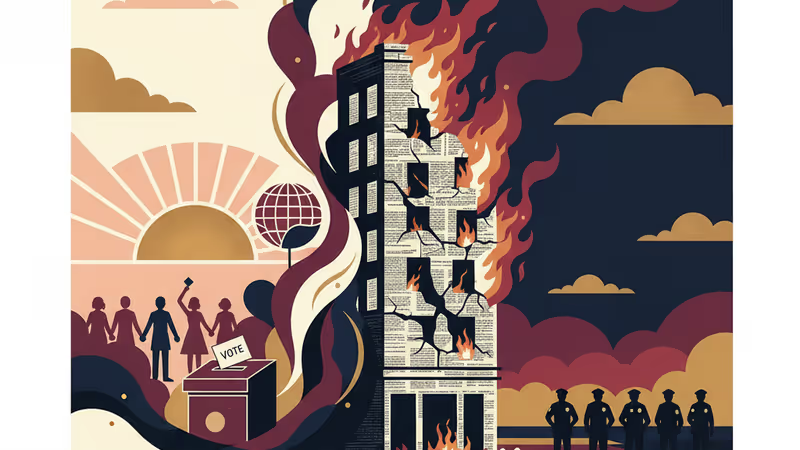
Anarchy in Dhaka: Assassination Unleashes Mob Violence as Bangladesh's Government Stands By
Following the assassination of politician Sharif Osman Hadi, Bangladesh's capital, Dhaka, has descended into violence. The interim government's failure to stop attacks on media outlets raises questions of complicity and state failure.
The assassination of a rising political figure, Sharif Osman Hadi, has plunged Bangladesh's capital into chaos. But the riots that erupted following his death on December 18 weren't the most alarming part. As organized mobs burned down media offices with journalists trapped inside, the interim government led by Dr. Muhammad Yunus and its security forces conspicuously failed to act, revealing a profound crisis of state responsibility and pushing the nation towards anarchy.
A Predictable Inferno, An Inactive State
The violence was neither spontaneous nor sudden. According to observers, it was the expected culmination of months of rising tension. Right-wing groups, including Chhatra Shibir—the student wing of Bangladesh's largest Islamist party, Jamaat-e-Islami (BJI)—had openly called for the shutdown of the targeted newspapers. Their plans to attack were reportedly an "open secret," yet the government took no preventative measures.
Even after attackers set the Prothom Alo building ablaze, they were allowed to march unimpeded to the Daily Star office. Journalists were forced to shelter on the roof for hours as the mob below blocked the army, police, and fire services from entering. Security forces, eyewitnesses said, appeared to be mere spectators.
Selective Inaction and Political Calculation
Critics argue the interim government's inaction isn't a sign of incapacity, but a conscious political choice. The Yunus administration has demonstrated it can act decisively when it wants to, particularly against its critics. Respected journalist Anis Alamgir was recently arrested under anti-terrorism laws for criticizing the government. Meanwhile, leftist protestors and teachers pressing for legitimate demands have been brutally dispersed by police.
This stark contrast—swift action against dissidents versus passivity towards violent mobs—leads to an unsettling conclusion: the interim government appears to have deliberately chosen not to intervene. This absence of punishment has normalized violence and sent a clear message: the state will not protect media and cultural institutions from its political allies. If crimes go unpunished, violence becomes the norm.
The crisis in Bangladesh transcends a simple breakdown of law and order; it's spiraling into a crisis of state legitimacy. Allowing such violence to go unchecked may offer short-term political advantages for certain factions, but it guarantees the long-term erosion of the rule of law and public trust. This instability has a direct effect on regional security in South Asia. A state that watches a media building burn with journalists inside loses the moral authority to govern.
Questions also swirl around Hadi's assassination itself. The killers, who struck in broad daylight, remain at large. Allegations have surfaced that the assassins escaped to India, but the government has reportedly not issued a request for cooperation or even alerted its border guards. This lack of interest suggests the government may not want the assassins found. Hadi's death and the ensuing violence stand as a damning indictment of the Bangladeshi state's failure.
本内容由AI根据原文进行摘要和分析。我们力求准确,但可能存在错误,建议核实原文。
相关文章

美國重要保守派智庫「傳統基金會」爆發員工離職潮,超過十數名員工出走。事件核心是圍繞右翼網紅所引發的路線之爭,凸顯美國保守主義運動面臨的深刻內部分裂。

南韓執政黨共同民主黨突然同意啟動「統一教」特檢調查,結束了朝野長期的政治對峙。在強大民意支持下,一場可能動搖政壇的全面調查即將展開,揭露宗教組織與政界間的複雜關係。

擁有近兩千年歷史的加薩大奧馬里清真寺在衝突中化為廢墟。本文探討此一文化遺產的歷史價值,並分析武裝衝突中破壞文化古蹟的深遠影響與國際爭議。

2025年即將結束,美國國會立法成果乏善可陳,議員退休潮卻日益加劇。多位前國會議員對此發出警告,直指國會運作已陷入「昏迷狀態」,並認為這些根深蒂固的問題已醞釀多年。