
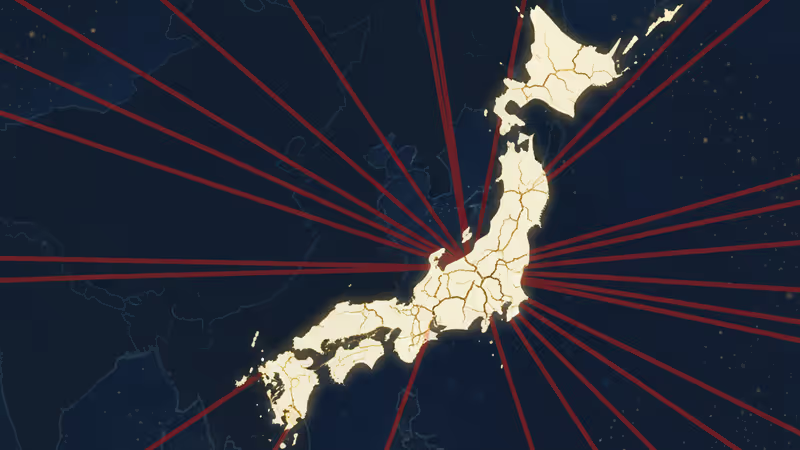
China's Okinawa Gambit: How Xi Jinping's Historical Claims Challenge the U.S.-Japan Alliance
Xi Jinping's historical comments on Okinawa (Ryukyu) are escalating geopolitical tensions. An analysis of how China's sovereignty claims challenge the U.S.-Japan alliance and America's Pacific strategy.
A quiet comment from China's leader is sending geopolitical shockwaves across East Asia. When President Xi Jinping referenced the 'deep connections' between China and Okinawa (the former Ryukyu Kingdom), he wasn't just reminiscing. This move has elevated a dormant sovereignty issue into a strategic challenge aimed at the heart of the U.S.-Japan alliance. It's widely seen as a calculated response to Japan’s hardening stance on Taiwan and an attempt to unsettle America's foundational strategy in the Indo-Pacific.
A Centuries-Old Sovereignty Game
The remarks Xi made at a Beijing archive on June 4, 2023, are rooted in a tributary relationship between the Ryukyu Kingdom and China's Ming Empire dating back to the late 14th century. While Ryukyu prospered as a privileged trade intermediary, its status shifted dramatically in 1609 after an invasion by Japan's Satsuma Domain, forcing it into a state of dual subordination to both China and Japan. This arrangement ended in the late 19th century when, following the Meiji Restoration, Japan formally annexed the islands. China's consistent position has been that while it never directly administered Ryukyu, the kingdom remained a tributary state within its sphere of influence—the historical basis for Beijing's modern claims.
Beijing's Playbook: Gray-Zone Pressure and Disinformation
Japan's political establishment was immediately alarmed by Xi's 'unprecedented' comments. This move aligns with China's 'Ryukyu Undetermined Status Theory,' which argues the 1951 San Francisco Peace Treaty didn't validate Japan's claim on Okinawa. Rather than direct confrontation, Beijing is employing gray-zone tactics, such as disinformation campaigns that indirectly support pro-Okinawan independence movements. Analysts at Japan's National Institute for Defense Studies (NIDS) warn of a strategy with 'no boundary between China’s peace and wartime actions.' In its 2025 Defense White Paper, Tokyo identified China as an 'unprecedented and the greatest strategic challenge.'
An Alliance Under Strain
Okinawa has been the linchpin of U.S. forward presence in the Pacific since 1945. More than 70 percent of the U.S. military presence in Japan is concentrated on the island, which makes up less than 1 percent of Japan's landmass. This concentration is a persistent source of local friction—a vulnerability China readily exploits. Beijing's gambit is further emboldened by a perceived wavering of Washington's commitment to its allies. Renewed demands for increased burden-sharing from the second Donald Trump administration have raised doubts about the durability of the U.S.-Japan security treaty. Ultimately, China'sOkinawa strategy isn't just a challenge to Japanese sovereignty; it's a long-term play to undermine the very foundation of the security order in Northeast Asia.
本内容由AI根据原文进行摘要和分析。我们力求准确,但可能存在错误,建议核实原文。
相关文章
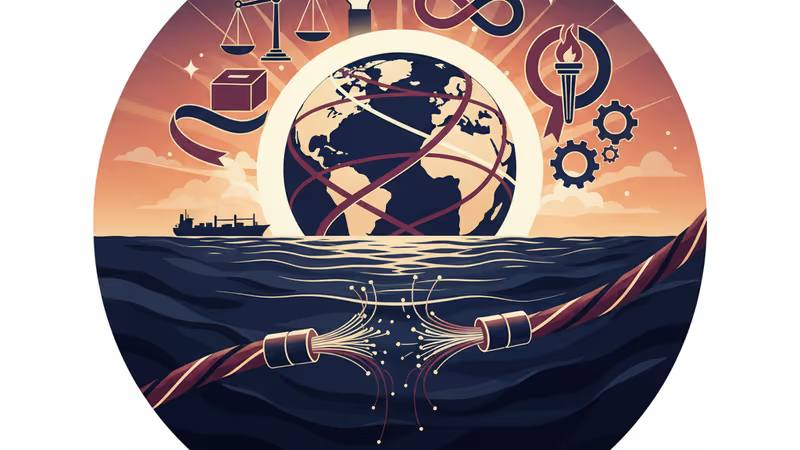
台灣海底電纜斷裂事件出現驚人轉折。中國指控兩名台灣人主導走私導致電纜損壞,並發出懸賞。台灣駁斥為「跨境鎮壓」,兩岸緊張關係再度升級。PRISM深入解析事件背後的角力。

奈及利亞東北部博爾諾州首府邁杜古利一處清真寺驚傳爆炸。攻擊發生於晚禱期間,據報已造成至少7人死亡。該地區為激進組織博科聖地的活動中心,安全情勢再度引發關注。

美國當局發現超過一百萬份與已故富豪艾普斯坦案相關的新文件。根據川普總統簽署的《艾普斯坦檔案透明法》,司法部律師正進行審查,保護受害者身份後,預計在未來數週內公布。

2025年成為巴基斯坦的轉捩點。透過與印度的軍事對峙,巴基斯坦重返國際舞台,改善與美國關係並擴大在中東的影響力。然而,國內經濟困境與政治僵局依然嚴峻。
台灣海底電纜斷裂事件出現驚人轉折。中國指控兩名台灣人主導走私導致電纜損壞,並發出懸賞。台灣駁斥為「跨境鎮壓」,兩岸緊張關係再度升級。PRISM深入解析事件背後的角力。
奈及利亞東北部博爾諾州首府邁杜古利一處清真寺驚傳爆炸。攻擊發生於晚禱期間,據報已造成至少7人死亡。該地區為激進組織博科聖地的活動中心,安全情勢再度引發關注。
美國當局發現超過一百萬份與已故富豪艾普斯坦案相關的新文件。根據川普總統簽署的《艾普斯坦檔案透明法》,司法部律師正進行審查,保護受害者身份後,預計在未來數週內公布。
2025年成為巴基斯坦的轉捩點。透過與印度的軍事對峙,巴基斯坦重返國際舞台,改善與美國關係並擴大在中東的影響力。然而,國內經濟困境與政治僵局依然嚴峻。