
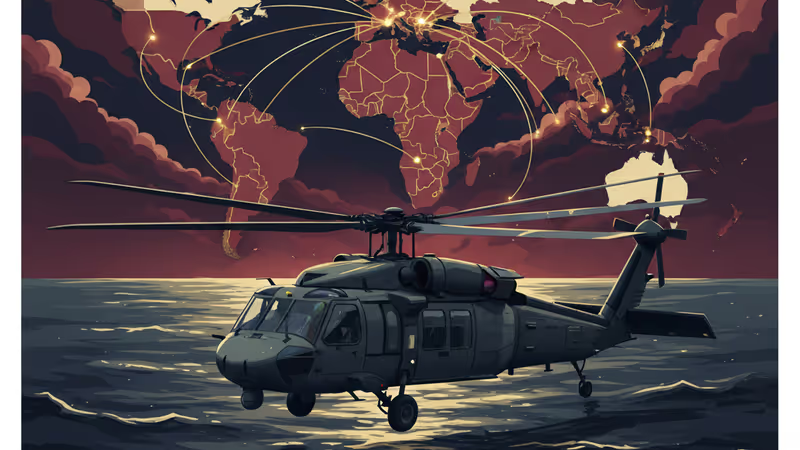
Indian Navy Deploys MH-60R 'Flying Frigates,' But Budget Cuts Hobble Drone Surveillance Plans
The Indian Navy is boosting its combat power with new MH-60R Romeo helicopters but is scaling back plans to acquire MQ-9B Sea Guardian drones due to budget issues.
The Indian Navy's combat aviation power is getting a major boost, but its ambitions for wide-area surveillance are being scaled back. While India recently commissioned a second squadron of advanced Sikorsky MH-60R Romeo helicopters, its plans to acquire a fleet of maritime surveillance drones from the U.S. have been sharply reduced due to budget constraints.
A 'Flying Frigate' Fills a Decades-Old Gap
Last week, the navy announced the commissioning of Indian Naval Air Squadron 335 (INAS 335), nicknamed the "Ospreys," at the INS Hansa naval air base in Goa. This is the second squadron to operate the MH-60R Romeo, following the first unit, INAS 334, based in Kochi. The induction is a major relief, addressing a critical operational shortfall caused by the attrition of its aging Seaking 42B/C fleet. Often called "flying frigates," the MH-60R is equipped for diverse missions, including anti-submarine warfare, anti-surface warfare, and search and rescue.
Eyes in the Sky Grounded by Budget Reality
In sharp contrast to the helicopter fleet's expansion, plans for maritime surveillance assets are facing headwinds. India's initial plan to acquire 22MQ-9B Sea Guardian unmanned aerial systems (UAS) from the U.S. in a deal worth an estimated $2 billion has reportedly been pared down to just 10 drones. The Sea Guardian, with an endurance of 24-36 hours, was expected to be a cornerstone of surveillance over the vast Indian Ocean Region (IOR).
The navy's long-range maritime reconnaissance fleet of Boeing P-8I Poseidon aircraft is facing similar cuts. A plan to expand the fleet from 12 to 28 aircraft has been revised, with the navy now expected to acquire only 8-10 more, capping the total fleet size at 20-22. This is seen as a direct consequence of a declining real capital budget for defense.
Alliance with the U.S. and Burden Sharing
These defense acquisitions are being pursued through the U.S. Department of Defense's Foreign Military Sales (FMS) program. Under FMS, the Pentagon acts as an agent for the buyer, negotiating terms with vendors and providing U.S. government guarantees on price and performance. This procurement model is part of a broader strategic alignment where India is increasingly sharing the cost and operational effort of maintaining maritime security in the IOR alongside partners like the Malabar countries and the AUKUS nations.
本内容由AI根据原文进行摘要和分析。我们力求准确,但可能存在错误,建议核实原文。
相关文章
印度海軍正式啟用第二支MH-60R「羅密歐」直升機中隊以強化艦隊戰力,但受限於國防預算,其MQ-9B無人機與P-8I巡邏機的採購計畫規模被迫縮減。

2026年明尼蘇達州長選舉,共和黨迎來勝選良機,但前總統川普的爭議言論與親信林德爾的參選,恐將反成敗筆。本文深入剖析共和黨內部的路線分歧與戰略困境。
據報導,巴西正計畫對中國的觀光及商務旅客實施免簽證,預計於2026年初宣布。此舉旨在回應中國的單方面免簽措施,並深化與其最大貿易夥伴的關係。

阿爾及利亞國會無異議通過立法,將法國長達132年的殖民統治宣告為「犯罪」,並正式要求道歉與賠償,為兩國緊張關係再添變數。
印度海軍正式啟用第二支MH-60R「羅密歐」直升機中隊以強化艦隊戰力,但受限於國防預算,其MQ-9B無人機與P-8I巡邏機的採購計畫規模被迫縮減。
2026年明尼蘇達州長選舉,共和黨迎來勝選良機,但前總統川普的爭議言論與親信林德爾的參選,恐將反成敗筆。本文深入剖析共和黨內部的路線分歧與戰略困境。
據報導,巴西正計畫對中國的觀光及商務旅客實施免簽證,預計於2026年初宣布。此舉旨在回應中國的單方面免簽措施,並深化與其最大貿易夥伴的關係。
阿爾及利亞國會無異議通過立法,將法國長達132年的殖民統治宣告為「犯罪」,並正式要求道歉與賠償,為兩國緊張關係再添變數。