
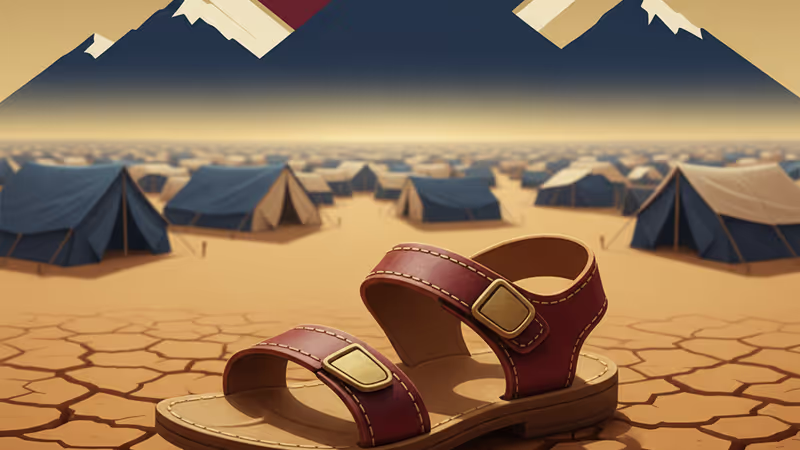
Sudan's Forgotten Crisis: A Doctor's Dispatch from a Camp That Grew 500% in Two Weeks
In December 2025, a displacement camp in al-Dabba, Sudan, swelled from 2,000 to over 10,000 people in two weeks. A doctor’s firsthand account reveals the human cost of the world’s largest, yet forgotten, humanitarian crisis.
In the first two weeks of `stat(December 2025)`, the population of an internally displaced persons (IDP) camp in al-Dabba, `keyword(Sudan)`'s Northern State, exploded from `stat(2,000)` to over `stat(10,000)`, according to a harrowing first-person account from Dr. Nabiha Islam, a physician volunteering in the `area`. The surge, driven by families fleeing intense fighting in cities like el-Fasher between the `keyword(Sudanese)` army and the paramilitary Rapid Support Forces (RSF), is stretching already scarce resources—food, water, and medicine—to a breaking point.
Portraits of Loss and Survival
Dr. Islam’s report highlights the profound human cost of the conflict through the stories of those she treated. She met Fatima, a `stat(15-year-old)` girl who was `stat(10 weeks)` pregnant after being raped. It had taken her `stat(21 days)` to flee el-Fasher. Another patient, Aisha, a mother of five who had lost her husband on the journey, was suffering from severe anemia but hesitated to leave her traumatized children for a necessary blood transfusion.
Perhaps most devastating was the story of Khadija. After witnessing her husband's murder, she fled on foot with three young children. Her youngest died of malnutrition en route. Then, after hitching a ride, a motor vehicle accident killed her second child. She arrived at the camp `stat(36 weeks)` pregnant, with only her eldest son surviving.
Resilience Amid the Ruins
Despite the overwhelming despair, Dr. Islam repeatedly witnessed what she described as the "courage, generosity, and selflessness" of the `keyword(Sudanese)` people. She describes an elderly woman, Auntie Najwa, who freely offered her prayer mat—one of her few possessions—to anyone in need. Her translator, Ahmed, had moved his family to safety in `keyword(Egypt)` at the war's start in `stat(2023)` but chose to return to `keyword(Sudan)` to continue his humanitarian work, a story of sacrifice she heard over and over from local staff.
A Global Blind Spot
The physician’s account serves as a stark reminder that behind the statistics lies immeasurable personal tragedy. Dr. Islam concludes with a powerful indictment of the international community's inaction. "I don’t know where the solutions lie," she writes. "But I do know we, as an international community, have failed `keyword(Sudan)` and its people over and over again... We can do better. We must do better." Her dispatch is a desperate call to look beyond geopolitical headlines and focus on the human reality of a deeply underreported crisis.
`keyword(Sudan)`'s crisis highlights a severe disconnect between humanitarian scale and global attention. As the world's largest displacement crisis, its failure to capture sustained media coverage and funding reveals how geopolitical priorities and 'crisis fatigue' can leave millions in a state of catastrophic neglect.
本内容由AI根据原文进行摘要和分析。我们力求准确,但可能存在错误,建议核实原文。
相关文章

全球地緣政治緊張局勢加劇。本文報導俄羅斯對烏克蘭的致命導彈襲擊、以色列防長對加薩的強硬表態,以及敘利亞、委內瑞拉等地的最新動態。
美國CBS新聞網王牌節目《60分鐘》臨時撤下一則關於薩爾瓦多爭議監獄的報導,引發軒然大波。內部人士指控母公司為討好川普政府而進行政治審查,正值其競購華納兄弟探索之際,新聞自由面臨嚴峻考驗。
美國貿易代表署(USTR)認定中國半導體產業政策具歧視性,對美國商業構成威脅,因此宣布將實施新關稅。初始稅率為0%,預計於2027年6月起調升。

加薩衛生官員警告,由於以色列封鎖,當地醫療系統瀕臨崩潰。近四分之三的藥品短缺,兩萬名患者等待轉診治療,已有上千人在等待中死亡。本文深入剖析這場人道危機。