
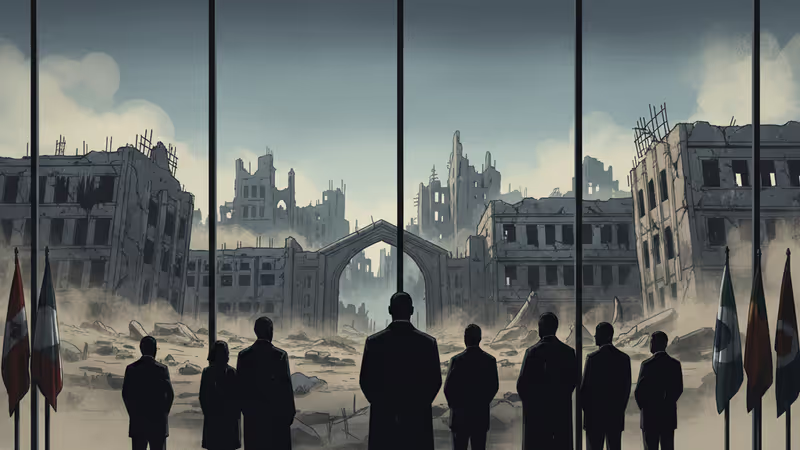
Gaza's Ghost Universities: The Geopolitics of Educational Erasure
The return to Gaza's destroyed universities is not just about resilience. It's a look at 'scholasticide'—the geopolitics of educational erasure and its global impact.
The Lede: Beyond the Rubble, a Battle for Human Capital
While images of students returning to the ruins of Gaza’s Islamic University offer a fleeting glimpse of resilience, the reality on the ground signals a far more profound geopolitical event. This is not merely a humanitarian crisis; it is the systematic dismantling of a society's future intellectual infrastructure. For global leaders and executives, the core issue is not just the destruction of buildings, but the strategic erasure of human capital. The long-term stability of the Middle East, future economic partnerships, and the very potential for a self-sustaining Palestinian state are being decided now, not in ceasefire talks, but in these hollowed-out lecture halls.
Why It Matters: The High Cost of a Lost Generation
The obliteration of Gaza's educational system creates cascading consequences with global reach. The immediate impact is the loss of two academic years for over 750,000 students, but the second-order effects are more severe:
- Brain Drain & Skills Vacuum: A generation deprived of higher education cannot produce the doctors, engineers, programmers, and administrators required to rebuild a shattered society. This guarantees long-term dependency on international aid and creates a governance vacuum, a fertile ground for radicalization and perpetual instability that will inevitably spill beyond Gaza's borders.
- Erosion of Institutional Memory: The destruction of universities like Isra University and the Islamic University of Gaza, along with the killing of over 150 academics, wipes out decades of localized research, cultural archives, and institutional knowledge. This is a targeted blow against a people's ability to self-define and innovate.
- Setting a Precedent: The international community's response to what UN experts have labeled "scholasticide"—the deliberate destruction of an education system—sets a dangerous precedent for future conflicts. If targeting centres of learning becomes an accepted, or at least unpunished, tactic of modern warfare, no nation's intellectual capital is truly safe.
The Analysis: 'Scholasticide' as a Strategic Doctrine
The term "scholasticide" moves the conversation from collateral damage to strategic intent. Historically, the targeting of cultural and educational institutions has been a hallmark of campaigns aimed at subjugating a population. The destruction of libraries and universities in Iraq and Syria by ISIS served a similar purpose: to erase history and impose a new, totalitarian order. In the context of Gaza, the destruction appears systematic.
Israeli military statements have often justified strikes on universities by alleging they were used by militant groups for operational purposes. While this perspective must be considered, it demands scrutiny under the principles of proportionality and distinction in international law. The demolition of Isra University, Gaza's last intact university, by Israeli forces in January 2024—an act captured on video—raises critical questions about military necessity versus the long-term, devastating impact of rendering an entire territory's higher education system non-functional. The strategic outcome is undeniable: a crippled society, incapable of intellectual or economic autonomy for a generation or more.
PRISM Insight: Tech's Double-Edged Sword in Post-Conflict Education
The crisis in Gaza presents a critical test case for the role of technology in disaster recovery and education. While the immediate focus is on physical reconstruction, the digital front is where the future of Gaza's knowledge economy will be won or lost. Investment and innovation should be focused on:
- Decentralized Digital Archives: The loss of physical libraries and university records highlights the urgent need for cloud-based, decentralized platforms to safeguard cultural and academic heritage from physical destruction. Blockchain-based solutions could ensure the immutability of academic credentials and archives.
- EdTech for Displaced Populations: While students like Youmna Albaba return to rubble, remote learning platforms offer a stop-gap. However, their efficacy is severely limited by the destruction of power grids, internet infrastructure, and a lack of personal devices. The challenge is not just content delivery, but creating a resilient, off-grid technological ecosystem for learning.
- Satellite-Driven Reconstruction Planning: High-resolution satellite imagery and AI analysis are crucial tools for objectively documenting the scale of educational infrastructure destruction. This data is vital not only for holding actors accountable but also for providing investors and international bodies with a clear roadmap for targeted, efficient reconstruction efforts.
PRISM's Take: The Future is an Intangible Asset
The return of students to a university that doubles as a refugee camp is a testament to human spirit, but it is not a solution. It is a symptom of a catastrophic failure of the international system to protect the fundamental right to education, especially during conflict. The story of Gaza's universities is a stark reminder that in the 21st century, the most valuable assets are intangible: knowledge, skills, and the capacity for innovation. Destroying these is not a tactic of war; it is a strategy to foreclose the possibility of a viable peace. For the global community, rebuilding Gaza cannot simply be about concrete and steel; it must be a concerted effort to restore the intellectual foundations that have been systematically targeted for erasure. The alternative is a black hole of instability in a region the world cannot afford to ignore.
相关文章

深度分析邦迪海灘恐怖攻擊如何衝擊澳洲的國家認同、多元文化主義,以及其在全球反猶太主義浪潮下的政治與立法應對。

教宗任命韓國水原教區新輔理主教。此舉不僅是人事變動,更揭示了梵蒂岡在東亞地緣政治中的長期戰略佈局與深層考量。

巴基斯坦前總理伊姆蘭汗在大選前夕再遭定罪。PRISM分析此案如何揭示軍方對政治的深度影響,以及對南亞地緣政治的潛在衝擊。

南京的GPS與北斗導航系統遭針對性干擾,揭示了全球對衛星定位的嚴重依賴與電子戰的現實威脅。這不僅是技術問題,更是地緣政治警訊。