
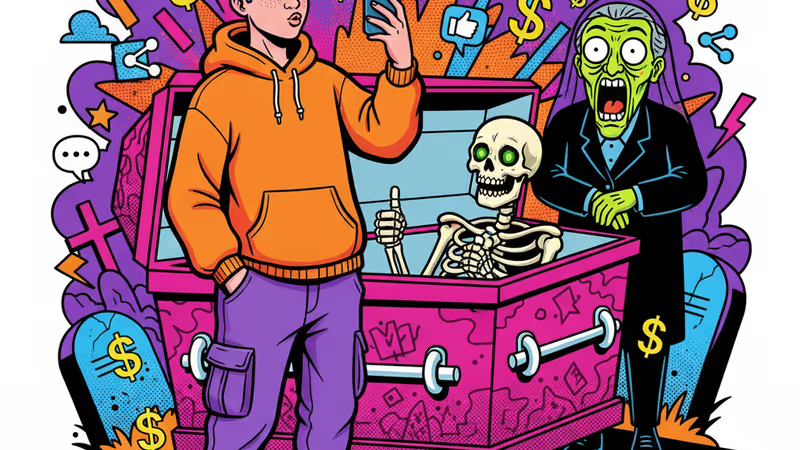
Context Collapse at the Casket: What Funeral Fails Reveal About the Future of the $20B Grief Economy
Viral funeral fails are more than jokes; they're market signals for the $20B grief economy. Discover how death-tech is disrupting tradition.
The Lede: Beyond the Viral Anecdote
Viral stories of funeral faux pas—from blasting Queen’s ‘Another One Bites the Dust’ to pallbearers dropping a (living) fainter—are more than just social media schadenfreude. For the strategic leader, they are critical data points signaling a seismic shift in societal norms. This breakdown of traditional decorum, accelerated by digital-native behaviors, reveals a fundamental decoupling from institutional ritual. This is a market signal: the multi-billion-dollar death care industry, and the tech platforms that shape our social lives, are failing to provide the tools for modern mourning. The resulting vacuum is creating a massive opportunity for disruption.
Why It Matters: The Experience Economy Meets Its End
The awkwardness captured in these stories stems from a collision of worlds: the solemn, prescribed rituals of the past crashing against the hyper-personalized, digitally-mediated expectations of the present. This has profound second-order effects:
- The End of One-Size-Fits-All Grief: The demand for a birthday balloon at a funeral or a laugh-out-loud moment of absurdity shows a clear market desire for personalization. The traditional, somber funeral home package is becoming as obsolete as the landline. This opens the door for 'Ritual-as-a-Service' (RaaS) platforms that offer bespoke memorial experiences.
- Platform Failure: Social media’s tools are blunt instruments. The same filters, check-ins, and music-sharing features designed for a party are being ineptly applied to a memorial service. This “context collapse” highlights a significant gap for specialized platforms or features designed with the nuance of grief in mind.
- Generational Disconnect as Market Inefficiency: What one generation sees as a profound lack of respect, another sees as an authentic, if clumsy, expression of self. This isn't just a culture war; it's a market inefficiency. The legacy death care industry is built on the values of its oldest customers, leaving younger demographics—and their future spending power—unserved.
The Analysis: Deconstructing Decorum
Historically, mourning rituals, from Victorian crepe to Irish wakes, provided a clear social script. They told participants how to behave, what to feel, and how to signal their role in the community of the bereaved. Today, that script is being deleted. Technology hasn't just provided new ways to be inappropriate; it has fundamentally altered our relationship with public versus private life, and with community itself.
The competitive landscape is shifting from physical presence to digital and emotional resonance. The legacy players—incumbents like Service Corporation International—compete on real estate and logistical scale. But a new wave of “death-tech” startups are competing on an entirely different axis: personalization, community-building, and digital legacy. Companies like GatheringUs (virtual memorial services), Eterneva (turning ashes into diamonds), and Cake (end-of-life planning) aren't just selling services; they're selling a new, more authentic script for the modern farewell.
PRISM Insight: The Rise of the Ambient Memorial
The key investment trend isn't just digitizing existing funeral services; it's creating entirely new paradigms for remembrance. The future is the 'Ambient Memorial'—a persistent, dynamic, and collaborative digital space that transcends a single event. This is the ultimate destination for our digital exhaust.
Imagine a private, curated social platform for the deceased's inner circle. AI tools could sort and tag a lifetime of photos and videos, generate a highlight reel, or even create an interactive chatbot trained on their writings. This isn't about a morbid sci-fi fantasy; it's about providing enduring, accessible, and managed connection. The investment thesis is clear: the most valuable real estate is no longer the cemetery plot, but the cloud server that hosts a person's digital soul. The opportunity lies in building the platforms that manage this new form of legacy with the dignity and nuance a Snapchat filter lacks.
PRISM's Take: From Faux Pas to Market Foresight
The man yelling "I'M ALIVE!" as he's carried out of a funeral is a perfect metaphor for the death care industry itself: it’s alive, but it’s being carried out by old customs and is desperately trying to signal that it's ready for a new reality. These viral moments of failed decorum are not aberrations. They are powerful, if chaotic, expressions of unmet market demand. They signal a deep human need to personalize one of our most profound rituals. The breakdown of old rules is clearing the ground for a new, tech-infused grief economy. The winners will not be those who try to enforce the old script, but those who provide the tools to write a new one.
相关文章

拜登在首場總統辯論中的災難性表現,引發民主黨內部恐慌與換人呼聲。PRISM深度分析這場政治地震如何影響市場、科技與全球格局。

日本壽司Sushiro在上海引爆排隊潮,揭示了中日政治冷、經濟熱的矛盾。PRISM深度分析消費者行為、軟實力與餐飲科技的真正力量。

一張C羅的半裸照片,揭示了運動員如何轉型為媒體巨頭與品牌CEO。PRISM深度分析其背後的商業策略、科技趨勢與投資啟示。

泰勒絲新紀錄片不僅揭露巡演秘辛,更展示其背後龐大的商業運作。從39秒換裝到品牌敘事,深度解析巨星經濟學的未來。