
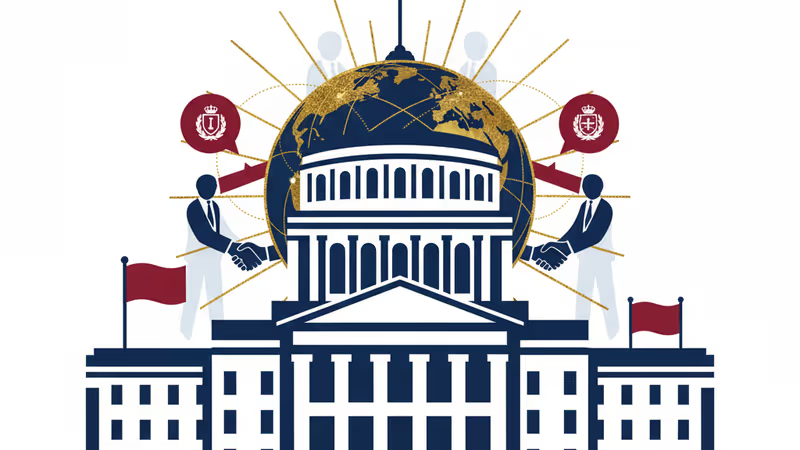
Congress Cages Trump's Foreign Policy in $901B Defense Bill
President Trump quietly signed a record defense bill, but its contents reveal a major policy clash with Congress over Ukraine aid and NATO, signaling deep US strategic uncertainty.
The Lede: A Silent Signature, A Resounding Message
President Trump signed a record $901 billion defense bill into law this week, but the real story isn't the historic price tag—it's the silence. The absence of a televised Oval Office ceremony speaks volumes. For global executives and strategists, this quiet act signals a profound and unstable rift in American power: a transactional President is being legislatively boxed in by a hawkish, institutional Congress. This isn't just a budget; it's a congressional cage built around an 'America First' foreign policy, creating significant uncertainty about the reliability and direction of the world's foremost military power.
Why It Matters: The Ripple Effects of a Divided Superpower
This legislative showdown creates a complex set of second-order effects for allies, adversaries, and industry alike.
- For European Allies: The bill is a short-term sigh of relief. By mandating troop levels, funding the Baltic Security Initiative, and pouring hundreds of millions into aid for Ukraine, Congress has provided a temporary bulwark against presidential whim. However, this reliance on annual legislation, rather than executive alignment, injects long-term volatility into strategic planning.
- For Russia: Moscow receives a dangerously mixed signal. While the President may be pursuing diplomatic negotiations, Congress is simultaneously writing checks to arm Ukraine and reinforce NATO's eastern flank. This duality complicates Russia's calculus, potentially leading to misinterpretation of US resolve.
- For the Defense Industry: The legislation is an unambiguous green light. The $901 billion authorization, which exceeds the White House's request, ensures robust funding for major procurement programs. The bill effectively serves as a roadmap for growth sectors for the coming fiscal year.
The Analysis: The Purse, The Power, and The Presidency
What we are witnessing is a classic constitutional power struggle between the executive and legislative branches, updated for an era of populist nationalism. For 65 consecutive years, Congress has passed the National Defense Authorization Act (NDAA), leveraging its “power of the purse” to shape foreign and military policy. This history gives the institution immense leverage.
Congress, with clear bipartisan consensus on this front, has used this must-pass bill to enforce a more traditional, interventionist American foreign policy. The message to the White House is clear: pursue your diplomatic tracks, but we will continue to fund the hard-power instruments of containment and deterrence. Trump’s previous NDAA veto in 2020, which Congress swiftly overrode, taught both sides a crucial lesson about the limits of presidential power when confronted with unified legislative opposition on national security.
The President's quiet signature represents a calculated political trade. In exchange for accepting provisions he deeply opposes—like aid to Ukraine and constraints on troop withdrawals from Europe—he secured funding for pet projects like the 'Golden Dome' missile defense system and achieved a key domestic policy goal: the elimination of diversity, equity, and inclusion programs at the Pentagon. It's a transactional victory within a strategic defeat.
PRISM Insight: Follow the Legislated Tech Vectors
Beneath the geopolitical drama lies a clear investment thesis. The NDAA is more than a policy document; it's a multi-year purchase order for the technologies that will define future conflict. The $800 million for the Ukraine Security Assistance Initiative will flow directly to US contractors specializing in the systems defining the modern battlefield: drones, advanced munitions, secure communications, and anti-armor systems. Furthermore, the explicit funding for advanced missile defense points to sustained, massive investment in next-generation interceptors, hypersonic tracking sensors, and the AI-driven command-and-control networks required to manage them. The bill legislates demand for a fully networked, AI-enabled defense architecture.
PRISM's Take: A Strategy of Stalemate
The 2026 NDAA is not a coherent national strategy; it is the codification of a stalemate. It reveals a US government fundamentally at war with itself over its role in the world. While Congress has successfully anchored America to its traditional alliances for another fiscal year, this annual battle creates a deeply unstable and unpredictable foreign policy. Allies are reassured only until the next budget cycle, while adversaries see a superpower divided against itself—an open invitation for strategic probing and exploitation. The critical takeaway is that US global strategy is no longer dictated from the Oval Office alone. It is a contentious, year-to-year negotiation, leaving the world to decipher the dangerously mixed signals.
相关文章
川普簽署創紀錄的兆元國防法案,儘管其內容與其孤立主義相悖。這場政治妥協揭示了美國外交政策的深刻分歧與全球盟友的新挑戰。

挪威積極推動綠色能源轉型,卻引發與薩米原住民的土地權利衝突。這場「綠色殖民」爭議,揭示了全球ESG浪潮下的核心挑戰。

美國在太平洋以打擊毒品為名發動軍事打擊,引發戰爭罪指控與地緣政治危機。這場行動的真正目標是委內瑞拉嗎?PRISM深度解析。

歐盟批准向烏克蘭提供900億歐元貸款,但避開動用凍結的俄羅斯資產。PRISM深度解析此決策背後的金融穩定考量、地緣政治裂痕及全球影響。