

China's Tariff Gambit: Why Beijing's 'Goodwill' Is a Calculated Play for Economic Survival
China's tariff waivers aren't a sign of peace, but a strategic move to manage domestic economic pressure. An essential analysis for global investors.
The Lede: Beyond the Olive Branch
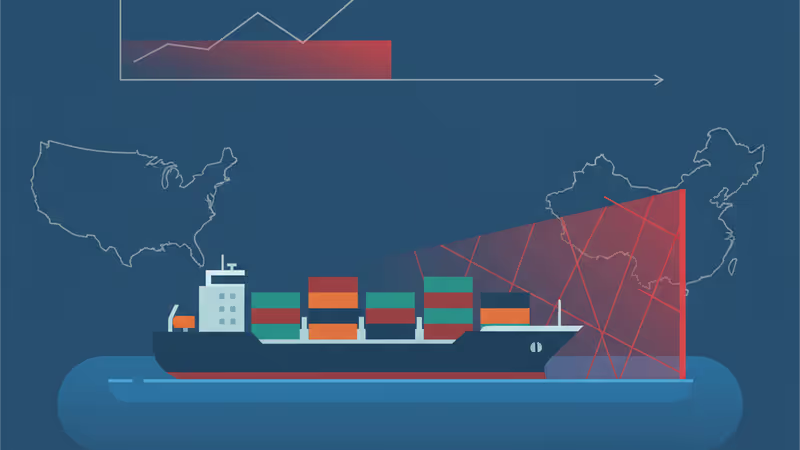
Beijing's recent announcement to waive retaliatory tariffs on select U.S. goods, including soybeans and pork, is being widely reported as a diplomatic olive branch. This is a dangerously simplistic reading. For global executives and investors, this move should not be seen as a de-escalation of the trade war, but as a clear signal of China's pressing domestic vulnerabilities. This isn't about goodwill; it's a calculated maneuver to manage internal economic pressures while doubling down on the technology war.
Why It Matters: The Strategic Bifurcation
This decision creates a strategic split screen, revealing Beijing's core priorities with startling clarity. While tariffs are being eased on agricultural and commodity inputs, the punishing levies on high-value U.S. technology and advanced manufacturing goods remain firmly in place. This tells us two things:
- Domestic Stability is Paramount: China is battling rising food inflation and needs to ensure food security. Lowering the cost of critical imports like soybeans (a primary animal feed) and pork directly addresses public discontent and stabilizes a key sector of the domestic economy. It's a tactical retreat on the consumer front.
- The Tech War is the Real War: By selectively easing tariffs, Beijing frees up capital and political bandwidth to intensify its push for technological self-sufficiency. The message is clear: China will buy what it must (food) to focus its resources on building what it needs (semiconductors, AI, advanced robotics).
For multinational corporations, this introduces a new layer of complexity to supply chain strategy. The move creates deliberate uncertainty, tempting some to reconsider diversifying away from China while simultaneously reinforcing the risks for those in strategic tech sectors.
The Analysis: From Tit-for-Tat to Targeted Strikes
This is a marked evolution from the blunt, tit-for-tat tariff escalations of 2018-2019. Beijing's current approach is far more surgical. Historically, China has used its vast consumer market as both a carrot and a stick. Now, it's using targeted procurement as a pressure valve for its own economy.
This aligns perfectly with President Xi's "dual circulation" strategy, which aims to reduce China's reliance on foreign markets while strengthening domestic demand. By lowering the cost of essential foreign inputs, Beijing is lubricating the gears of its internal circulation machine. This isn't about opening up to the world; it's about using the world to fortify its domestic base to withstand a prolonged geopolitical and technological conflict with the West.
Competitively, this is a sophisticated defensive play. It allows China to appear conciliatory on the global stage, potentially easing diplomatic pressure from the EU and other trade partners, without conceding an inch on the technological battleground that will define 21st-century economic power.
PRISM Insight: The 'Two Chinas' Investment Thesis
For investors, the era of treating "China exposure" as a monolithic asset class is over. This policy pivot crystallizes a 'Two Chinas' investment thesis:
- The 'Necessity' Economy: Sectors essential to China's domestic stability—such as ag-tech, food production, and resource management—may see more predictable, albeit state-controlled, opportunities for foreign participation. These are areas where Beijing is willing to trade for security.
- The 'Sovereignty' Economy: Sectors critical to national power—semiconductors, AI, quantum computing, biotech—will see accelerated state investment and an increasingly hostile environment for foreign firms. Capital here is not just economic, it's geopolitical. Expect intense competition and regulatory hurdles.
The key tech trend to watch is the flow of capital. The billions saved by waiving agricultural tariffs are, in effect, a subsidy for China's domestic tech champions like SMIC and Huawei. The tariff waiver is fuel for the tech decoupling engine.
PRISM's Take: Read the Signal, Not the Noise
Do not mistake a tactical adjustment for a strategic surrender. China's tariff waivers are a sign of pragmatic realism, not a change of heart. Beijing has identified its economic weak spots—food security and inflation—and is acting decisively to patch them so it can continue the long-term fight for technological supremacy.
For the C-suite, this is a roadmap to China's priorities. It highlights where your business may be a welcome partner and where it will be viewed as a strategic threat. The fundamental trajectory of U.S.-China competition remains unchanged. This move simply clarifies the rules of engagement and the nature of the battlefield.
相关文章
中國對美大豆採購承諾進度緩慢,大量未發貨訂單引發市場對潛在取消的擔憂。這不僅是貿易問題,更是地緣政治的博弈與戰略緩衝。
日銀即將告別負利率,日本金融巨頭正以兆元資金佈局數位轉型與海外併購。PRISM深度解析此結構性轉變對全球投資者的意涵。

德國大麻合法化開啟歐洲新紀元,但其獨特的「社交俱樂部」模式對投資者是機遇還是陷阱?PRISM深度解析監管迷宮與科技賦能的投資新賽道。

從雲端依賴到國家掌控,主權AI引爆新一輪全球科技軍備競賽。本文深度解析其對半導體、資料中心與全球投資者的戰略影響。