
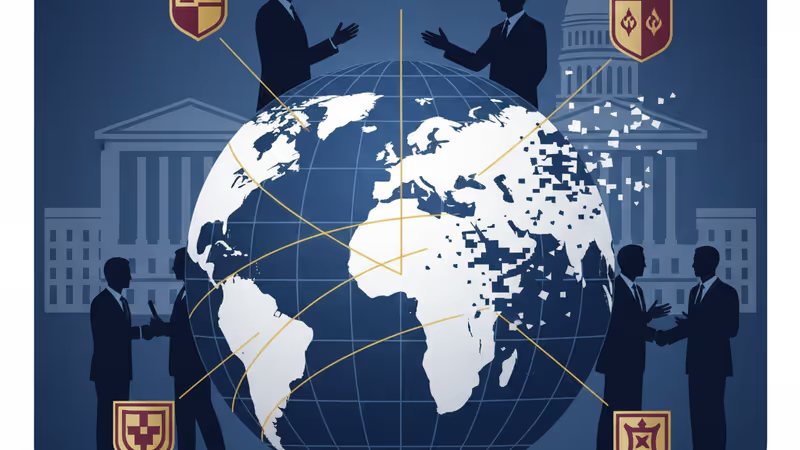
China's Bid for Global Leadership Has a Software Problem
As the US rethinks its global role, China sees a leadership vacuum. But top advisors admit its bid is failing to win 'hearts and minds.' An analysis.
The Race to Write the World's Next Operating System
As the United States recalibrates its global footprint, a power vacuum is emerging at the heart of the international order. Beijing sees the opening and is preparing its bid for leadership. But top Chinese strategists are now publicly acknowledging a critical vulnerability: China’s global ambition has a software problem. While its economic and military hardware is formidable, its ability to win 'hearts and minds'—the essential software of global influence—is lagging. For executives and policymakers, this isn't an abstract debate; it's a signal that the foundational rules of global commerce, technology, and diplomacy are being rewritten.
Why It Matters: A Fork in the Global Network
The contest for global leadership is not merely about which country has the largest navy or economy. It's a battle over the underlying 'operating system' of international relations—the norms, standards, and values that govern everything from trade and internet governance to human rights. A successful Chinese bid would represent the most significant shift in the global order since the end of the Cold War.
- For Global Business: Companies may soon navigate a bifurcated world. One sphere may operate on Western principles of transparency, data privacy, and democratic values. The other, guided by Beijing, could prioritize state control, data sovereignty, and collective development over individual rights. This creates profound compliance, supply chain, and ethical challenges.
- For Geopolitics: The push for an "alternative" to Western modernization, as articulated by government adviser Zheng Yongnian, is a direct challenge to the post-WWII liberal international order. This isn't about replacing the US, but about offering a competing model that is highly attractive to nations in the Global South wary of Western-imposed conditions.
The Analysis: Hard Power vs. Soft Power
Historically, America’s global leadership was built not just on military might but on the appeal of its culture, political values, and economic system—a powerful soft power package. The Marshall Plan wasn't just aid; it was an advertisement for a way of life. Washington built a global alliance system based on shared values, however imperfectly applied.
China’s approach has been hardware-first. The Belt and Road Initiative (BRI) built ports, rails, and digital infrastructure across continents. Its economic model has lifted millions from poverty. Yet, this transactional, infrastructure-led diplomacy has often failed to translate into genuine trust or admiration. Initiatives like the BRI are often perceived as debt traps, and its 'Wolf Warrior' diplomacy has alienated potential partners. The recognition that Beijing needs better 'messaging' is an admission that its current narrative—focused on state-led efficiency and non-interference—is failing to inspire the voluntary followership that is the hallmark of true leadership.
The Competing Value Propositions:
- The US-led Pitch: Freedom, democracy, free markets, and individual rights. Its credibility has been damaged by internal divisions and foreign policy missteps, but its core appeal remains potent for many.
- The China-led Pitch: Stability, long-term planning, economic development without political interference, and national sovereignty. This resonates strongly with authoritarian-leaning governments and developing nations seeking an alternative to the Western model.
PRISM Insight: The Geopolitical Stack
Think of this competition as the 'Geopolitical Stack.' China excels at the lower layers: the Infrastructure Layer (BRI, ports, 5G networks) and the Standards Layer (pushing its tech standards in AI and IoT at international bodies). Where it struggles is the Application Layer—the cultural and ideological appeal that makes a system attractive and self-sustaining. This is the 'hearts and minds' component. For investors, this means 'ideological due diligence' is now critical. The alignment of a company’s technology, data governance, and supply chain with either the US-led or China-led stack will become a core determinant of its geopolitical risk profile and market access.
PRISM's Take: More Than a Messaging Problem
Beijing's diagnosis is correct: a leadership vacuum exists, and a purely transactional approach is insufficient. However, framing the solution as a 'messaging' problem fundamentally misunderstands the nature of soft power. Influence cannot be manufactured through a better PR campaign; it is the organic byproduct of a nation's domestic system and its actions on the world stage.
The core challenge for China is not its communication strategy, but the inherent contradictions in its model. It's difficult to sell a vision of a 'shared future for mankind' when that vision is built on a foundation of domestic information control, opacity, and a political system that prioritizes the state over the individual. True global leadership requires a level of trust and transparency that Beijing's current system is structurally incapable of providing. The world is not necessarily seeking a new hegemon to replace the old one; it is seeking reliable partners. Until Beijing can prove it is more than a powerful but self-interested actor, its bid to write the world's next operating system will remain an ambition, not a reality.
相关文章
挪威積極推動綠色能源轉型,卻引發與薩米原住民的土地權利衝突。這場「綠色殖民」爭議,揭示了全球ESG浪潮下的核心挑戰。

美國在太平洋以打擊毒品為名發動軍事打擊,引發戰爭罪指控與地緣政治危機。這場行動的真正目標是委內瑞拉嗎?PRISM深度解析。

歐盟批准向烏克蘭提供900億歐元貸款,但避開動用凍結的俄羅斯資產。PRISM深度解析此決策背後的金融穩定考量、地緣政治裂痕及全球影響。

歐盟批准900億歐元對烏克蘭貸款,但迴避動用俄羅斯凍結資產。此舉凸顯了歐洲內部的法律謹慎與對未來美國政策不確定性的深層考量。