
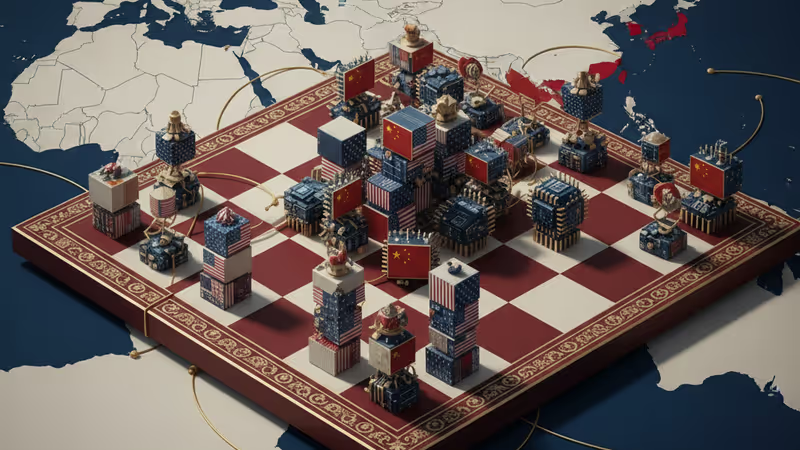
It's Not a New Cold War—It's a U.S.-China Chess Game
The latest Trump administration National Security Strategy reframes the U.S.-China relationship as an economic rivalry, not a new Cold War. Deep economic interdependence and domestic political constraints on both sides prevent a full-scale decoupling.
The `keyword:Donald Trump` administration's latest National Security Strategy document is turning heads for how it talks—and doesn't talk—about `keyword:China`. As `keyword:CNN` noted, "Gone are the sweeping declarations about `keyword:China` being `keyword:America`’s most consequential geopolitical challenge." Instead, the new strategy emphasizes the U.S.-China economic rivalry above all else. This shift fundamentally challenges the popular framing of the relationship as a second Cold War.
Fragmentation, Not Decoupling
The original Cold War was a contest between the communist `keyword:Soviet Union` and the capitalist, democratic `keyword:United States`. Their blocs were largely insulated from each other, with minimal flows of goods, finance, and technology. That's not the case today. The world's economic landscape is defined by global value chains, where production happens in multiple stages across several countries. This deep integration means a full 'decoupling' is incredibly costly.
What is observable is a degree of fragmentation. Recent research by Harvard economist Gita Gopinath shows a decline in trade between political blocs relative to flows within them. But this is far from the near-total separation of the Cold War. Unlike the U.S.-Soviet rivalry between distinct economic systems, both the `keyword:U.S.` and `keyword:Chinese` economies rely on private capital, international trade, and technology transfers, creating inter-dependencies that are hard to sever.
Mutual Dependence and Domestic Constraints
The `keyword:U.S.` acts as a provider of services, tech, and investment, while `keyword:China` remains the world's factory. This interdependence creates constraints. For `keyword:China`, facing an aging population and weakening domestic demand, export-led growth is critical for domestic political stability. Its merchandise exports to the `keyword:U.S.` stood at around `stat:$525 billion` in `stat:2024`, representing about `stat:15%` of its total.
The `keyword:U.S.`, in turn, benefits from cheaper imports that help keep consumer prices in check. With inflation a central political concern, especially heading into the `stat:2026` midterm elections, the scope for aggressive trade confrontation is limited. An estimate from the Federal Reserve Bank of St. Louis suggests that tariff hikes during the three-month period of `stat:June-August 2025` added around `stat:0.5 percentage points` to headline inflation.
The Other Players on the Board
`keyword:Russia`, while no longer a global pole like the Soviet Union, remains a military heavyweight. Its economy's reliance on energy exports means it operates largely outside the economic logic that constrains both Washington and Beijing. Meanwhile, `keyword:India`'s young, large population positions it as a major future market. Its ability to translate this demographic potential into production strength will depend on its integration with Asian value chains.
Today's U.S.-China competition is better understood as a pragmatic and transactional game of chess. Unlike the ideologically-driven conflict of the 20th century, this rivalry is shaped by domestic economic needs, leaving it more open to negotiation and adjustment. While strategic tensions will persist, the structural conditions for a full-fledged Cold War are simply absent.
本内容由AI根据原文进行摘要和分析。我们力求准确,但可能存在错误,建议核实原文。
相关文章
中國審議《南極活動與環境保護法》草案,擬將行政許可從科學考察擴大至旅遊、漁業與航運,旨在強化其在全球南極治理中的法律基礎與角色。
2025年,全球經濟體系面臨轉捩點。專家分析,隨著美中集團化成形,AI時代的決勝關鍵已非美元,而是能源與水資源。本文深入剖析此一趨勢對全球權力格局的影響。

墨西哥海軍一架載有8人的醫療專機在美國德州沿岸墜毀,造成至少5人死亡。該飛機當時正運送一名燒燙傷兒童就醫。美國國家運輸安全委員會(NTSB)已介入調查事故原因。

韓國國會23日通過法案,將設立特別法庭審理前總統尹錫悅戒嚴案相關的內亂事件。執政黨稱此舉為確保審判公正,但在野黨則痛批其企圖掌控司法。