
China Blames Taiwanese Smugglers for Severed Subsea Cable, Escalating Feud with Taiwan
China accuses Taiwanese nationals of smuggling in a subsea cable-cutting incident, escalating a blame game with Taiwan, which suspects Beijing of 'grey zone' warfare.
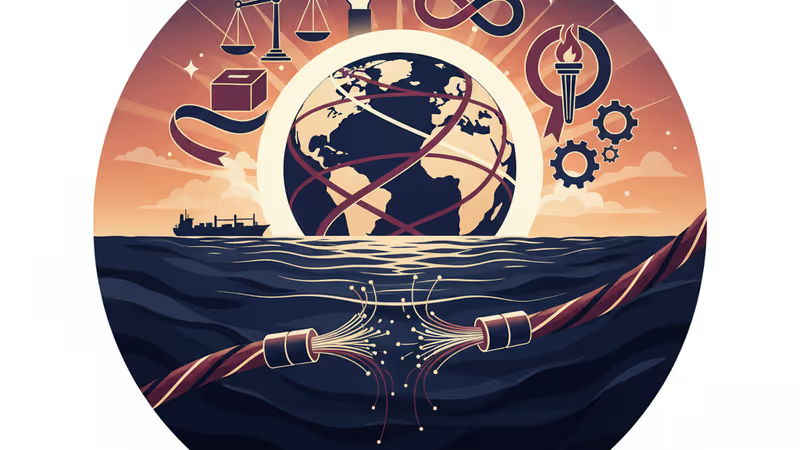
A severed cable, a jailed captain, and now a smuggling plot. China and Taiwan are locked in a new war of words over who cut the island's digital lifeline. Beijing has now accused two Taiwanese nationals of leading a smuggling operation that damaged a critical subsea communications cable in February, directly countering Taipei's claims that the incident was a deliberate act of sabotage.
Beijing's Counter-Narrative: Smuggling, Not Sabotage
The public security bureau in Weihai, a city in China’s Shandong province, announced on Wednesday that its investigation showed the vessel involved—the Togo-registered Hong Tai 58—was operated by two Taiwanese men smuggling frozen goods. According to Chinese state media, China's Taiwan Affairs Office accused Taiwan’s governing Democratic Progressive Party (DPP) of falsely framing the incident to “stir cross-Strait confrontation.” Authorities have offered a reward of up to 250,000 yuan ($35,569) for information on the suspects, identified by the surnames Chien and Chen, who have reportedly been on a wanted list since 2014.
Taiwan Fires Back: 'Political Manipulation'
Taipei swiftly rejected the accusations. Taiwan’s Mainland Affairs Council stated that the Chinese Communist Party has no jurisdiction over Taiwan and urged Beijing to provide concrete evidence. “In the absence of concrete evidence, publicly announcing names and offering rewards is not a civilized practice,” the council said, calling it “another instance of cross-border repression and political manipulation.” Previously, Taiwan had labeled the cable-cutting a “grey zone” tactic—a coercive act with plausible deniability. In June, a Taiwanese court had already sentenced the Chinese captain of the Hong Tai 58 to three years in jail for intentionally damaging the cables.
A Fragile Global Lifeline
Subsea cables form the backbone of the global internet, carrying nearly all of the world's data traffic. They're also remarkably vulnerable. According to industry data, between 100 and 200 cable breakdowns occur annually, and proving malicious intent is notoriously difficult. Since 2023, there have been at least 11 cases of subsea cable damage around Taiwan alone. The issue isn't isolated to Asia; countries in Europe's Baltic Sea have also seen a spike in similar incidents involving Russia- and China-linked ships since the invasion of Ukraine.
本内容由AI根据原文进行摘要和分析。我们力求准确,但可能存在错误,建议核实原文。
相关文章
美國當局發現超過一百萬份與已故富豪艾普斯坦案相關的新文件。根據川普總統簽署的《艾普斯坦檔案透明法》,司法部律師正進行審查,保護受害者身份後,預計在未來數週內公布。
2025年成為巴基斯坦的轉捩點。透過與印度的軍事對峙,巴基斯坦重返國際舞台,改善與美國關係並擴大在中東的影響力。然而,國內經濟困境與政治僵局依然嚴峻。

中國對法國與日本的熊貓外交政策呈現明顯對比,反映出雙邊關係的溫度。本文深入剖析此現象,並揭示熊貓外交的起源可追溯至1941年的蔣介石,而非中共。
2026年明尼蘇達州長選舉,共和黨迎來勝選良機,但前總統川普的爭議言論與親信林德爾的參選,恐將反成敗筆。本文深入剖析共和黨內部的路線分歧與戰略困境。
美國當局發現超過一百萬份與已故富豪艾普斯坦案相關的新文件。根據川普總統簽署的《艾普斯坦檔案透明法》,司法部律師正進行審查,保護受害者身份後,預計在未來數週內公布。
2025年成為巴基斯坦的轉捩點。透過與印度的軍事對峙,巴基斯坦重返國際舞台,改善與美國關係並擴大在中東的影響力。然而,國內經濟困境與政治僵局依然嚴峻。
中國對法國與日本的熊貓外交政策呈現明顯對比,反映出雙邊關係的溫度。本文深入剖析此現象,並揭示熊貓外交的起源可追溯至1941年的蔣介石,而非中共。
2026年明尼蘇達州長選舉,共和黨迎來勝選良機,但前總統川普的爭議言論與親信林德爾的參選,恐將反成敗筆。本文深入剖析共和黨內部的路線分歧與戰略困境。