
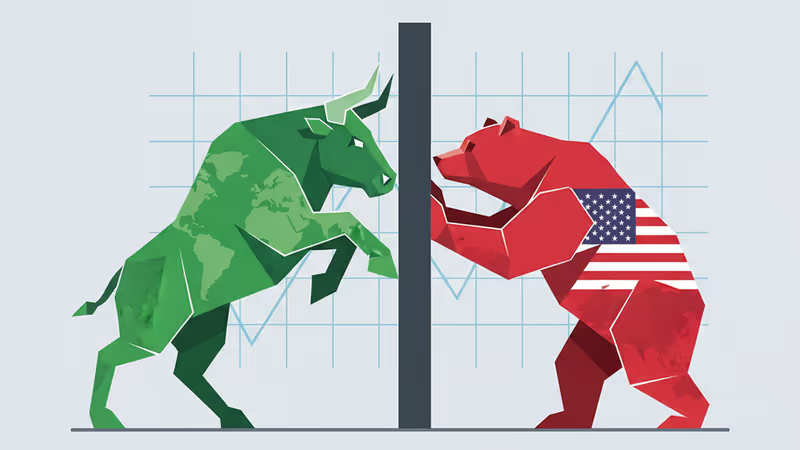
Bitcoin's Civil War: U.S. Profit-Takers Battle Global Bulls at the $90K Wall
Bitcoin is stuck below $90,000, revealing a clash between U.S. sellers and international buyers. Our analysis explains why this pattern matters for the future of crypto.
The Lede: More Than a Price, a Battleground
Bitcoin's struggle below $90,000 isn't just market chop; it's a high-stakes tug-of-war revealing a new, critical schism in the global crypto market. A distinct pattern has emerged: international markets push BTC up, only for U.S. market hours to trigger consistent selling pressure. This isn't random volatility. This is the new face of a maturing asset class where the institutional capital of one nation is acting as the gatekeeper for the next major breakout, forcing every executive in the space to ask: has the U.S. market turned from a driver to a drag on crypto's momentum?
Why It Matters: The U.S. Session as a Global Bellwether
The repeated failure to hold gains during U.S. trading hours signifies more than just profit-taking. It highlights a fundamental tension with profound second-order effects:
- Capital Competition is Real: While crypto-related equities like BitMine and MicroStrategy are catching a bid alongside a surging Nasdaq, Bitcoin itself is being sold. This suggests U.S. institutional capital is making a choice: rotate profits from direct BTC exposure into either high-beta tech stocks (like the soaring AI sector) or the regulated wrapper of crypto-related equities. Bitcoin is no longer competing only with other digital assets; it's competing with NVIDIA.
- Market Structure Maturity: The clear delineation between trading sessions is a direct consequence of the 2024-2025 Spot ETF boom. The market is no longer a monolithic, 24/7 retail-driven arena. It now has a TradFi-aligned prime time, and U.S. institutional flows during these hours have an outsized impact on sentiment and price discovery.
- A Cap on Contagion: While altcoins like ETH, SOL, and SUI are showing pockets of strength, their rally remains fragile. A sustained rejection of Bitcoin at this level, driven by the world's largest capital market, will inevitably dampen risk appetite across the entire digital asset ecosystem. The U.S. session is effectively setting the risk ceiling for everyone else.
The Analysis: ETFs Created a New Gatekeeper
Historically, Bitcoin bull runs were characterized by a continuous, rolling wave of global buying. The current dynamic is fundamentally different. We are witnessing the "ETF-ification" of Bitcoin price action. The very vehicles designed to bring in mainstream U.S. capital have also tethered its behavior to the rhythms and risk calculus of Wall Street.
The sell pressure during U.S. hours can be attributed to several factors: early ETF investors taking profits near psychological round numbers, macro funds de-risking ahead of the holidays, or a simple rotation into hotter narratives like AI, which is showing explosive strength. The simultaneous rally in U.S. equities isn't lifting all boats; it's creating a powerful alternative for yield-hungry traders. The U.S. isn't necessarily bearish on crypto, but it appears more disciplined and opportunistic, selling into strength provided by more aggressive Asian and European sessions.
PRISM Insight: Watch the Clock, Not Just the Ticker
For investors and traders, the key takeaway is that the *timing* of a price move is now as important as the move itself.
A breakout above $90,000 during Asian or European hours is becoming less meaningful. It has proven to be a bull trap, providing liquidity for U.S. entities to sell into.
The truly significant, trend-confirming signal will be a decisive break and hold of the $90,000 level *during* the U.S. session (9:30 AM - 4:00 PM EST). Such a move would indicate a fundamental shift in sentiment among U.S. institutions, from profit-taking to accumulation. Until that happens, this level remains the most formidable resistance on the chart, engineered by the market's newest and largest participants.
PRISM's Take: The Battle for Bitcoin's Narrative
The $90,000 price ceiling is a geopolitical and structural line in the sand. It represents the maturation of Bitcoin into an asset class influenced, and for now, controlled, by the whims of traditional U.S. market hours. While global bullishness provides a solid floor under the market, the key to unlocking the next parabolic advance lies squarely with U.S. institutional sentiment. This battle isn't about technicals; it's about who controls the capital flows that now define the market. The side that wins this tug-of-war won't just determine Bitcoin's price in Q1 2026—it will define the balance of power in digital assets for the foreseeable future.
相关文章

FTX核心高管遭SEC重罰,分析指出這不僅是懲罰,更象徵加密產業告別草莽,進入嚴格合規與治理的新紀元。投資者應如何應對?

美國聯準會考慮為加密企業設立新型「支付帳戶」。這一步將如何重塑金融科技競爭格局,並為投資者帶來新機遇?PRISM深度解析其背後意涵。

EigenLayer提出新的EIGEN代幣經濟學,旨在將協議收入與代幣持有者掛鉤,推動生態系從投機轉向實際應用。這對再質押賽道意味著什麼?
比特幣在9萬美元遭遇強大阻力,呈現「美國時段拋售」模式。本篇深度分析探討機構行為、資本輪動至山寨幣的現象,並提供關鍵投資洞察。