
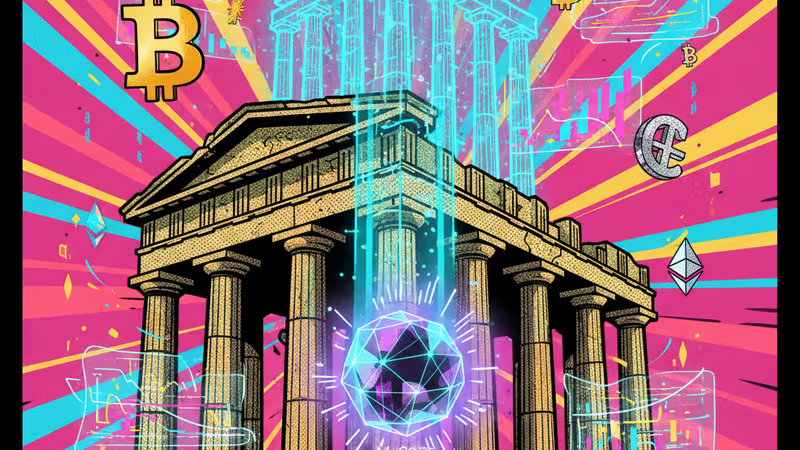
Beyond the Ruin: How AI is Resurrecting Lost Worlds for a New Economy
A photographer's viral project isn't just art. It's the start of a new 'Digital Restoration' economy, using AI to reshape real estate, tourism, and media.
The Lede: This Isn't Art, It's an Economic Signal
An Italian photographer's viral project, which uses AI to visually 'restore' abandoned buildings, is more than a compelling art experiment. For the busy executive, this is a critical signal. It marks the birth of 'Digital Restoration'—a new category of generative media where AI acts as a time machine, creating high-fidelity reconstructions of the past. This isn't just about creating pretty pictures; it’s a proof-of-concept for a new economy built on computational nostalgia, with immediate applications in real estate, media, tourism, and cultural preservation.
Why It Matters: The Second-Order Effects
The ability to instantly visualize 'what was' or 'what could be' moves from a specialized, expensive service to an accessible tool. This has massive downstream implications:
- Real Estate & Architecture: Developers can now generate photorealistic 'before' and 'after' scenarios for historical restoration projects in seconds, not weeks. This will dramatically accelerate client buy-in and project financing.
- Tourism & Culture: Imagine museum exhibits or city guides where visitors can point their phone at a ruin and see it in its prime. This technology allows for the creation of immersive, interactive historical experiences at a fraction of the traditional cost of CGI.
- Entertainment & Media: Film and game production studios can leverage this for rapid environmental concepting, pre-visualization, and creating historically accurate digital sets, slashing pre-production costs and timelines.
The Analysis: From Photographer to Prompt Engineer
Photographer Eleonora Costi's work highlights a fundamental shift in the creator economy. The value is no longer solely in the difficult act of capturing the present (the 'proof-of-work' in traveling to remote ruins). The new, defensible value is in the curation of a unique dataset (her years of original photos) and the artistic skill to direct the AI to a desired outcome (the 'proof-of-imagination').
This is a new creative workflow where the artist acts as a director and the AI is the world's most knowledgeable, instantaneous scenic designer. It democratizes historical visualization, moving it from the hands of niche VFX studios to individual creators. The competitive landscape is no longer just about the best lens, but the most insightful prompt and the most compelling narrative bridge between the real and the imagined.
PRISM Insight: Investing in the 'Digital Restoration' Stack
The core investment opportunity isn't just in the artists, but in the enabling technology—the 'Digital Restoration' stack. This project was likely created with general-purpose tools like Midjourney or Stable Diffusion. However, we predict the emergence of specialized platforms trained on architectural and historical data.
Think of a 'Getty Images for Lost Worlds,' a service providing AI-generated assets of historical locations in their prime. The most valuable assets in this new ecosystem are proprietary, high-quality image datasets of specific domains—like Costi's collection of ruins. Companies that can acquire and build specialized models on such unique data will own the market in creating digital heritage on demand. This is the new frontier of synthetic data, applied to culture and history.
PRISM's Take: The Future of Memory is Computational
This trend represents a profound shift from passive documentation to active, imaginative reconstruction. The line between historian, photographer, and technologist is irrevocably blurring. The key takeaway is that the raw data of our world—in this case, photos of decay—is the fuel for AI to not only show us what is, but to build a tangible, visual connection to what was lost.
This isn't about replacing reality or erasing history; it's about augmenting it. We are witnessing the fusion of human exploration with machine imagination. The future of preserving our past lies not just in protecting physical ruins, but in computationally resurrecting their stories for a new generation.
相关文章

深入分析獨裁者的飲食習慣,揭示食物如何成為權力、偏執與控制的工具。從歷史教訓看見現代「零信任」資安架構的未來。
在愛潑斯坦家中發現的川普保險套不只是一則花邊新聞。它揭示了政治品牌IP化、迷因戰爭以及實體物件在數位時代的全新風險。
一部關於綿羊偵破謀殺案的電影為何值得關注?PRISM深度解析其背後的好萊塢IP戰略、影視技術革新與下一波內容趨勢。
一項追蹤2800萬人的法國研究顯示,新冠疫苗不僅能預防病毒,更能將總體死亡率降低25%。這對未來公共衛生與mRNA技術意味著什麼?