
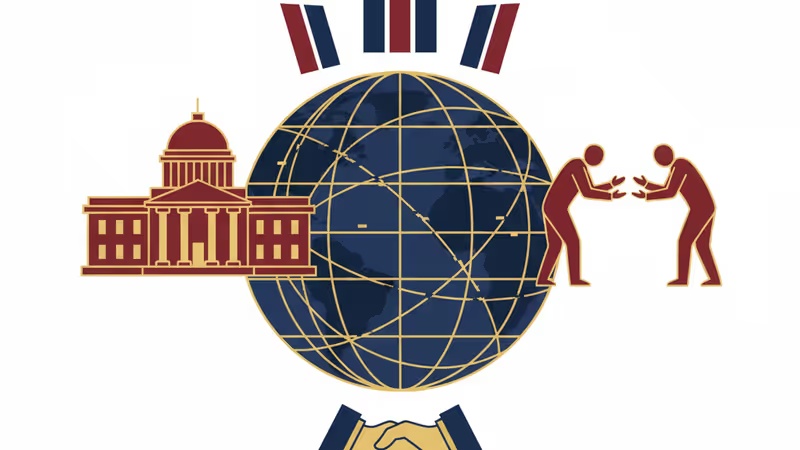
Beyond the Battlefield: The Era of Hybrid Warfare and Permanent Crisis
Analysis of the new era of hybrid warfare, where economic sanctions, digital sieges, and political unrest are reshaping global conflict and business risk.
The Lede: Why This Matters to You
Global stability is no longer a reliable baseline for strategic planning. From the trenches of Ukraine to the throttled internet of Gaza and the protest-filled streets of Bangladesh, the world has entered an era of persistent, hybrid conflict. For business leaders and strategists, this isn't distant noise; it's a fundamental shift in operational reality. The new battlefields are financial systems, digital networks, and public opinion—directly threatening supply chains, remote workforces, and market stability. Understanding this new paradigm is no longer optional; it's critical for survival.
Why It Matters: The Second-Order Effects
The nature of geopolitical conflict has fundamentally evolved, creating a new and complex risk landscape:
- Finance as a Weapon: The EU's plan to use profits from frozen Russian assets to fund Ukraine—a move Vladimir Putin labels 'robbery'—establishes a powerful precedent. This weaponization of the global financial system means corporate assets in any politically volatile region are now potential leverage in state-level disputes.
- Infrastructure as a Target: The struggle of Gaza's tech workers, deprived of electricity and internet, is a stark microcosm of a global trend. Control over digital infrastructure is now a key tactic in modern sieges, crippling economies and directly impacting the viability of a global, remote workforce.
- The Unpredictability of Public Unrest: Mass protests demanding justice in Bangladesh are not an isolated event. They represent a global surge in citizen-led movements that can erupt suddenly, paralyzing local operations and creating significant political risk for international businesses.
The Analysis: A New Playbook for Global Conflict
We are witnessing the mutation of post-Cold War "frozen conflicts" into active, multi-domain hybrid wars. The traditional calculus of military power is being supplemented—and in some cases, supplanted—by new levers of influence.
In Eastern Europe, the war is a brutal military reality, yet it's sustained by an unprecedented economic conflict. The EU's $105 billion loan to Ukraine and the G7's strategy on Russian assets demonstrate that the West's primary counter-offensive is economic. This transforms central banks and financial regulators into quasi-military actors, a development that will reshape international finance for decades.
Simultaneously, the situation in the Middle East highlights the critical vulnerability of our digital-first world. While policymakers like Senator Rubio debate the political conditions for peace, the on-the-ground reality is that economic life and access to the global community are being choked by infrastructure denial. This is siege warfare for the 21st century, where cutting fiber optic cables is as strategic as cutting physical supply lines.
These protracted external conflicts are mirrored by rising internal pressures. The protests in Bangladesh underscore a growing fragility in domestic governance worldwide. In an era of instantaneous information flow, popular discontent can scale rapidly, making domestic political stability a far more volatile variable for global organizations.
PRISM Insight: The Emerging Tech & Investment Landscape
This new era of permanent conflict is creating distinct technological and investment imperatives:
- Resilience-as-a-Service: Expect a surge in investment for technologies that ensure operational continuity. This includes decentralized communication networks (like Starlink's role in Ukraine), localized micro-grid energy solutions, and hardened, geographically distributed cloud infrastructure. The focus is shifting from efficiency to survivability.
- AI-Powered Geopolitical Intelligence: The need to navigate this complex landscape will fuel a boom in 'Geopolitical Risk as a Service' (GRaaS). Advanced AI platforms that can analyze real-time data on sanctions, social media sentiment, and infrastructure stability will become essential tools for C-suites.
- The Balkanization of Technology: As nations weaponize digital access, the concept of a single, open internet will continue to decay. This will accelerate the rise of sovereign clouds, data localization mandates, and national technology stacks, creating immense compliance challenges but also opportunities for specialized regional tech players.
PRISM's Take: Adapt for Attrition
The lines between war and peace have blurred into a persistent state of global competition. Victory is no longer defined simply by military conquest but by economic attrition, narrative dominance, and technological superiority. For leaders, this demands a radical shift in mindset from risk mitigation to resilience engineering. The core strategic challenge is no longer just navigating the next crisis, but building an organization designed to endure a state of permanent contest. Diversifying supply chains, de-risking financial exposure across political blocs, and investing in technological sovereignty are the new table stakes for navigating the 21st century.
相关文章
台灣軍方正轉向去中心化指揮,借鑑烏克蘭經驗以反制中國的快速打擊能力。此舉旨在提高防禦韌性,增加任何入侵行動的成本與不確定性。

分析美國對敘利亞的報復性空襲,揭示其不僅是對ISIS的打擊,更標誌著後阿薩德時代美國與敘利亞新型合作關係的開端及其地緣政治影響。
川普政府以大學槍擊案為由,暫停多元化簽證(綠卡抽籤)計畫。此舉不僅是應對悲劇,更是美國移民政策從多元化轉向限制主義的重大信號。
2025年底,烏俄戰爭陷入軍事僵局與外交拉鋸。歐盟巨額貸款改變賽局,但領土爭議仍是和平的巨大障礙。PRISM深度解析終局走向。