
Antitrust's Unintended Consequence: iRobot's Bankruptcy and the Chilling Effect on Tech M&A
iRobot's bankruptcy, following Amazon's blocked acquisition, exposes the unintended economic fallout of antitrust scrutiny and the growing challenges for tech startups.
Antitrust's Unintended Consequence: iRobot's Bankruptcy and the Chilling Effect on Tech M&A
The Lede: More Than Just a Robot Vacuum
The recent bankruptcy filing of iRobot, the pioneer behind the iconic Roomba, is far more than a cautionary tale for a single consumer electronics brand. It represents a stark, high-profile casualty in the ongoing global tussle between aggressive antitrust regulation and the often-complex realities of tech innovation and market dynamics. For business leaders, investors, and tech entrepreneurs, iRobot’s fall is a flashing red light, signaling a profound shift in the M&A landscape and the very viability of certain startup exit strategies.
Why It Matters: A New Paradigm for Struggling Tech
iRobot’s demise, accelerated by the abandoned $1.7 billion acquisition by Amazon due to EU antitrust pushback, unveils several critical, second-order effects:
- The M&A Freeze-Out: Regulators’ increasingly broad interpretations of market power are creating a "chilling effect," deterring larger tech players from acquiring smaller, struggling innovators. This isn’t just about blocking monopolies; it's about eliminating a crucial lifeline for companies that might otherwise face obsolescence or bankruptcy.
- Innovation Under Threat: For startups, the prospect of a strategic acquisition often fuels R&D and investor confidence. When this traditional exit ramp closes, the calculus for venture capital shifts, potentially stifling innovation in capital-intensive sectors like robotics, where scaling independently is a formidable challenge.
- Global Power Shift: The most striking outcome? iRobot is now owned by its largest creditor, Shenzhen Picea Robotics Co., a Chinese contract manufacturer. This highlights a growing trend where Western tech companies, starved of capital or strategic partnerships, are increasingly vulnerable to being absorbed by their Asian supply chain partners or competitors. It's a subtle but significant reordering of global economic power.
The Analysis: Where Regulation Meets Reality
For decades, M&A served as a vital mechanism in the tech ecosystem: a pathway for larger firms to acquire talent and technology, and for smaller firms to scale, access capital, and find a stable home. However, the last few years have seen a dramatic pivot in regulatory philosophy, particularly in Europe and increasingly in the U.S.
The argument against the Amazon-iRobot deal centered on hypothetical future harms – the idea that Amazon, with its market dominance, could somehow unfairly leverage Roomba data or stifle competing smart home devices. Yet, the reality has proven far more immediate and concrete: without the acquisition, iRobot lacked the financial muscle and distribution reach to withstand a flood of cheaper, often lower-quality, competitors. The company, which once defined a category, found itself caught between the prohibitive cost of innovation, relentless price pressure from generics, and an antitrust framework that prioritized theoretical future competition over present-day economic survival.
This situation exposes a fundamental tension: is the goal of antitrust to protect nascent competition at all costs, even if it leads to the collapse of an established innovator, or to foster a healthy, dynamic market where various forms of growth and exit are possible? In iRobot’s case, the regulators' stance arguably led to less competition (fewer viable players) and a loss of an iconic American brand.
PRISM Insight: Navigating the New M&A Labyrinth
For tech investors and entrepreneurs, the iRobot saga underscores a critical shift:
- Diversify Exit Strategies: Relying solely on an acquisition by a tech giant is now a high-risk proposition. Focus on sustainable profitability, independent scaling, and potential IPO readiness much earlier in the company lifecycle.
- Due Diligence on Regulatory Risk: M&A deals, especially those involving dominant tech platforms, must now factor in a significant "regulatory risk premium." Legal and economic counsel on antitrust implications should be paramount, not an afterthought.
- Protecting IP and Supply Chains: The ownership transfer to a contract manufacturer is a stark reminder of the financial leverage held by key suppliers, especially those in regions with different intellectual property regimes. Companies must fortify their supply chain relationships and IP protections.
- The China Factor: Expect more instances where Chinese manufacturers, already deeply embedded in global supply chains, may acquire distressed Western tech assets, gaining technology and market share at a discount.
PRISM's Take: The Cost of a Cautious Age
The bankruptcy of iRobot is a tragic symptom of a more cautious, and perhaps overly cautious, regulatory era. While the impulse to curb unchecked corporate power is understandable and often necessary, the outcome in this instance suggests an imbalance. When antitrust policy inadvertently pushes innovative companies into bankruptcy, diminishes investor confidence, and cedes strategic assets to international competitors, it's time to re-evaluate its real-world impact. The tech industry, and indeed the broader economy, must grapple with the unintended consequences of an M&A environment where preventing hypothetical future harm actively prevents present-day survival and strategic growth. The question is no longer just "who is too big to acquire?" but "who is too small to survive without being acquired?"
相关文章
iRobot破產是反壟斷阻礙科技併購的典型案例。分析大型科技公司監管挑戰、市場競爭與併購策略轉變,為投資者及新創提供新常態下的戰略指引。
iRobot聲請破產,不僅是一家公司的失敗,更是對全球監管、市場競爭和投資策略的警示。PRISM為投資者深度解析其背後的三大教訓。
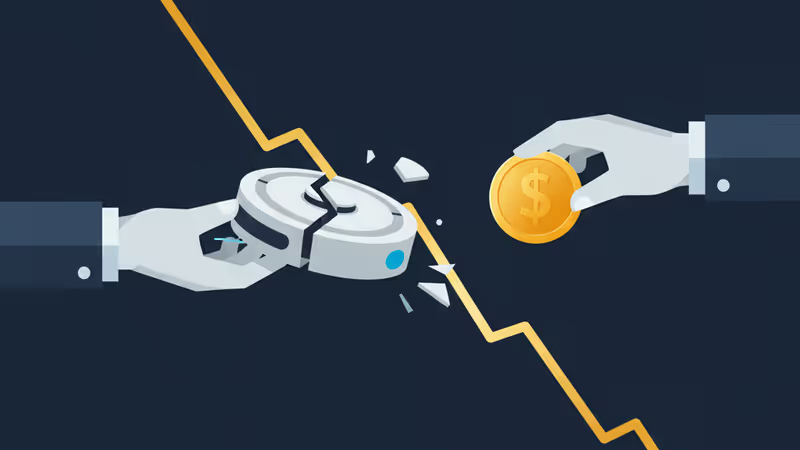
iRobot聲請破產,由其中國供應商接手。本分析深入探討亞馬遜交易失敗的影響、市場競爭格局,以及給科技投資者的警示。
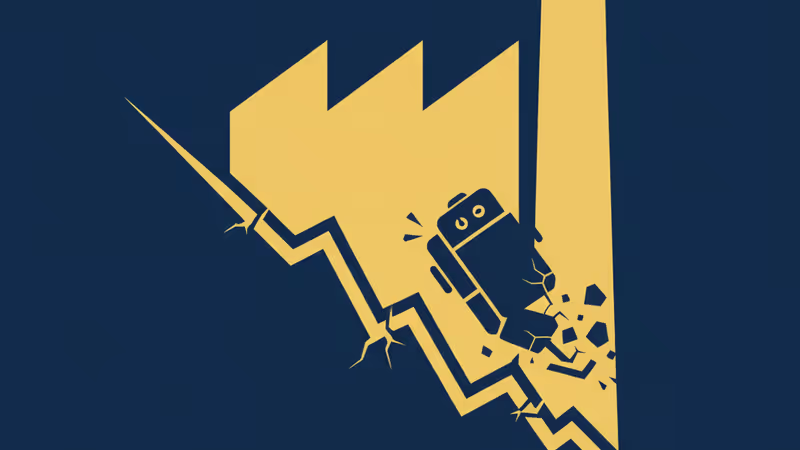
iRobot聲請破產並由其中國代工廠Picea收購。本分析深入探討這場債務換股權交易背後的產業權力轉移,為投資者揭示供應鏈風險與未來機會。