
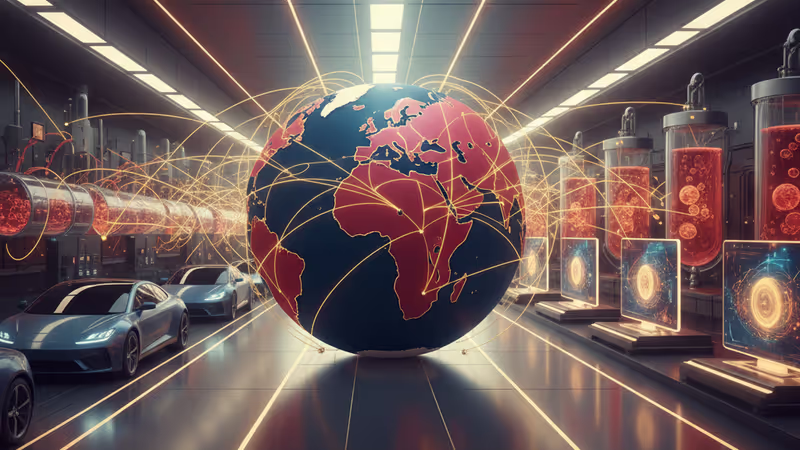
China Unplugs a Decade of EV Subsidies, Pivoting to the Next Tech Frontier
China has dropped electric vehicles (EVs) from its list of strategic industries for the first time in a decade, signaling a major policy shift. What does this mean for the global market, and what lessons can the U.S. learn from China's industrial playbook?
After a decade of relentless state-led investment that made it the world's undisputed electric vehicle (EV) leader, China has made a stunning policy pivot. In its 15th Five-Year Plan (2026-2030), Beijing omitted EVs from its official list of strategic industries for the first time in ten years. The move signals that China's leadership believes the industry has graduated from its hyper-accelerated development phase and is ready to face market forces, a transition that holds critical lessons for the U.S. and its allies.
Venture-Capital Statecraft and Its Side Effects
China's EV dominance was built on a strategy best described as venture-capital statecraft. From 2009 to 2023, the government poured an astonishing $230 billion into the sector through subsidies, tax breaks, and cheap credit. This happened even when demand was negligible; in 2009, total EV sales in China were just 500 units. The bet paid off. By 2024, China's EV production hit 12.4 million units, accounting for 70% of global output.
However, this supply-side push created severe economic distortions. The strategy led to what Beijing now calls “involution”—a state of hyper-competition, overcapacity, and deflation. China's EV production capacity is now three times its domestic demand. As of August 2025, only three EV makers—BYD, Li Auto, and Aito—are profitable. This imbalance is economy-wide: nearly a quarter of all industrial firms are losing money, the highest share since 2001, as investment consistently outpaces consumption.
The Export Release Valve and the New Blueprint
So far, China has managed these pressures through a crucial 'release valve': exports. With domestic demand weak, overseas markets have absorbed the massive overcapacity. China's record $992 billion trade surplus in 2024 was a key driver of its 5% GDP growth. In markets like Brazil, Mexico, and Thailand, Chinese models account for over 80% of EV imports. Some local officials even resorted to inflating economic data by exporting “zero-mileage” cars as 'used' to foreign markets at a discount.
With the EV industry now considered mature, Beijing is applying the same playbook to a new set of frontiers. The new strategic industries list is a guide to the future: quantum technology, bio-manufacturing, hydrogen and fusion energy, 6G communications, embodied intelligence, and brain-computer interfaces. These sectors are now slated to receive the same preferential financing and state support that built China's EV empire.
China's experience offers a clear, if costly, blueprint for scaling new industries. For U.S. policymakers, the lesson is twofold. First, industrial policy must balance supply-side incentives with demand-creation measures like public procurement and tax credits to avoid creating domestic overcapacity. Second, strategic coordination with allies on R&D, market access, and targeted protectionism is crucial to effectively compete with China's state-driven model.
本内容由AI根据原文进行摘要和分析。我们力求准确,但可能存在错误,建议核实原文。
相关文章

墨西哥海軍一架載有8人的醫療專機在美國德州沿岸墜毀,造成至少5人死亡。該飛機當時正運送一名燒燙傷兒童就醫。美國國家運輸安全委員會(NTSB)已介入調查事故原因。

韓國國會23日通過法案,將設立特別法庭審理前總統尹錫悅戒嚴案相關的內亂事件。執政黨稱此舉為確保審判公正,但在野黨則痛批其企圖掌控司法。

敘利亞政府軍與庫德族部隊SDF在阿勒頗達成停火協議,此前衝突造成平民死亡。事件發生於土耳其外長訪問期間,凸顯該地區複雜的地緣政治角力。

中國網路近期掀起「1644史觀」熱潮,將近代苦難歸咎於清朝統治,引發官方批評與激烈辯論,觸及歷史敘事、民族主義與社會治理等敏感議題。