
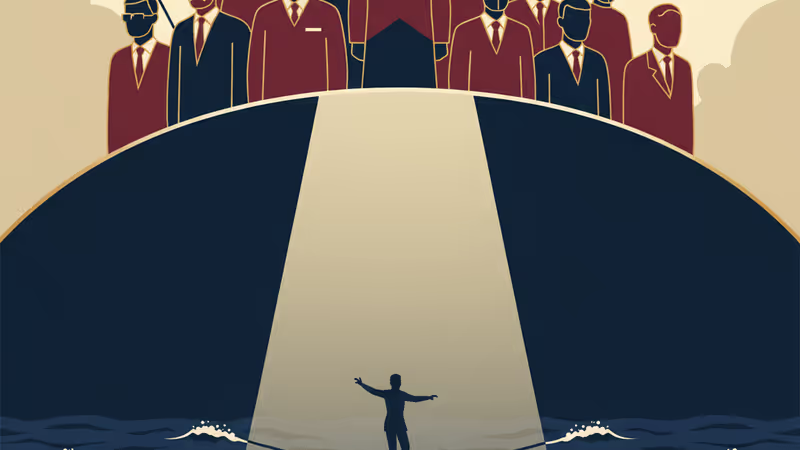
Pakistan's Paradox: A 2025 Comeback on the World Stage Masks Deep Cracks at Home
In 2025, Pakistan made a dramatic return to the world stage after military clashes with India, yet it remains plagued by deep-seated domestic political and economic turmoil. An analysis of the four turning points.
It’s back on the world stage, but its foundation at home is cracking. For Pakistan, 2025 proved to be a turning point. After years of relative obscurity, the country suddenly found itself mattering again in international affairs, even as persistent political and economic instability festered domestically. Four major developments defined this complex picture, highlighting both the opportunities and obstacles Pakistan faced during a turbulent year.
A New Strategic Credibility
Pakistan's return to prominence was sparked by intense, four-day military clashes with India in May. Its air force showcased formidable capabilities, reportedly downing several Indian jets and demonstrating it had effectively countered New Delhi's military modernization despite domestic economic woes. This performance significantly restored Pakistan's strategic credibility. Consequently, relations with the United States warmed, while it also formalized a major mutual defense pact with Saudi Arabia and secured a $4 billion arms deal with Libya.
A Harder Line on Afghanistan
Islamabad also adopted a tougher stance toward Afghanistan, shifting from accommodation to sustained pressure on the Afghan Taliban. The goal: dismantle the Tehreek-e-Taliban Pakistan (TTP) and force Kabul to sever ties with the group. Pakistan's willingness to use hard power, including military strikes on Afghan soil, shocked the Taliban regime. The pressure campaign worked, leading over 1,000 Afghan clerics to issue a decree prohibiting attacks on neighboring countries. It was a clear signal that continued support for the TTP would carry severe diplomatic costs.
Economic Woes and a Privatization Win
Despite diplomatic wins, the economy remained in dire straits. Foreign direct investment declined, and persistent issues like high energy costs and a difficult tax environment hampered industry, contributing to rising poverty. Amid the gloom, there was one bright spot: the successful privatization of Pakistan International Airlines (PIA). The sale of the chronically loss-making, state-run enterprise was the first major privatization in around 20 years. The landmark deal could mark a turning point, encouraging greater private sector activity and injecting momentum into the economy.
An Unresolved Political Standoff
Domestically, political tensions persisted. The Pakistan Tehreek-e-Insaf (PTI) party, led by the jailed Imran Khan, continued its opposition to the military and federal authorities, raising questions about political stability. Khan’s repeated calls for protests from prison only intensified the standoff. On a more positive note, the state took strong measures against the extremist Tehreek-e-Labbaik Pakistan (TLP), demonstrating a growing intolerance for violent radicalism. Still, broader strains on the social contract, fueled by inflation and inequality, remain a challenge to national cohesion.
本内容由AI根据原文进行摘要和分析。我们力求准确,但可能存在错误,建议核实原文。
相关文章
泰國與柬埔寨在長達16天的邊境衝突造成至少86人死亡後,雙方軍事官員已展開停火談判。本文深入報導在持續的砲火與相互指責下,由東協與美國斡旋的和平前景。
美國甘迺迪中心遭董事會更名為「川普-甘迺迪中心」,引發民主黨議員提告,指控其程序非法。白宮強勢回擊,甘迺迪家族亦表態反對,一場法律與政治風暴就此展開。

敘利亞內政部12月24日宣布,在首都大馬士革郊區成功逮捕ISIS關鍵領袖塔哈·祖比。官方稱此行動與美國為首的聯軍合作,但美軍中央司令部尚未證實。
美國司法部宣布發現超過一百萬份與傑佛瑞・艾普斯坦案相關的新文件,導致依《透明法》的解密進度延遲數週,引發國會議員對政府透明度的強烈質疑。
泰國與柬埔寨在長達16天的邊境衝突造成至少86人死亡後,雙方軍事官員已展開停火談判。本文深入報導在持續的砲火與相互指責下,由東協與美國斡旋的和平前景。
美國甘迺迪中心遭董事會更名為「川普-甘迺迪中心」,引發民主黨議員提告,指控其程序非法。白宮強勢回擊,甘迺迪家族亦表態反對,一場法律與政治風暴就此展開。
敘利亞內政部12月24日宣布,在首都大馬士革郊區成功逮捕ISIS關鍵領袖塔哈·祖比。官方稱此行動與美國為首的聯軍合作,但美軍中央司令部尚未證實。
美國司法部宣布發現超過一百萬份與傑佛瑞・艾普斯坦案相關的新文件,導致依《透明法》的解密進度延遲數週,引發國會議員對政府透明度的強烈質疑。